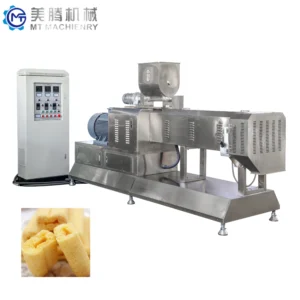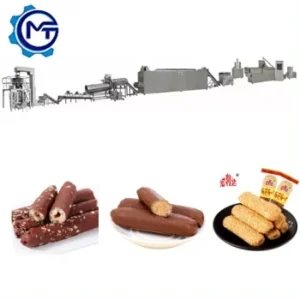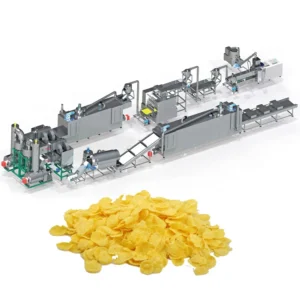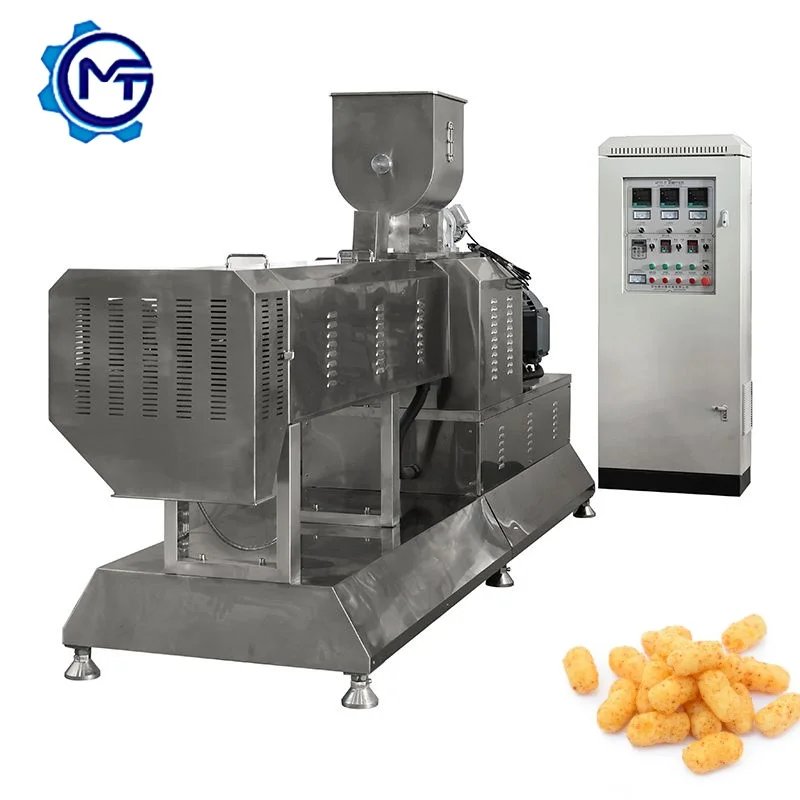
Integrated Line Matching — every station from batching to packing is sized to the extruder’s real throughput on your grain recipe, not assembled from catalog pages.
Technical Specifications
| Parameter | Value |
|---|---|
| Model | MT65 / MT70 / MT85 / MT100 |
| Product Type | Twin Screw Extruder for Puffed Snack Production Line |
| Screw Type | Twin Screw |
| Installed Power | MT65: 130 kW; MT70: 180 kW; MT85: 220 kW; MT100: 240 kW |
| Real Consumption | MT65: 95 kW; MT70: 120 kW; MT85: 130 kW; MT100: 160 kW |
| Output Capacity | MT65: 120–150 kg/h; MT70: 200–300 kg/h; MT85: 300–500 kg/h; MT100: 600–800 kg/h (basis not stated in source — confirm raw material type, moisture content and die configuration) |
| Control System | Frequency speed controlling system |
| Lubrication | Automatic lubricating system |
| Cooling | Automatic cooling system |
| Heating Source Options (Dryer) | Electric, steam, or gas |
| Flavoring System | Double drum with sugar melting, spraying nozzle and elevator |
| Core Filling Option | Available with addition of core filling machine and cutting machine |
| Die Shapes | Cheese ball, tube, stick, ring, fruit loop, star, wheel, flower, heart |
| Raw Materials | Corn, rice, wheat, oat, barley flour and similar grain-based materials |
| Certifications | CE, ISO |
Application Suitability
| Application | Material or Output |
|---|---|
| Cheese puffs and corn curls | Corn grits and cheese powder blends with controlled fat content |
| Rice and multigrain puffed snacks | Rice flour, oat and barley flour mixtures |
| Core-filled snack variants | Grain-based outer shell with cream, chocolate or fruit filling |
| Shaped extruded snacks | Rings, tubes, stars, wheels and custom die profiles |
What the Nameplate Capacity Leaves Out on a Twin Screw Extruder for Puffed Snack Production Line
A rated output figure means nothing until it is validated on the buyer’s actual grain blend and moisture level.
I have seen lines shipped across continents only to stall at half the promised throughput because the screw configuration was designed around standard corn meal while the buyer runs a high-fat, high-protein recipe. The extruder barrel fills unevenly, the die pressure drops, and the product density drifts outside what the packaging machine can handle. Every downstream station — dryer, flavoring drum, cooler — was specified to a capacity the extruder never reaches [NEED_CITE: importance of raw material trial runs in extrusion line sizing]. The twin screw extruder for puffed snack production line avoids this mismatch by locking screw profile, die geometry and dryer volume to your specific recipe before production begins.
How the Full Equipment Range Covers Every Station
This twin screw extruder for puffed snack production line spans four model tiers — MT65 through MT100 — with installed power ranging from 130 kW to 240 kW and real energy consumption notably lower than nameplate figures. Each tier pairs with a dryer, double drum flavoring system, cooling conveyor and packing station whose individual throughputs are calculated against the extruder’s verified output, not its maximum theoretical rating. The frequency speed controlling system allows operators to adjust screw RPM in response to real-time product density readings.
Dryer and Flavoring Sizing That Follows the Extruder
Moisture removal is where many snack lines bottleneck. The dryer in this range accepts electric, steam or gas heating sources configured to your site utilities, and its belt length and air volume are matched to the extruder’s actual discharge rate. The double drum flavoring line integrates a sugar melting unit and spraying nozzle system so that coating weight stays uniform even when extruder output fluctuates within the verified capacity band. Undersized flavoring drums cause product buildup and uneven seasoning [NEED_CITE: flavoring drum capacity matching in snack extrusion].
Reading the Specs: What Actually Drives Snack Quality
The twin screw configuration handles a wider range of grain viscosities than a single screw design, which matters when a recipe shifts from pure corn grits to a blend containing oat or barley flour with different gelatinisation temperatures. Installed power and real consumption figures are separated in the specification sheet so that buyers can calculate actual energy cost rather than relying on motor nameplate ratings. The automatic lubricating and cooling systems maintain barrel temperature consistency across long production runs, preventing the localized overheating that scorches starch and introduces off-flavors. Die selection — from cheese ball to fruit loop profiles — directly controls expansion ratio and final product density, and each die is paired with a specific screw element arrangement to manage shear and residence time [NEED_CITE: die geometry and expansion control in twin screw extrusion].
The Hidden Cost of a Mismatched Line Configuration
When the extruder, dryer and packing station are sourced from separate vendors, nobody owns the throughput gap between them. A dryer rated for 500 kg/h paired with an extruder that delivers 350 kg/h on your recipe wastes floor space and energy. A packing machine cycling faster than the cooler can feed it causes product jams and breakage. These mismatches surface only after installation, when change orders and line re-balancing add weeks to commissioning [NEED_CITE: throughput balancing across extrusion line stations].
Why Source the Full Equipment Range Here
Every station — material batching, extruding, drying, coating, cooling and packing — is engineered under one supplier so that throughput calculations start from the extruder’s verified output on your raw material and propagate forward. The in-house testing workshop runs your actual grain recipe before shipment, producing a trial run report that locks screw configuration and die selection. Electrical schematics, voltage and frequency are confirmed against your facility before production starts. Wear parts lists and screw element specifications are documented so that replacements arrive with the correct profile rather than a generic substitute.
Documentation & Verification
- Line layout showing throughput calculation for each station matched to your recipe
- Screw and die configuration record tied to your raw material blend and target shape
- Electrical schematic with voltage and frequency confirmed for your facility
- Trial run report on your grain material conducted in the testing workshop
- CE declaration of conformity and ISO certificate for export compliance
- Operation and maintenance manual with wear parts list and replacement intervals
Installation, Commissioning & Support
- Foundation and utility planning matched to the MT model’s installed power and footprint
- Voltage and frequency verification before dispatch to prevent commissioning delays
- Frequency speed controlling system setup and parameter logging during first production runs
- Operator training covering screw element changes, die swaps and automatic lubrication checks
- Wear parts list with screw and die specifications for first reorder cycle
- Dryer heating source commissioning aligned with site electric, steam or gas supply
Preparing Your Inquiry
Provide the specific grain flour blend, moisture content and target product shape so that screw and die configuration can be drafted before quotation. Include your site voltage, frequency and available heating sources for the dryer. Confirm whether core filling capability is required and state your daily production target along with available floor space and ceiling height.
Frequently Asked Questions
Q: How is actual output capacity verified against my specific grain recipe?
A: Your raw material is run in the in-house testing workshop on the selected MT model. Screw configuration, die geometry and moisture settings are adjusted until the target product density and shape are achieved. The resulting output rate is documented in a trial run report, and this verified figure — not the nominal rating — is used to size the dryer, flavoring drum and packing station.
Q: What voltage, frequency and control language options are confirmed before shipment?
A: The electrical schematic is drafted based on your facility’s power supply specifications. Voltage, frequency and control panel language are confirmed in writing before production begins. This prevents the common delay where a machine arrives with a motor wired for the wrong supply or an HMI displaying an unfamiliar language.
Q: How are screw configuration and die design matched to my target snack shape?
A: Each die profile — ring, tube, star, cheese ball or custom shape — requires a specific screw element arrangement to control shear, residence time and expansion. The configuration is developed during the trial run on your actual grain blend and recorded so that identical product characteristics can be reproduced across every production batch.
Q: What stations are included, and how is throughput balanced between them?
A: The line covers material preparation, batching, extruding, drying, flavoring, cooling, packing and stacking. Throughput at each station is calculated from the extruder’s verified output on your recipe, ensuring the dryer belt length, flavoring drum volume and packing speed all align without one station bottlenecking another.
Q: Is a trial run on my raw material available before shipment?
A: Yes. The testing workshop runs your grain recipe on the specified MT model, producing sample product for your evaluation. Screw profile, die selection, barrel temperature and moisture settings are locked during this run and documented in the trial run report that ships with the line.