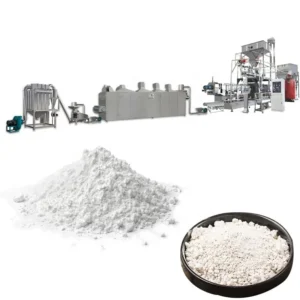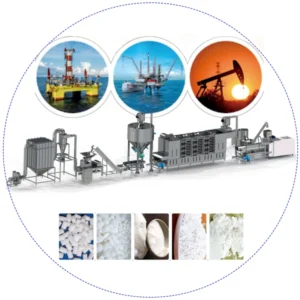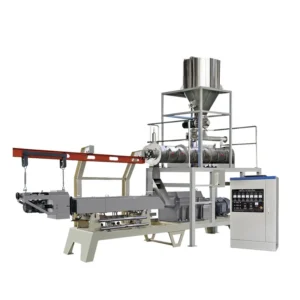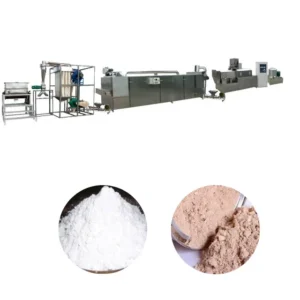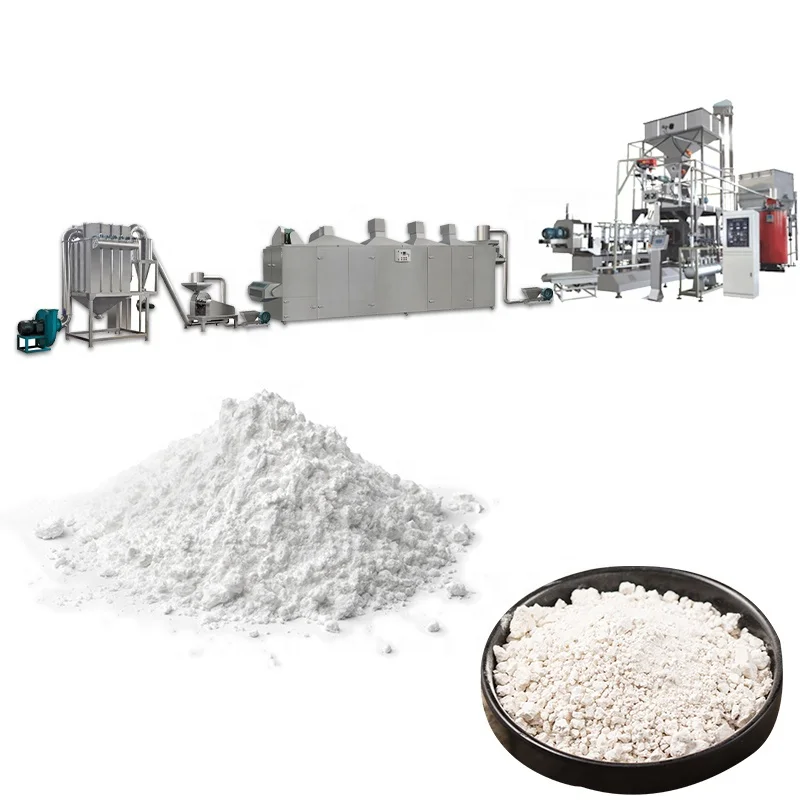
Screw & Die Matched to Starch — Every MT series line specifies screw configuration and die geometry against the buyer’s actual starch feedstock before production starts, not copied from a generic extrusion build.
Technical Specifications
| Parameter | Value |
|---|---|
| Product Type | Modified Pregelatinized Starch Processing Line |
| Extruder Models | MT70 / MT70C / MT75 |
| Screw Type | Twin Screw |
| Installed Power | 120 kW (MT70), 150 kW (MT70C), 180 kW (MT75) |
| Power Consumption | 120 kW (MT70), 125 kW (MT70C), 135 kW (MT75) |
| Output Capacity | 100–150 kg/h (MT70), 250–300 kg/h (MT70C), 200–250 kg/h (MT75) (basis to be confirmed) |
| Overall Dimensions (L×W×H) | 30000×1500×2200 mm (MT70), 34000×3500×4300 mm (MT70C), 32000×3500×4300 mm (MT75) |
| Control System | Frequency conversion speed regulation (feeding, driving, rotary cutting) |
| Line Stations | Mixer → Twin-screw extruder → Dryer → Pulse grinder → Packaging machine |
| Mixer Power Options | 4 kW / 7.5 kW / 15 kW |
| Mixer Batch Capacity | 20–30 kg / 70–80 kg / 170–180 kg per batch |
| Mixer Construction | 201 or 304 Stainless Steel |
| Mixer Voltage | 380V 50Hz Three Phase |
| Pulse Grinder Drive Motor | 15 kW |
| Pulse Grinder Air Circulating Motor | 1.5 kW |
| Pulse Grinder Impeller Fan | 1.1 kW |
| Pulse Grinder Mesh | 100–120 mesh |
| Dryer Transmission | Double pitch roller chain, round-trip drying |
| Raw Materials | Corn starch, cassava starch, potato starch, maize starch, tapioca starch |
| Standards | CE, ISO |
Application Suitability
| Application | Material or Output |
|---|---|
| Oil drilling fluid loss agents | Pregelatinized starch from corn or cassava, stable at elevated temperatures |
| Industrial adhesives and binders | Modified or denatured starch processed from maize and potato feedstock |
| Paper and textile sizing agents | Denatured starch derivatives requiring specific particle size distributions |
| Food-grade modified starch | Pregelatinized starch powder for food ingredient blending, food-grade contact materials throughout |
Why "Nominal kg/h" Is the Wrong Question to Ask First
A quoted output figure means nothing until it is tied to your specific starch source, moisture content, and target degree of gelatinisation.
I have watched buyers sign off on a modified starch processing line manufacturer’s proposal based on a capacity number that looked solid on paper, only to discover during commissioning that cassava starch gelatinises at a different temperature profile than the corn starch used during the factory test. The extruder ran, but throughput dropped and the starch did not reach the required modification level. The line then spent weeks in parameter adjustment while the buyer absorbed downtime costs [NEED_CITE: starch gelatinisation temperature differences across botanical sources]. A modified starch making machine for sale should always be validated against the actual feedstock before it leaves the factory floor.
How Twin-Screw Configuration Shapes Starch Modification
The twin-screw extruder in this line uses frequency-variable control across feeding, driving, and rotary cutting systems. This allows the operator to adjust screw speed, residence time, and shear force independently — critical when switching between corn starch and cassava starch, which respond differently to mechanical and thermal input. The screw configuration and barrel temperature profile are specified to the buyer’s target starch derivative, whether that is a lightly pregelatinised powder for food use or a heavily modified product for industrial adhesive applications. A modified starch processing line manufacturer that does not document the screw arrangement against your raw material is leaving your output quality to chance.
Drying and Grinding: Where Line Balance Decides Real Output
The round-trip dryer uses a double pitch roller chain to move starch through controlled heating zones without jamming, which is a frequent failure point in lines assembled from mismatched stations. Downstream, the pulse grinder operates with a 15 kW drive motor and an integrated air circulating system (1.5 kW motor, 1.1 kW impeller fan) to pull ground particles through a 100–120 mesh screen while removing dust. If the dryer cannot remove moisture fast enough to match the extruder’s output, or if the grinder becomes overloaded with material still above target moisture, the entire modified starch processing line bottlenecks at the weakest station [NEED_CITE: throughput balancing in multi-station starch processing lines].
Reading the Power and Dimension Data Against Your Facility
The three models — MT70, MT70C, and MT75 — span installed power from 120 kW to 180 kW, with line lengths ranging from 30 to 34 metres. The MT70 at 30000×1500×2200 mm fits tighter workshop footprints, while the MT70C and MT75 require wider bays at 3500 mm width and 4300 mm height for the dryer and grinder sections. Frequency conversion speed regulation across the feeding, driving, and rotary cutting systems means the control cabinet must support the specified 380V 50Hz three-phase supply at minimum — but voltage and frequency must be confirmed against the buyer’s local grid before production. The mixer alone draws 4 to 15 kW depending on batch size selection, and the pulse grinder adds another 15 kW plus auxiliary motors. Electrical load planning should account for simultaneous startup surge, not just running consumption.
The Cost of Skipping the Raw Material Trial
When a line is configured on assumed starch behaviour rather than tested feedstock, the problems surface after installation: inconsistent gelatinisation degree, particle size outside specification, and throughput that never reaches the quoted range. The buyer then pays for engineer visits, replacement screw elements, and lost production days while the parameters are reworked from scratch. I have seen this pattern repeat across starch processing projects in humid climates where ambient moisture alone shifts the drying requirement enough to throw off a line that was tuned in a dry factory environment [NEED_CITE: ambient humidity effects on starch drying and extrusion consistency].
Why Procurement Here Reduces Integration Risk
Every station from the stainless steel mixer through the twin-screw extruder, dryer, pulse grinder, and packaging machine is supplied by one manufacturer, so throughput is calculated across the full line rather than assumed from individual component ratings. Screw configuration and die design are specified against the buyer’s raw material and target starch product, not carried over from a previous customer’s build. An in-house testing workshop runs trial batches on your starch source before shipment, generating a documented trial run report. Voltage, frequency, and control language are confirmed through an electrical schematic document before production begins. Wear parts including screws, dies, and grinder screens are listed at order stage with first-replacement availability confirmed.
Documentation & Verification
- Line layout and capacity calculation matched to your starch type and target output
- Screw and die configuration record specifying the arrangement for your feedstock
- Electrical schematic with voltage and frequency confirmed before production starts
- Trial run report on your raw material documenting actual output and starch modification level
- CE declaration of conformity and ISO certificate for the complete line
- Wear parts list covering screws, dies, and grinder screens with replacement schedules
Installation, Commissioning & Support
- Foundation must support line lengths up to 34 metres with level tolerance for the roller chain dryer track
- Dedicated three-phase circuit required for 120–180 kW installed power depending on model selection
- Equipment ships in modular sections for workshop door clearance and on-site assembly sequencing
- First commissioning includes barrel temperature profiling and screw speed calibration for your starch feedstock
- Operator training covers frequency conversion adjustment across feeding, driving, and cutting systems
- Wear parts inventory recommended at order: spare screw elements, die plates, and 100–120 mesh grinder screens
What to Include in Your Inquiry
Provide your starch source — corn, cassava, potato, or tapioca — along with typical moisture content and the target modification or pregelatinisation specification your end market requires. Confirm your facility’s voltage, frequency, and preferred control language so the electrical schematic matches local conditions from day one. Share your available workshop length, width, and ceiling height so the line layout is designed around your actual space rather than a standard template.
Frequently Asked Questions
Q: How is output capacity verified, and what raw material basis does the quoted kg/h figure assume?
A: Output varies by starch type, moisture content, and target gelatinisation degree. The quoted range assumes a specific feedstock that must be confirmed. We run trial batches on your actual starch source in our testing workshop before shipment and document the real throughput achieved under your product specification.
Q: Can the twin-screw configuration and barrel temperature profile be adjusted for different starch sources?
A: Yes. Screw element arrangement, die geometry, and barrel heating zones are specified to your starch feedstock — corn, cassava, potato, or tapioca — and the target modification level. Frequency-variable control allows fine adjustment of shear and residence time during production runs.
Q: Is the line throughput balanced across all stations, or will the dryer or grinder bottleneck production?
A: Every station is supplied and throughput-matched by one manufacturer. The dryer capacity and pulse grinder throughput are calculated against the extruder’s output on your specific starch, so no single station limits the line below its designed capacity.
Q: What voltage, frequency, and control language options are confirmed before shipment?
A: Voltage and frequency are confirmed through an electrical schematic document before production begins. Control language for the frequency conversion system is set to your preference. This prevents commissioning delays caused by electrical mismatches at your facility.
Q: Is a trial run on my raw material performed before delivery, and what documentation is provided?
A: Yes. Your starch source is run through the complete line in our testing workshop. A trial run report is provided documenting actual output, modification degree, particle size achieved, and the screw and die configuration used, so production parameters are established before the line arrives at your site.