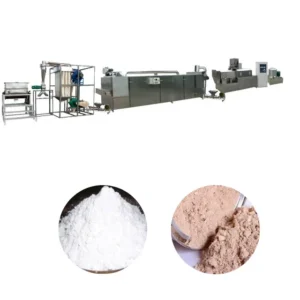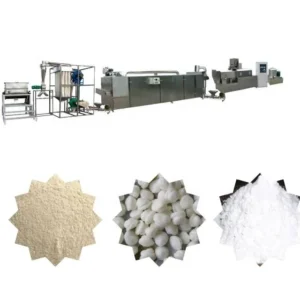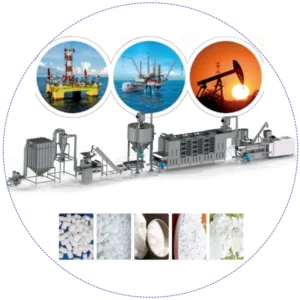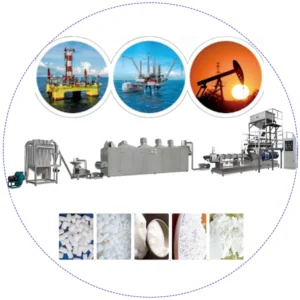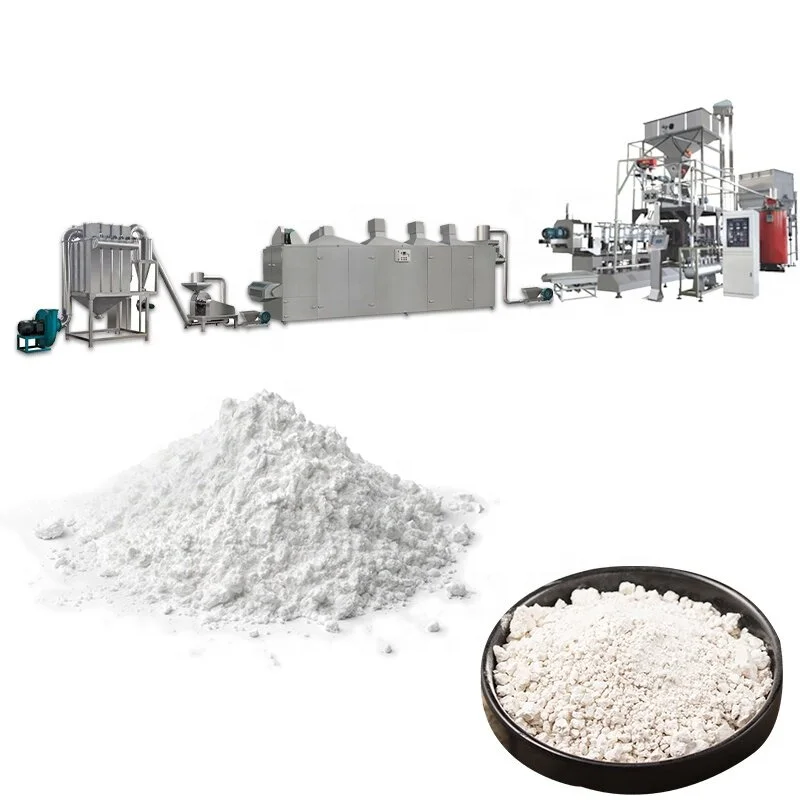
Matched Throughput Across Every Station — The Modified Starch Extrusion Production Line balances mixer batch size, extruder output, dryer residence time, and grinder capacity against your specific starch type, so no single unit bottlenecks the run.
Technical Specifications
| Parameter | Value |
|---|---|
| Product Type | Modified Starch Extrusion Production Line |
| Model Options | MT65 / MT70 / MT70C / MT75 |
| Screw Type | Twin-screw |
| Screw Material | 38CrMoAl (molybdenum-aluminum alloy steel) |
| Barrel Material | 45# steel |
| Outer Sealing Plate | Stainless steel 201 or 304 |
| Installed Power | 84 kW (MT65) / 160 kW (MT70) / 190 kW (MT70C) / 200 kW (MT75) |
| Power Consumption | 59 kW (MT65) / 120 kW (MT70) / 140 kW (MT70C) / 145 kW (MT75) |
| Output Capacity | 100–150 kg/h (MT65, basis to be confirmed) / 150–200 kg/h (MT70, basis to be confirmed) / 200–250 kg/h (MT70C, basis to be confirmed) / 250–300 kg/h (MT75, basis to be confirmed) |
| Overall Dimensions (L×W×H) | 41000×1500×2200 mm (MT65) / 41000×1500×2200 mm (MT70) / 41000×1500×3200 mm (MT70C) / 45000×1500×3500 mm (MT75) |
| Screw Length Options | 1050 mm / 1520 mm / 1699 mm |
| Main Motor Options | 22 kW / 30 kW / 45 kW |
| Mixer Batch Capacity | 20–30 kg / 70–80 kg / 170–180 kg per batch |
| Mixer Power | 4 kW / 7.5 kW / 15 kW |
| Mixer Dimensions | 1000×900×1300 mm / 1300×1200×1500 mm / 1500×1400×1600 mm |
| Mixer Voltage | 380 V / 50 Hz / Three-phase (standard) |
| Dryer Type | Multi-layer electric oven (fuel oil or gas options available) |
| Dryer Temperature Range | 0–200 °C |
| Dryer Configurations | 3-layer 5 m / 5-layer 5 m / 5-layer 7 m / 7-layer 10 m / 5-layer 12 m |
| Pulverizer | Pulse grinder with cyclone discharge and dust collector |
| Grinder Components | Feeding hopper, auger feeder, rotor, stator, classifier, cyclone discharge, filter bag dust collector |
| Control System | Control cabinet (PLC / MCC options to confirm) |
| Standards | CE |
| Delivery Time | 15–35 working days after deposit |
| Warranty | 1 year with lifetime maintenance service |
Application Suitability
| Application | Material or Output |
|---|---|
| Pre-gelatinized starch for food ingredients | Cassava, corn, potato, wheat starch feedstocks |
| Modified starch for industrial adhesives | Native starch with chemical or physical modification agents |
| Nutritional and fortified starch powders | Blended starch with vitamin and mineral premixes |
| Texturized starch for meat analogues | High-amylose corn and pea starch blends |
| Starch with adjusted thermal viscosity | Waxy maize and tapioca starch under controlled barrel temperature profiles |
| Starch with improved freeze-thaw stability | Cross-linked starch processed through specific screw configurations |
Why a Line Quoted on Nominal Capacity Fails on Your Starch
Every capacity figure must be verified against your actual raw material and target moisture before the line is built.
A modified starch line quoted at a fixed throughput number often assumes a standard corn starch feedstock at a specific moisture level. Switch to cassava or potato starch, and the gelatinization temperature shifts, the screw speed that produced acceptable expansion no longer works, and the dryer must handle a different moisture release curve. I watched a pre-gelatinized starch line ship out running perfectly on cassava starch, then spend weeks recalibrating on site when the buyer switched to potato starch. The Modified Starch Extrusion Production Line avoids this by running your material through trial testing before the configuration is locked in. [NEED_CITE: starch gelatinization temperature variance across botanical sources]
Barrel Zone Control and Starch Gelatinization Precision
The twin-screw extruder uses configurable barrel temperature zones and 38CrMoAl screw elements arranged to manage shear and residence time precisely. For the Modified Starch Extrusion Production Line, this means the gelatinization window — where starch granules absorb water, swell, and lose crystallinity — can be held within a narrow band across every barrel section. Different starch sources demand different thermal profiles: waxy maize gelatinizes at a lower temperature than high-amylose corn starch, and the barrel zone layout reflects that difference. The screw length options of 1050 mm, 1520 mm, or 1699 mm allow the residence time to be extended for starches that need longer exposure to reach full gelatinization without thermal degradation.
Dryer Configuration Matched to Product Moisture Target
After extrusion, the modified starch carries significant surface and internal moisture that must be reduced to a precise specification before grinding. The multi-layer dryer is available in configurations from 3-layer 5 m to 7-layer 10 m, with electric heating as standard and fuel oil or gas as options. The dryer temperature range of 0–200 °C provides the headroom needed for starches that require aggressive early-stage moisture removal followed by a gentler finish to avoid case hardening. Selecting the wrong layer count or length against your target moisture means either over-drying — which damages the functional properties the modification was designed to create — or under-drying, which causes the pulse grinder to clog and produce inconsistent particle size. [NEED_CITE: relationship between residual moisture and starch grinding behavior]
Screw Configuration and Modification Method Alignment
The way starch is modified — physically through heat and shear, chemically with reagents introduced at the feed point, or enzymatically with controlled residence time and temperature — determines how the screw elements must be arranged. Kneading blocks, reverse-flight sections, and conveying elements are sequenced differently for each modification approach. The 38CrMoAl alloy screws resist the abrasive wear that starch feedstocks generate over extended production runs, while the 45# steel barrels provide structural stability under the pressures involved. For chemical modification, the screw layout must ensure uniform reagent dispersion before the gelatinization zone. For physical modification targeting specific viscosity profiles, the shear intensity at each screw section is calculated against the raw material’s amylose-to-amylopectin ratio. The pulse grinder downstream, with its rotor, stator, and classifier assembly, then reduces the dried extrudate to the particle size your market requires, while the cyclone discharge and filter bag dust collector keep the grinding environment clean.
What Happens When the Line Is Assembled from Mismatched Vendors
When an extruder is sourced from one supplier, a dryer from another, and a grinder from a third, nobody owns the throughput calculation across all stations. The extruder may deliver more output than the dryer can handle at the required moisture level, forcing the operator to slow the screw speed and accept lower throughput. Or the grinder may be undersized for the volume of dried extrudate arriving from the dryer, creating a backlog that shuts the line down every few hours. I have seen starch processors lose weeks to these mismatches after installation, paying for on-site engineering visits that should have been resolved during the line design phase. [NEED_CITE: throughput mismatch consequences in multi-vendor food processing lines]
Why Procuring the Full Line Under One Supplier Matters Here
The mixer batch capacity — from 20 kg to 180 kg per batch — is sized against the extruder feed rate so that raw material preparation never starves the screw. The extruder model is selected based on the output range and the starch type, with the motor power matched to the torque demand of the chosen screw configuration. The dryer layer count and length are calculated from the extruder output and the moisture delta between extrusion exit and grinding inlet. The pulse grinder capacity is verified against the dryer throughput. Every station in the Modified Starch Extrusion Production Line is specified under one supplier so the throughput math is done once, consistently, before any equipment is built. The in-house testing workshop runs your raw material before shipment, producing a trial run report that documents the screw speed, barrel temperatures, moisture levels, and product properties achieved on your actual starch. [NEED_CITE: factory trial run standards for food extrusion equipment]
Documentation & Verification
- Line layout showing throughput matching across mixer, extruder, dryer, and grinder
- Screw and die configuration record specified to your starch type and modification method
- Trial run report on your raw material from in-house testing workshop before shipment
- Electrical schematic with voltage and frequency confirmed to your facility standard
- CE declaration of conformity for the complete line
- Operation and maintenance manual with wear parts list
Installation, Commissioning & Support
- Foundation and floor space planning based on the 41–45 m line length and station-specific utility connections
- Power supply confirmation against installed power ranging from 84 kW to 200 kW depending on model selected
- Equipment shipped in modular sections for sequential assembly and alignment on your workshop floor
- Barrel temperature profiles and screw speed parameters set during 7–14 day on-site commissioning
- Operator training covering mixer batching sequence, extruder control, dryer temperature staging, and grinder classifier adjustment
- Wear parts list supplied covering screws, barrel liners, die plates, and grinder rotor elements with replacement intervals
What to Include in Your Inquiry
To configure the line accurately, provide the starch type you will process, the modification method you intend to use, and the target functional property — whether that is gelatinization temperature, thermal viscosity stability, freeze-thaw behavior, or film-forming characteristics. Share your facility voltage, frequency, and any control language requirements so the electrical specification is confirmed before production begins. If you have existing upstream or downstream equipment that must integrate with this line, include the connection points and capacity details.
Frequently Asked Questions
Q: How is output capacity verified against my specific starch raw material?
A: The in-house testing workshop runs your actual starch through the extruder before the line ships. The trial run documents the screw speed, barrel temperature profile, moisture content at each station, and the functional properties of the finished modified starch. The capacity figure in your quotation is based on this trial data, not on a generic benchmark.
Q: Which dryer configuration matches my target pre-gelatinized starch moisture?
A: The dryer layer count and length are selected based on the moisture delta between extruder exit and grinder inlet, the volume of material flowing through, and the drying curve of your specific starch. A higher amylose starch may require a longer residence time at moderate temperature, favoring a 5-layer 7 m or 7-layer 10 m configuration over a shorter unit.
Q: Can the screw configuration handle different modification methods?
A: Yes. The screw elements — kneading blocks, reverse-flight sections, and conveying elements — are arranged based on whether the modification is physical, chemical, or enzymatic. Each method demands a different sequence of shear intensity, residence time, and reagent dispersion zones, and the configuration is documented in your specification record before production.
Q: What voltage and control options are confirmed before the line is built?
A: The electrical schematic and control cabinet specification are confirmed with your facility voltage, frequency, and phase requirements before production starts. The standard mixer voltage is 380 V / 50 Hz three-phase, but the line can be configured for other standards. Control language and interface preferences are also locked in at this stage.
Q: What spare wear parts should I plan for?
A: The wear parts list covers screws, barrel liners, die heads, mixer blades, and grinder rotor and stator elements. The list includes expected replacement intervals based on the abrasiveness of your starch feedstock. A first set of spare wear parts is typically recommended to be on hand when the line reaches its initial maintenance milestone.