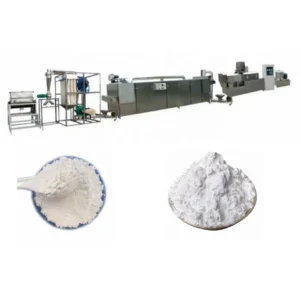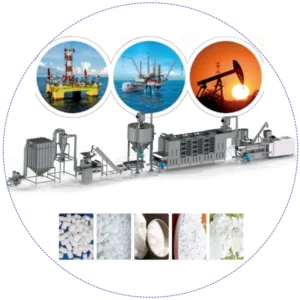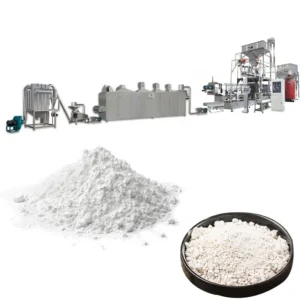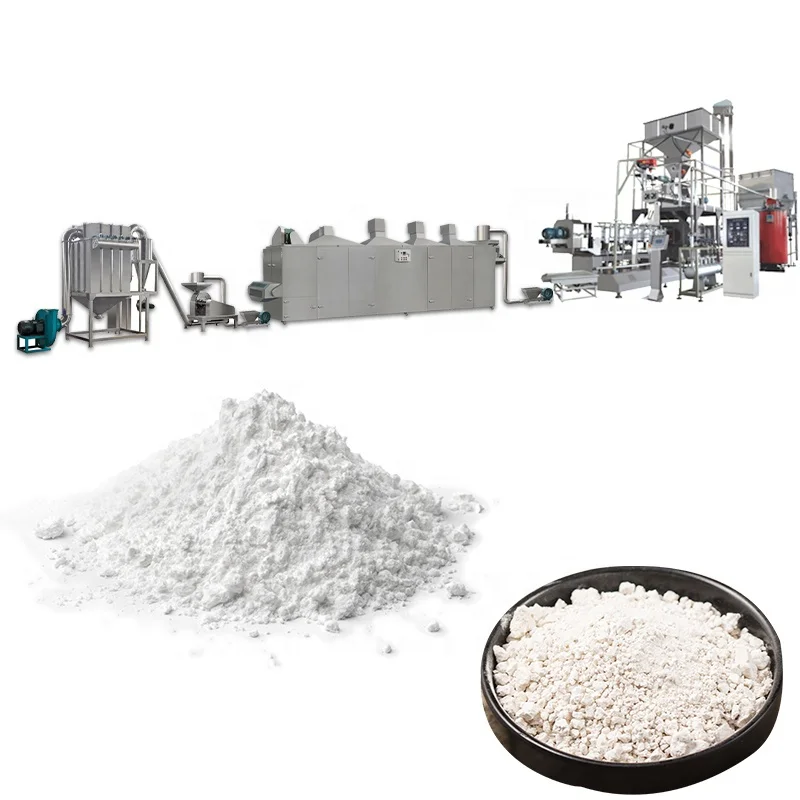
Integrated Starch Line Engineering — Every station from batching to packing is configured under one supplier so throughput matches at each transfer point instead of bottlenecking at the weakest link.
Technical Specifications
| Parameter | Value |
|---|---|
| Product Type | Modified Starch Extrusion Production Line |
| Available Models | MT70, MT85, MT75 |
| Extruder Type | Twin-screw |
| Screw Material | 38CrMoAl |
| Main Motor Power | 30 kW |
| Feeding Power | 0.75 kW |
| Cutting Power | 0.75 kW |
| Oil Pump Power | 0.37 kW |
| Heating Configuration | 7 × 2 kW = 14 kW |
| Barrel Cooling | Integrated cooling system for temperature control |
| Voltage & Frequency | 380V / 50Hz / Three Phase |
| Mixer Batch Options | 20–30 kg, 70–80 kg, or 170–180 kg per batch |
| Mixer Power Options | 4 kW / 7.5 kW / 15 kW |
| Mixer Material | 201SS or 304SS |
| Dryer Type | 5-layer baking oven |
| Dryer Dimensions | 5.0 × 1.2 × 2.3 m |
| Dryer Power | 3 kW |
| Dryer Heating Source | Gas or diesel |
| Dryer Speed Control | Inverter controlled |
| Dryer Weight | 1800 kg |
| Grinder Type | Pulse grinder with cyclone discharge and dust collector |
| Control System | PLC and MCC control |
| Line Stations | Mixing → Extrusion → Drying → Grinding → Packing |
| Standards | CE (since 2014), ISO |
Application Suitability
| Application | Material or Output |
|---|---|
| Pregelatinized cassava starch | Raw cassava starch for food and industrial binders |
| Modified corn starch | Corn starch for paper sizing and textile warp |
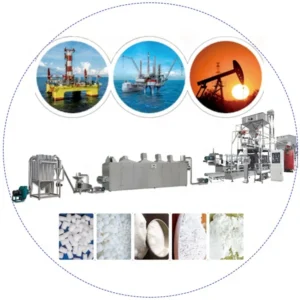
| Oil drilling fluid loss agent | Denatured starch for water-based drilling mud |
| Paper industry starch | Cationic or oxidized starch for surface sizing |
| Food-grade modified starch | Cross-linked or esterified starch for sauces and bakery |
What "Rated Capacity" Means When Your Starch Arrives at 38% Moisture
The number on the nameplate only holds if your raw material matches the test basis.
I remember a Southeast Asian buyer who ordered a pregelatinized cassava starch line based on a brochure figure. His local tubers arrived with moisture content well above what the test sample showed. The extruder choked, throughput dropped to roughly half the expected level, and the dryer could not keep up either. The whole modified starch processing line stalled at the extrusion station while upstream mixing kept producing batches that had nowhere to go. [NEED_CITE: moisture content variability in tropical cassava supply chains] That is why every specification conversation now starts with a raw material sample in the testing workshop, not a catalog number.
How the Stations Connect Across the Workflow
This modified starch processing line is arranged so that each station hands off to the next at a matched rate. The mixer options span three batch sizes — 20–30 kg, 70–80 kg, and 170–180 kg — each paired with an appropriate motor rating to keep blending cycles aligned with the extruder feed hopper. Material flows from the mixer into the twin-screw extruder where gelatinisation and modification occur under controlled barrel temperature, then exits into the five-layer dryer for moisture reduction before reaching the pulse grinder.
Why Throughput Matching Matters More Than Peak Extruder Output
An extruder running ahead of the dryer creates a backlog of wet, partially gelatinised starch that clumps and degrades. An extruder running behind the grinder means the pulveriser cycles on and off, producing inconsistent particle size distribution. The inverter-controlled dryer belt speed allows the operator to synchronize residence time with the actual extrusion rate, which fluctuates depending on starch type and target modification degree. [NEED_CITE: residence time distribution in multi-layer belt dryers for starch products] When every station is sourced from one supplier, these interfaces are designed together rather than patched together on site.
Reading the Screw and Barrel Configuration for Starch Work
Twin-screw geometry is chosen here because starch modification demands intense mixing and uniform shear that a single screw cannot deliver at production scale. The 38CrMoAl nitrided screws resist the abrasive wear that native starch granules produce over long campaigns. Barrel cooling zones work alongside the 14 kW heating rings to maintain a precise temperature profile — starch gelatinisation is highly sensitive to thermal overshoot, which causes unwanted dextrinisation and off-colour in the final powder. The seven independently controlled heating zones allow operators to build a stepped profile: gentle pre-conditioning near the feed zone, peak temperature in the gelatinisation section, and a controlled drop toward the die. Motor power at 30 kW provides the torque needed for high-viscosity starch melts without stalling during startup transients.
The Cost of Skipping the Dryer Capacity Check
When a buyer sources the extruder from one vendor and the dryer from another, nobody owns the gap between them. Wet starch pellets entering an undersized dryer emerge with residual moisture that causes caking in storage bags and inconsistent performance in the end application. [NEED_CITE: residual moisture limits for pregelatinized starch in drilling fluid applications] In oil drilling starch production, even a small moisture overshoot can compromise the fluid loss properties that the driller relies on. The same principle applies in reverse: an oversized dryer running partially empty wastes fuel and exposes the starch to excessive heat history, reducing cold-water viscosity.
Why Buyers Spec the Full Range Here
Screw configuration and die design are specified against the buyer’s actual raw material sample, not copied from a generic starch build. The testing workshop runs trial batches before the line ships, so the operator already has a baseline parameter set on day one. Electrical schematics and voltage are confirmed against the destination facility before production begins, avoiding commissioning delays. PLC and MCC controls are supplied as integrated panels rather than assembled from separate vendors, which means the interlocks between the mixer, extruder, dryer, and grinder are factory-tested. Wear parts lists ship with the line so that the first screw or die replacement does not become an emergency procurement exercise.
Documentation & Verification
- Line layout drawing showing station spacing and material flow for the selected model
- Screw and die configuration record matched to your starch type and modification target
- Electrical schematic with confirmed voltage, frequency, and control language
- Factory trial run report on your raw material sample before dispatch
- CE declaration of conformity and ISO certificate for the complete line
- Operation and maintenance manual with wear parts replacement intervals
Installation, Commissioning & Support
- Overall line length up to 45 m requires a clear floor span with level concrete foundation
- 380V three-phase supply with dedicated breaker sized for 210 kW installed load on MT75
- Line ships in modular sections for container loading and reassembly at site
- Commissioning includes first-run parameter tuning on your starch formulation
- Operator training covers PLC interface navigation and barrel temperature profile adjustment
- Spare screws, dies, and heating rings included with recommended replacement schedule
What We Need to Configure Your Line
Share your starch source — cassava, corn, or potato — along with the target modification type and the end-use application such as drilling fluid, paper sizing, or food thickener. Provide your local voltage and frequency so the motor and heating circuits are wound correctly before fabrication. If you have a preferred daily output target, include it alongside a raw material sample so the testing workshop can validate the configuration against your actual feedstock.
Frequently Asked Questions
Q: What stations are included and how is throughput matched between them?
A: The modified starch processing line covers mixing, twin-screw extrusion, five-layer drying, pulse grinding, and packing. Mixer batch size, extruder feed rate, dryer belt speed, and grinder capacity are all sized against each other during the layout phase. Inverter control on the dryer allows fine synchronization with the extruder output rate.
Q: How do I choose between the MT70, MT85, and MT75 models?
A: Selection depends on your target output and raw material characteristics. The MT70 suits smaller production runs, the MT85 fits mid-range volumes, and the MT75 handles higher throughput. A trial run on your starch sample in the testing workshop confirms which model delivers the required gelatinisation degree at your desired rate.
Q: What voltage and control options are available for export markets?
A: Standard configuration is 380V / 50Hz / three-phase, but motors and heating circuits can be specified for other voltages and frequencies. PLC and MCC control panels support multiple language options for the operator interface. Electrical schematics are confirmed with the buyer before production starts.
Q: Can the dryer heating source and mixer size be customized?
A: Yes. The five-layer dryer is available with gas or diesel heating to match your facility fuel supply. The mixer is offered in three batch sizes — 20–30 kg, 70–80 kg, and 170–180 kg — with corresponding motor ratings. Both selections are finalized during the line configuration stage.
Q: What spare wear parts should I plan for?
A: The screw set, die plates, and heating rings are the primary wear items in starch extrusion service. A wear parts list with part numbers and recommended replacement intervals ships with every line. Initial spares can be included in the first shipment so replacements are on hand before the first changeover is due.