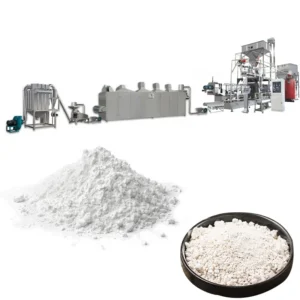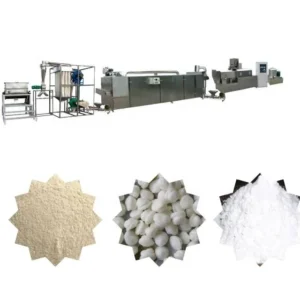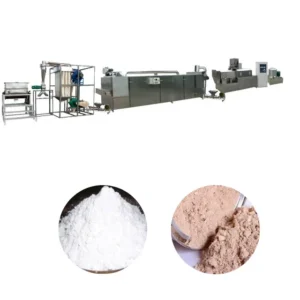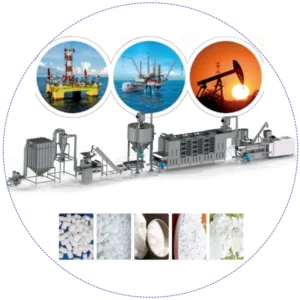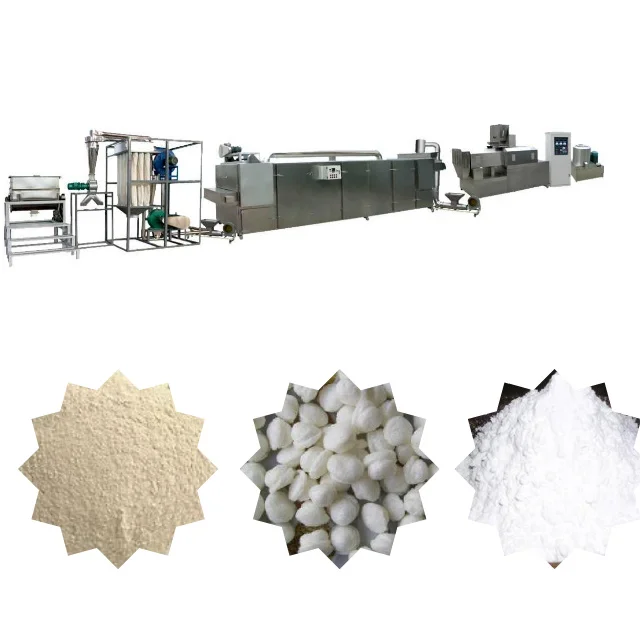
Complete turnkey line configuration — Every station from mixing to packing is throughput-matched, so a modified starch processing line holds its rated output without bottlenecks at the dryer or grinder.
Technical Specifications
| Parameter | Value |
|---|---|
| Product Type | Modified Starch Processing Line (Twin-Screw Extrusion) |
| Model | MT85 / MT100 / MT110 / MT135 |
| Screw Type | Twin-screw |
| Raw Materials | Corn starch, tapioca starch, potato starch |
| Capacity Range | 100–1500 kg/h (across line models; basis not stated in source — confirm raw material and moisture content) |
| MT85 Installed Power | 90 kW |
| MT85 Real Consumption | 63 kW |
| MT100 Installed Power | 180 kW |
| MT100 Real Consumption | 120 kW |
| MT110 Installed Power | 200 kW |
| MT110 Real Consumption | 150 kW |
| MT135 Installed Power | 240 kW |
| MT135 Real Consumption | 165 kW |
| Control System | Frequency speed controlling system (verify PLC / MCC options at quotation) |
| Barrel and Screw Design | Changeable per product target (gelatinisation, rheological modification) |
| Dryer Heating Source Options | Electric, steam, gas (configurable to local utility) |
| Grinding Machine Discharge | Bottom butterfly valve |
| Grinding Particle Fineness | Less than 10 mm (source value — verify target mesh for final starch powder) |
| Contact Materials | Food-grade stainless steel 304 (grinder food-contact parts confirmed; full line contact material — verify) |
| Lubrication | Automatic lubricating and cooling system |
| Processing Flow | Material preparation → Material blending → Mixing → Extruding → Drying → Grinding → Packing |
| Line Stations | Mixing system, twin-screw extruder, dryer/roasting machine, grinding machine, packing system |
| Assembly State | Complete turnkey line |
| Warranty | 1 year free warranty |
| Delivery Time | ~30 working days for small-capacity lines, ~50 working days for large-capacity lines (source value — confirm against current production schedule) |
Application Suitability
| Application | Material or Output |
|---|---|
| Pre-gelatinised starch for food processing | Corn, tapioca or potato starch (thickening, binding, freeze-thaw stability) |
| Modified starch for textile sizing | Tapioca or corn starch with specific rheological targets |
| Industrial starch for papermaking | Modified corn or potato starch |
| Starch-based binders for construction materials | Pre-gelatinised starch from corn or tapioca |
| Modified starch for oil drilling fluids | Cross-linked or chemically modified starch bases |
Why "500 kg/h" Means Nothing Without the Raw Material Spec
The capacity number on a modified starch processing line is only valid when tied to the exact starch source, moisture content, and target gelatinisation degree.
A line rated at a certain throughput on pure tapioca starch may behave completely differently when the buyer blends in corn flour or protein additives. I once watched a Southeast Asian customer spend an entire week re-tuning screw speed and barrel temperature curves because their local raw material mix shifted the gelatinisation point. The extruder was the same; the material behaviour was not. That is why any modified starch extrusion equipment for sale should always ship with a trial run report on the buyer’s own starch blend [NEED_CITE: twin-screw extrusion behaviour on blended starch matrices].
Barrel Segmentation and Gelatinisation Control
The twin-screw extruder in this modified starch processing line uses a segmented barrel design with independently controlled heating zones. This allows operators to build a temperature profile that matches the specific gelatinisation window of their starch source. Corn starch, tapioca starch, and potato starch each have distinct gelatinisation onset temperatures, and a flat temperature profile will either under-cook or scorch sections of the material stream. The changeable screw configuration further refines shear intensity, which directly controls the degree of starch molecule breakdown and the resulting viscosity of the extrudate.
Dryer Matching and Energy Source Flexibility
The dryer station is where many starch lines lose throughput. If the dryer cannot remove moisture at the rate the extruder delivers product, the entire line slows to the dryer’s pace. This modified starch processing line addresses that by offering three heating source options — electric, steam, or gas — so the buyer selects based on local utility availability and energy cost [NEED_CITE: industrial dryer energy source selection for starch processing]. Gas-fired dryers tend to suit regions with low natural gas prices, while steam integration makes sense where the factory already runs a boiler for other processes. The key point is that dryer capacity must be specified against the extruder’s actual output moisture, not a generic assumption.
Power Consumption and Real Operating Cost
Looking at the four extruder models, installed power ranges from 90 kW on the MT85 to 240 kW on the MT135, but real consumption is notably lower — 63 kW and 165 kW respectively. This gap reflects motor sizing for peak torque during start-up and transient load spikes, not continuous draw. For a buyer planning electrical infrastructure, the real consumption figure matters more for transformer sizing and monthly energy forecasting. The automatic lubricating and cooling system on the extruder also plays a role here, keeping barrel friction stable across long production runs so power draw does not creep upward as wear builds.
What Happens When Supporting Stations Are Undersized
A twin-screw extruder producing pre-gelatinised starch at a steady rate feeds into a grinder that must handle that volume continuously. If the grinder’s discharge rate or particle fineness target is mismatched, material backs up or the final powder spec drifts outside tolerance. I have seen lines where the extruder ran fine but the grinder bottlenecked output because nobody checked the throughput match at the quotation stage. The grinding machine here uses a bottom butterfly valve for discharge, which helps with continuous flow, but the particle fineness spec still needs verification against the buyer’s end-market requirement [NEED_CITE: starch powder mesh size requirements by application sector].
Why Procurement From a Single Line Supplier Matters
Every station in this modified starch processing line — mixing, extruding, drying, grinding, packing — is specified together so throughput is matched across the chain. The screw and die configuration is selected based on the buyer’s specific starch source and target product, not copied from a generic build. An in-house testing workshop allows trial runs on the buyer’s raw material before shipment, catching gelatinisation mismatches early. Pre-sales consultation covers line layout and utility planning, and on-site installation support carries through to operator training and ongoing maintenance.
Documentation & Verification
- Line layout and capacity calculation showing throughput matching across mixer, extruder, dryer, grinder, and packer
- Screw and die configuration record matched to your starch source and target gelatinisation profile
- Trial run report on your own corn, tapioca, or potato starch blend before shipment
- Electrical schematic with voltage, frequency, and control language confirmed for your installation country
- CE declaration of conformity and ISO certificate included with shipment documentation
Installation, Commissioning & Support
- Foundation and floor space planning based on the selected line model’s footprint and utility connections
- Electrical supply verification against the extruder’s real consumption (63–165 kW depending on model)
- Full assembly from delivered modules with alignment checks on extruder barrel and dryer conveyor
- First-run parameter tuning on your starch raw material with screw speed and temperature curve adjustment
- Operator training covering frequency speed control, automatic lubrication system, and grinder butterfly valve operation
- Wear parts list with lead times for screws, dies, and grinder blades for first replacement planning
What We Need to Quote Your Line Accurately
To configure a modified starch extrusion equipment line that matches your production target, provide your starch source (corn, tapioca, potato, or a blend), the target product application, and your local voltage and frequency standard. We also need your available workshop dimensions and whether you prefer electric, steam, or gas heating for the dryer. If you have an existing upstream batching system or downstream packing line, let us know so we can match the interface.
Frequently Asked Questions
Q: How is line capacity verified and what raw material assumptions underpin the kg/h figures?
A: Capacity for each modified starch processing line model is tied to a specific starch type and moisture content. Before quotation, we request your raw material details and run a trial in our testing workshop to confirm the actual throughput your blend will achieve, rather than quoting a generic bench-test number.
Q: Which supporting stations are included and how is throughput matched between them?
A: The line includes mixing, twin-screw extrusion, drying, grinding, and packing stations. Each station is sized so its throughput capacity aligns with the extruder’s confirmed output, preventing bottlenecks at the dryer or grinder that would reduce the overall line rate.
Q: What voltage, frequency, and control language options are available for my installation country?
A: Electrical specifications are confirmed during the quotation stage based on your local standard. The frequency speed controlling system and any optional PLC or MCC controls can be configured with the operator language required at your facility [NEED_CITE: electrical standards for food processing machinery exports].
Q: Can the barrel, screw, and die configuration be tailored to a specific starch source?
A: Yes. The twin-screw extruder features changeable barrel segments, screw elements, and die designs. These are selected based on your target gelatinisation degree and starch rheology, ensuring the extrudate meets the required modification profile.
Q: What spare wear parts are supplied and what is the lead time for the first replacement?
A: A wear parts list covering screws, dies, and grinder blades is provided with every line shipment. Lead times for first replacement orders are confirmed at the time of purchase so you can plan inventory before your initial stock depletes.