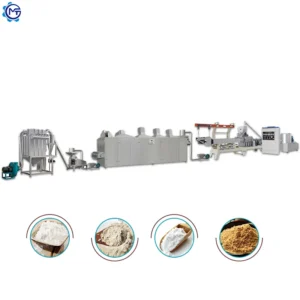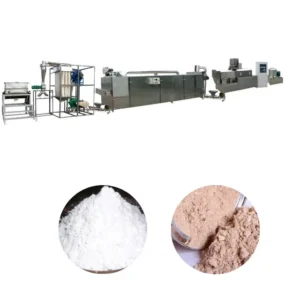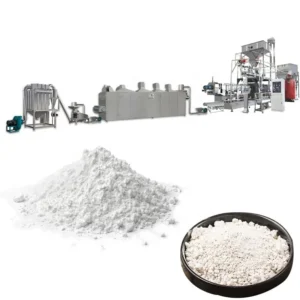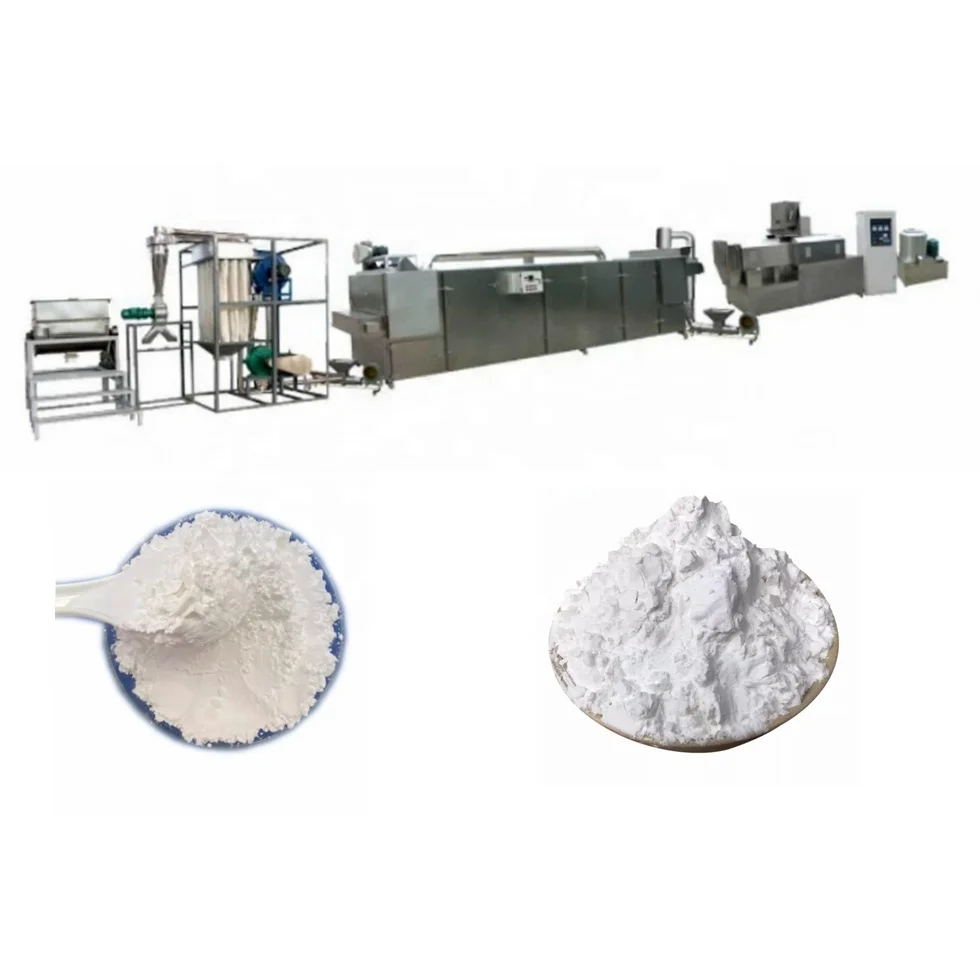
Integrated Line Engineering — A modified starch processing equipment manufacturer matching throughput across extrusion, cooling, and grinding stations so the line runs as one unit.
Technical Specifications
| Parameter | Value |
|---|---|
| Product Type | Modified Starch Twin-Screw Extrusion Production Line |
| Extruder Type | Twin-screw |
| Control System | PLC and MCC control |
| Rated Power | 45–200 kW |
| Capacity | 100–1500 kg/h (basis not stated in source — confirm raw material, moisture content, and target modification level) |
| Machine Weight | 1000–5000 kg (source value — verify against manufacturer catalog) |
| Voltage & Frequency | 220–440 V, 3-phase (confirm exact Hz and phase per destination market) |
| Line Stations | Mixing and batching, twin-screw extruder, cooling conveyor, pulse grinder (cyclone discharge with dust collector), packing interface |
| Barrel Temperature | Multi-zone temperature control |
| Contact Materials | Food-grade stainless steel on product contact parts; PVC on some conveyor sections |
| Fuel Options (for dryer if included) | Gas / diesel / electricity / steam (to be confirmed at quotation stage) |
| Standards | CE (since 2014), ISO |
Application Suitability
| Application | Material or Output |
|---|---|
| Modified tapioca and cassava starch production | Raw tapioca or cassava starch blended with custom additives |
| Pregelatinised corn starch for food ingredients | Corn starch processed for instant food and bakery applications |
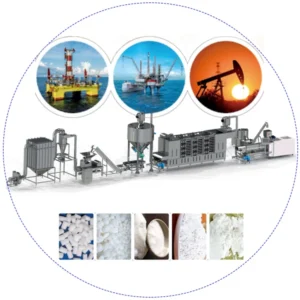
| Industrial-grade modified starch | Starch modified for paper making and oil drilling fluid use |
| Nutritional and fortified food ingredient bases | Potato and wheat starch blends for infant formula and nutrition powders |
Why the Raw Material Question Must Come Before the Quotation
A twin-screw modified starch line for sale is only as capable as the raw material it was tested on.
I spent two days on the floor of a tapioca processing plant watching an entire line sit idle. The extruder had been configured and tested on standard corn starch at the factory, and it ran perfectly there. When the machine arrived on site and the buyer fed in their local cassava starch, the gelatinisation temperature was off. The output came out in solid lumps, completely unusable. The crew had to stop, pull the screws, and spend another two days mapping new temperature profiles and moisture ratios from scratch. That kind of setback is avoidable when the modified starch processing equipment manufacturer runs the buyer’s actual material through a trial before the machine leaves the factory [NEED_CITE: starch gelatinisation temperature variance across raw material sources].
How Each Station Fits the Next
Buyers surveying equipment often look at the extruder first and treat cooling, grinding, and packing as afterthoughts. The problem is that a modified starch processing line bottlenecks at its slowest station. If the twin-screw extruder pushes material faster than the cooling conveyor can bring it to ambient temperature, the product reaches the pulse grinder still warm and tacky. The grinder then clogs, and the whole line slows to match. Meiteng builds each station — mixing and batching, extrusion, cooling, grinding, and packing interface — to the same throughput target, so material flows continuously without queuing at any single point.
The Cooling and Grinding Stage in Detail
Once starch exits the extruder die, it must cool uniformly before grinding. The cooling conveyor on this line uses a low-noise air knife structure that dries the surface without damaging product colour or integrity. Downstream, the pulse grinder discharges through a cyclone into a dust collector, keeping the workshop environment clean and controlling particle size distribution. For buyers producing pregelatinised starch for food-grade applications, dust containment is not optional — it affects both workplace safety compliance and final product purity [NEED_CITE: food-grade dust emission standards in starch processing facilities].
Reading the Specs That Actually Matter
The twin-screw extruder at the centre of this modified starch processing line operates with multi-zone barrel temperature control. For starch modification, this is critical: different zones govern preconditioning, gelatinisation, and shear-induced molecular restructuring. A single-zone barrel cannot manage the thermal gradient that tapioca starch requires versus corn starch. The PLC and MCC control system coordinates barrel temperature, screw speed, and feed rate from one interface, which matters when operators need to replicate a successful trial run across multiple production batches. Voltage and frequency must be confirmed for the destination market before build — a 440 V motor rewired on site after delivery introduces delays and potential warranty complications [NEED_CITE: voltage and frequency standards by export market].
What Happens When Stations Are Sourced Separately
I have seen buyers purchase the extruder from one vendor, the dryer from another, and the grinder from a third, each quoting a nominal capacity that sounds compatible on paper. In practice, the extruder’s actual output on the buyer’s specific starch formulation differs from its nameplate rating, the dryer cannot remove moisture fast enough at that throughput, and the grinder chokes on material that arrives above its design temperature. The result is a line that never reaches the capacity any single vendor promised. Sourcing the complete modified starch processing equipment manufacturer package from one supplier means every interface — mechanical, thermal, and electrical — is designed and tested together [NEED_CITE: throughput mismatch consequences in multi-vendor processing lines].
Why Buyers Spec This Line Here
The screw configuration and die design are specified to the buyer’s raw material and target modification level, not copied from a generic build. This matters because cassava starch and corn starch respond differently to shear and temperature, and the wrong screw profile produces the wrong degree of modification. The in-house testing workshop runs the buyer’s actual material before shipment, so product development happens at the factory rather than on the buyer’s floor during commissioning. Supporting stations — cooling conveyor, pulse grinder, cyclone and dust collector — are original equipment, not third-party add-ons, which keeps warranty and service under one responsibility. Pre-sales consultation through on-site installation, commissioning, and operator training means the same engineering team follows the project from line layout to first production run.
Documentation & Verification
- Line layout drawing showing station spacing and utility connection points for your capacity target
- Screw and die configuration record matched to your starch type and modification specification
- Trial run report produced on your raw material with temperature, moisture, and throughput data
- Electrical schematic and voltage confirmation sheet locked to your destination market supply
- Wear parts list covering screws, dies, and grinder screens with recommended replacement intervals
- CE declaration of conformity and ISO certificate for customs and local regulatory submission
Installation, Commissioning & Support
- Foundation and floor space planning based on the full line footprint from batching to packing interface
- Electrical supply verification against the confirmed 220–440 V, 3-phase requirement before energising
- Factory-assembled stations disassembled for transport and reassembled on site by the installation team
- First-run parameter setting using the trial run report as baseline for barrel temperature and screw speed
- Operator training covering PLC and MCC interface, emergency stop sequences, and batch changeover procedures
- Spare screw elements, die plates, and grinder screens supplied with the initial shipment for first replacement cycle
What to Prepare Before Requesting a Quote
To configure a line that actually matches your production conditions, share your raw starch source and current moisture content, the specific modification or pregelatinisation outcome you need, and your target hourly output on that material. Include your facility’s available floor area and ceiling height, the local voltage and frequency supply, and whether your operators need the control interface in a specific language. If you have upstream batching or downstream packing equipment already in place, note the interface specifications so the line connects without modification.
Frequently Asked Questions
Q: What raw material and process conditions is the 100–1500 kg/h capacity range based on?
A: That range depends entirely on the starch source, its moisture content entering the extruder, and the degree of modification or pregelatinisation required. Cassava starch at one moisture level will process at a different rate than corn starch at another. Confirm your specific raw material and target specification so the line can be sized to your actual throughput rather than a generic figure.
Q: Can the voltage and frequency be locked before the machine is built?
A: Yes. The electrical system is configured to the destination market’s supply standard during production, not after arrival. Providing your exact voltage, phase, and frequency at the inquiry stage ensures the motor, control panel, and heating elements are all built to match, avoiding rewiring delays during commissioning.
Q: Are the extruder, cooling conveyor, and grinder throughput rates synchronised?
A: Each station is designed to the same line throughput target. The cooling conveyor length and air knife capacity are matched to the extruder output, and the pulse grinder is sized to handle the cooled material flow. This prevents bottlenecks that occur when stations are sourced from separate vendors with incompatible nominal ratings.
Q: Will the screw and die configuration be customised to my starch formulation?
A: The screw profile and die design are specified to your raw material and target product characteristics. Before shipment, your actual starch is run through the extruder in the testing workshop, and the configuration record is documented. This means the machine arrives already set to your process, not to a generic starch specification.
Q: Does the pulse grinder dust collection meet food-grade workshop emission requirements?
A: The pulse grinder uses a cyclone discharge system paired with a dust collector designed to contain fine starch particulate. The specific emission level depends on local regulations, so share your workshop’s dust control standard at the inquiry stage to confirm the collector specification matches your compliance requirements.