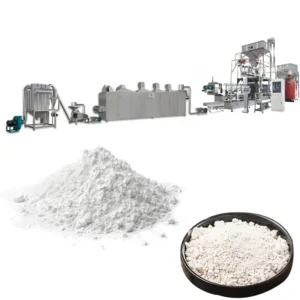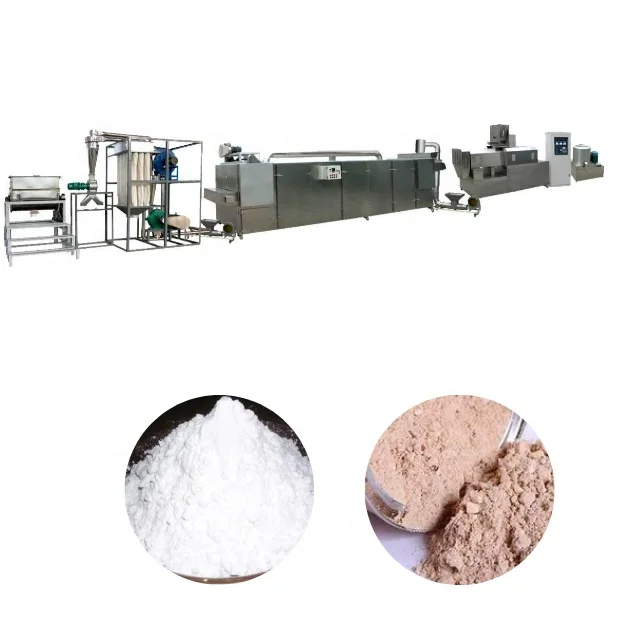
Integrated Line Throughput — Every station in the modified starch line is sized to the same output target, preventing the bottleneck that appears when extruders, dryers and grinders come from different vendors.
Technical Specifications
| Parameter | Value |
|---|---|
| Product Type | Modified Starch Twin-Screw Extrusion Production Line |
| Screw Type | Twin-screw |
| Main Drive Power | 45–200 kW |
| Capacity Range | 100–1500 kg/h (basis not stated in source — confirm raw material, moisture, starch type) |
| Machine Weight | 1000–5000 kg |
| Voltage Supply | 220–440 V, three-phase (configurable to local grid) |
| Control System | PLC and MCC |
| Line Stations | Twin-screw extruder, cooling and air-drying conveyor, pulse grinder with cyclone discharge and dust collector |
| Contact Material | Food-grade stainless steel |
| Fuel Options for Drying | Gas / diesel / electricity / steam (to be confirmed at quotation) |
| Certification | CE, ISO |
Application Suitability
| Application | Material or Output |
|---|---|
| Food-grade modified starch for nutrition and fortified products | Corn flour, wheat flour, rice flour with functional additives |
| Oil drilling fluid starch additives | Modified corn starch and cassava-based starch with viscosity modifiers |
| Papermaking-grade modified starch | Wheat and corn flour blends requiring controlled gelatinisation |
| Pre-gelatinised starch for instant food and infant formula | Soybean flour, grain flour blends with protein and micronutrient additives |
Why the Capacity Number on a Modified Starch Line Often Misleads
A rated throughput figure means little without the raw material and moisture content behind it.
When I helped a plant set up a pre-gelatinised starch line last year, the buyer ordered based on a corn starch capacity number. Their actual feedstock was cassava starch, which develops far higher viscosity during gelatinisation. The screw configuration that handled corn starch choked on cassava, and throughput dropped significantly on site. We spent days reconfiguring the screw elements and adjusting barrel temperatures before the line stabilised. A modified starch processing line manufacturer who quotes capacity without locking the raw material basis is quoting a number that may not survive the first production run. [NEED_CITE: typical viscosity differences between corn and cassava starch during extrusion]
Matching Extruder Stations to the Full Modified Starch Workflow
A modified starch extruder equipment for sale is only one piece of the production chain. The twin-screw extruder handles gelatinisation and modification, but the material then needs controlled cooling before grinding, and the grinder must produce a uniform particle size without overheating the starch. When these stations are sourced separately, throughput mismatches are common — the extruder pushes more than the conveyor can cool, or the grinder becomes the constraint. Sizing every station to the same target output from the start keeps the line balanced and avoids costly retrofits later.
How Screw Configuration Shapes Starch Modification
The degree of starch modification depends on shear intensity, residence time and barrel temperature profile inside the extruder. Different screw element arrangements — conveying, kneading, reverse-flight — change how much mechanical energy transfers into the material. For a high-viscosity modified starch used in oil drilling fluids, a longer kneading zone may be necessary to achieve full gelatinisation. For a food-grade pre-gelatinised starch where excessive shear could degrade functionality, a gentler configuration preserves the molecular structure. This is why screw and die selection must follow the raw material and the target modification, not a generic build. [NEED_CITE: twin-screw element arrangement effects on starch gelatinisation degree]
Reading the Specifications That Matter for Modified Starch
The power range of 45–200 kW reflects the difference between small-batch specialty starch production and continuous industrial output. Higher motor power supports the torque needed when processing high-viscosity formulations like cassava-based or heavily modified starches. The voltage range of 220–440 V three-phase means the electrical system can be configured before build to match the buyer’s local grid — a detail that, if missed, delays commissioning by weeks while transformers or panels are reworked. PLC and MCC control across the line ensures that extruder barrel temperatures, conveyor speed and grinder feed rate stay coordinated, which matters when batch-to-batch consistency is a contract requirement. The pulse grinder with cyclone discharge and integrated dust collector addresses a problem specific to starch processing: fine powder recovery and airborne dust control in a combustible environment.
The Cost of Skipping the Trial Run
Lines shipped without a trial run on the buyer’s actual raw material often require extended on-site debugging. Screw elements that performed well on the manufacturer’s test material may produce incomplete gelatinisation or excessive degradation on the buyer’s feedstock. The grinder may yield an incorrect particle size distribution, forcing screen changes and re-tests. These delays consume raw material, idle operators and push back the first commercial shipment. [NEED_CITE: industrial extrusion line commissioning delays caused by untested raw material]
Why Procurement Consolidation Matters Here
A single supplier delivering the extruder, cooling conveyor and pulse grinder as a matched set eliminates the finger-pointing that occurs when separate vendors blame each other for throughput shortfalls. Screw configuration and die design are specified to your raw material and target starch type before the build begins. The in-house testing workshop runs your actual feedstock through the line, generating a trial report that locks parameters before shipment. Electrical schematics and voltage confirmation are completed against your local grid specification, not assumed. Pre-sales consultation, on-site installation, commissioning and operator training are handled by the same engineering team that built the line, so knowledge does not get lost between departments.
Documentation & Verification
- Line layout and capacity calculation matched to your workshop footprint and target starch type
- Screw and die configuration record specified to your raw material formulation
- Electrical schematic with voltage and frequency confirmed for your local grid
- Trial run report on your actual raw material from the in-house testing workshop
- CE declaration of conformity and ISO certificate on file
- Operation and maintenance manual with wear parts list for extruder screws and grinder blades
Installation, Commissioning & Support
- Foundation and floor loading plan based on the 1000–5000 kg line weight and extruder vibration profile
- Dedicated three-phase power circuit sized to the confirmed kW rating within the 45–200 kW range
- Assembled stations arrive with extruder barrel and screw pre-fitted; conveyor and grinder positioned per layout
- First-run parameter lock including barrel temperature zones, screw speed and grinder screen selection
- Operator training covering PLC interface navigation, MCC safety interlocks and emergency stop sequences
- Wear parts kit with spare screw elements, die plates and grinder blades for the first replacement cycle
What to Prepare Before Requesting a Quote
To configure a modified starch processing line that matches your production target, share the following: your exact raw material formulation including starch type and any additives, target hourly output with moisture content specified, available workshop floor area and ceiling height, local voltage and frequency, preferred control language, and whether you can send a sample batch for a pre-shipment trial run.
Frequently Asked Questions
Q: How is line capacity verified and what raw material basis is used?
A: The 100–1500 kg/h range is a reference that shifts depending on starch type, moisture content and target modification degree. Before quotation, we confirm your exact raw material and run a trial in our testing workshop. The resulting trial report documents the achievable throughput under those specific conditions, so the capacity figure in your contract reflects your actual feedstock.
Q: Which voltage and frequency configurations are available?
A: The electrical system supports 220–440 V three-phase supply. Voltage, frequency and plug configuration are confirmed during the specification stage to match your local grid standard. The MCC panel and all motor ratings are then built to that confirmed specification, avoiding on-site rewiring or transformer additions during commissioning.
Q: How are screw and die configurations matched to different starch materials?
A: Screw element arrangement — conveying, kneading and reverse-flight sections — is selected based on the shear and residence time your raw material requires. Die design controls the pressure and expansion at discharge. For high-viscosity starches like cassava, a stronger kneading zone is typical. For food-grade pre-gelatinised starch, a gentler profile preserves functionality.
Q: Can a trial run be performed on our raw material before shipment?
A: Yes. We request a sample of your actual raw material and run it through the configured line in our in-house testing workshop. The trial run report records screw speed, barrel temperatures, throughput and product quality under those parameters. This report ships with the line and serves as the baseline for on-site commissioning.
Q: What spare wear parts are supplied and how are replacements handled?
A: A wear parts list is included with your documentation, covering extruder screw elements, die plates and pulse grinder blades. A recommended first-cycle spare set can be shipped with the line. Replacement specifications are documented so you can reorder directly or source locally using the same dimensional and material standards.