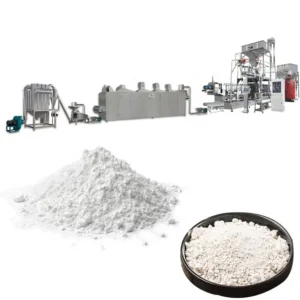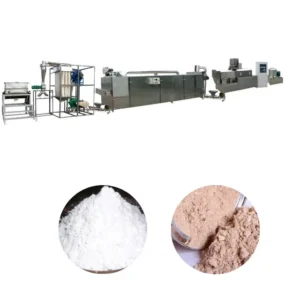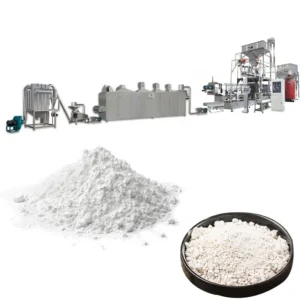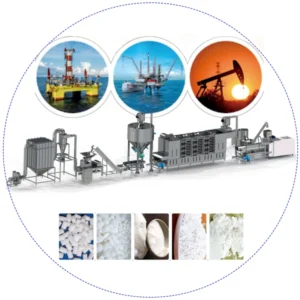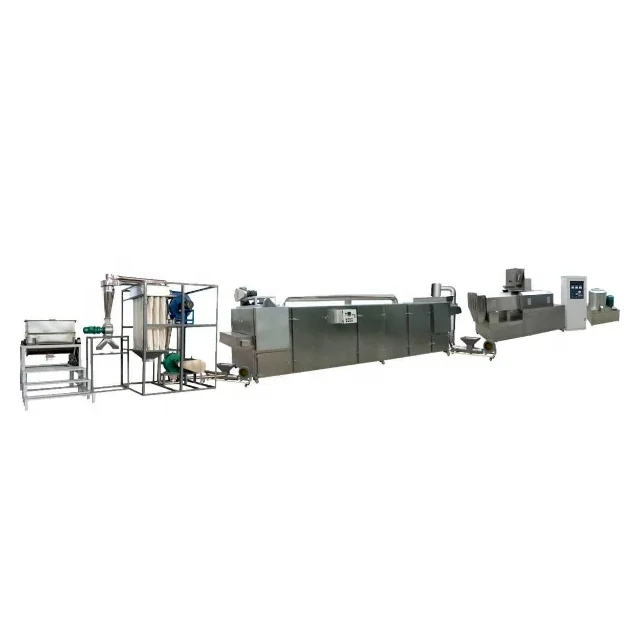
Throughput-matched line configuration — Every station from extrusion to grinding is specified against the buyer’s raw material to prevent bottlenecks across the modified starch processing equipment.
Technical Specifications
| Parameter | Value |
|---|---|
| Product Type | Modified Starch Processing Production Line |
| Extruder Type | Twin screw |
| Power | 45–200 kW |
| Capacity | 100–1500 kg/h (basis not stated in source — confirm raw material type, moisture content, modification degree) |
| Weight | 1000–5000 kg (varies by line configuration) |
| Voltage | 220–440V, tri-phase (frequency to confirm) |
| Extruder Design | Three-generation evolution covering cereals, potato starch, protein, chemicals, plastics, and rubber |
| Line Stations | Twin screw extruder, cooling conveyor, pulse grinder |
| Cooling Conveyor | Wind knife blower, ambient temperature drying |
| Pulse Grinder | Cyclone discharge, dust collector, speed-controlled auger feeder |
| Contact Materials | Food-grade stainless steel (except designated PVC conveyors) |
| Control System | Control panel included (PLC / MCC available on request) |
| Fuel Options | Gas, diesel, electricity, or steam (buyer specifies at quotation) |
Application Suitability
| Application | Material or Output |
|---|---|
| Pregelatinised starch for food ingredients | Corn flour, potato starch, rice flour |
| Modified starch for oil drilling fluids | Corn flour, grain-based nutritional flours |
| Paper making starch preparation | Corn flour, soybean flour, potato starch |
| Nutritional grain flour modification | Rice flour, soybean flour, blended grain flours |
What "100–1500 kg/h" Actually Means on Your Raw Material
Capacity numbers are meaningless without knowing the starch source, moisture content, and target modification degree.
I worked on a line for a South American buyer two years ago who ran trial tests on standard corn starch — everything looked stable. When they switched to their actual cassava starch on site, the gelatinisation temperature was off by a noticeable margin, expansion dropped, and we spent half a month re-tuning screw speed, barrel zones, and moisture feed. That is the kind of mismatch that turns a clean commissioning into an extended troubleshooting session [NEED_CITE: gelatinisation temperature variation across starch sources]. Naming a throughput figure without tying it to raw material behaviour sets the wrong expectation before the machine is even built.
Matching Extruder Output to Downstream Cooling and Grinding
A modified starch production line only runs as fast as its slowest station. The twin screw extruder pushes material through barrel zones where shear, heat, and moisture complete the starch modification. If the cooling conveyor cannot remove surface moisture at the same rate, material clumps before it reaches the pulse grinder. The wind knife blower on this line handles ambient-temperature surface drying, and its belt speed is set to match extruder output so that product enters the grinder at a consistent temperature and moisture level.
How the Pulse Grinder Controls Final Particle Size
The pulse grinder uses cyclone discharge paired with a dust collector to manage particle size reduction without overheating the starch. A speed-controlled auger feeder meters material into the grinding chamber at a steady rate, which matters because modified starch is sensitive to friction heat — too fast and the starch retrogrades, losing the functional properties the extruder just created. This station closes the loop between extrusion chemistry and the particle specification the end customer expects [NEED_CITE: starch retrogradation during mechanical processing].
Reading the Specs That Matter for Starch Modification
The twin screw configuration gives operators independent control over shear and residence time, which is critical when switching between corn, potato, and rice starch sources that gelatinise at different temperatures. The three-generation extruder design reflects iterative changes to screw element geometry and barrel zone layout, each generation addressing raw material behaviour that the previous one did not fully resolve. Power ranges from 45 to 200 kW depending on line throughput and the degree of modification required — higher modification degrees demand more shear energy. The fuel option choice (gas, diesel, electricity, or steam) affects how barrel temperature profiles are maintained; steam offers finer zone control for heat-sensitive starches, while direct gas firing suits higher-throughput installations where response speed matters more than precision. Food-grade stainless steel contact materials prevent contamination across all product grades, including industrial starches destined for oil drilling or paper making.
The Cost of Skipping Raw Material Trials Before Shipment
Buyers who approve a line based on generic starch trials and then commission with their own material often face weeks of unplanned reconfiguration. Screw elements may need reordering, barrel zone temperatures require recalibration, and downstream cooling belt speed must be adjusted to match a different extrusion rate. In the worst cases I have seen, the pulse grinder receives material at the wrong moisture level, and the cyclone separator clogs repeatedly until the entire line rhythm is reset [NEED_CITE: commissioning delays from untested raw material]. These are not warranty issues — they are specification gaps that a pre-shipment trial run would have surfaced and resolved.
Why Sourcing the Full Line from One Builder Matters
Matching throughput across the extruder, cooling conveyor, and pulse grinder is only possible when one supplier designs all three stations together. Our machine testing workshop runs trial batches on the buyer’s actual raw material before the line ships, so screw configuration, barrel profile, and cooling rate are set to real data rather than generic assumptions. The line layout document we provide shows capacity calculation at every station, not just at the extruder. Electrical schematics confirm voltage, frequency, and control language before production begins, avoiding commissioning delays on site. We supply wear parts lists and configuration records for screws and dies so that the first replacement order can be placed without guesswork.
Documentation & Verification
- Line layout showing throughput calculation at extruder, cooler, and grinder stations
- Screw and die configuration record matched to buyer’s starch source and modification target
- Electrical schematic with voltage, frequency, and control language confirmed pre-production
- Factory trial run report on buyer’s raw material with temperature and expansion data
- CE declaration of conformity and ISO certificate included with shipment
- Wear parts list covering screws, dies, and grinder auger components
Installation, Commissioning & Support
- Foundation plan accounts for extruder weight up to 5000 kg and grinder vibration isolation
- Dedicated power circuit sized for 45–200 kW extruder motor plus cooling and grinding loads
- Line arrives in modular sections; assembly sequence follows the extruder-cooler-grinder flow
- First-run commissioning includes barrel zone calibration and wind knife blower speed tuning
- Operator training covers screw speed adjustment and auger feeder rate setting for each starch type
- Wear parts kit ships with initial spare screws, die plates, and grinder cyclone liners
Before You Request a Quote
To configure a modified starch processing equipment line that matches your production target, we need to know the starch source you will run (corn, potato, rice, soybean, or a blend), the target modification degree, and your local voltage and frequency. Share your workshop floor dimensions and ceiling height so we can draft a line layout that fits. If you have existing upstream mixing or downstream packing equipment, let us know the interface specifications so throughput is matched end to end.
Frequently Asked Questions
Q: What stations are included in a complete modified starch line and where does each fit?
A: The line includes a twin screw extruder for starch modification, a cooling conveyor with wind knife blower for surface moisture removal, and a pulse grinder with cyclone discharge for particle size reduction. Upstream mixing and downstream packing are available through partner suppliers and integrated into the line layout at the quotation stage.
Q: How is throughput matched between the extruder, cooling conveyor, and grinding station?
A: Each station is sized during the layout phase so that belt speed, cooling rate, and grinder feed rate align with extruder output. The line capacity calculation document shows the throughput figure at every station, confirming there is no bottleneck before production begins.
Q: Can the line handle different raw materials without hardware changes?
A: Corn, potato, rice, and soybean starches can all be processed, but screw configuration, barrel temperature profile, and moisture settings must be adjusted for each source. A trial run on the buyer’s actual material before shipment ensures the correct setup is documented and repeatable.
Q: What fuel options are available for the extrusion and drying stages?
A: Gas, diesel, electricity, and steam are all available. Steam provides finer barrel zone temperature control for heat-sensitive starches, while gas or diesel suits higher-throughput installations where rapid heating response is more important.
Q: Is a packing station included or sourced separately?
A: Packing is handled through partner equipment and integrated into the overall line layout. The line quotation specifies the packing station interface so that throughput from the pulse grinder to the packing hopper is matched and documented.