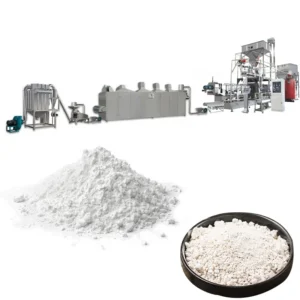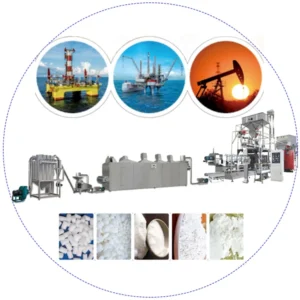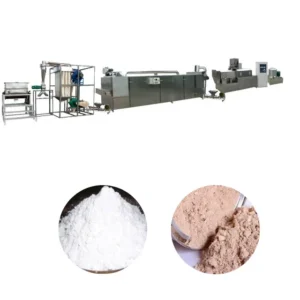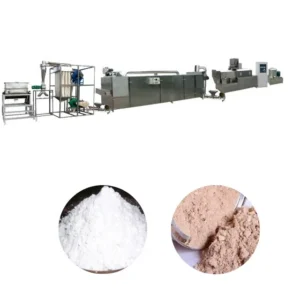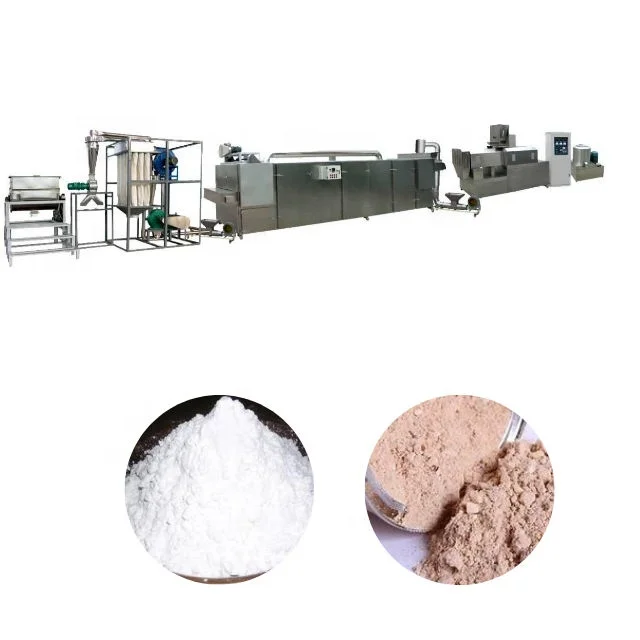
Balanced Station Throughput — Every mixer, extruder, dryer, grinder and packer in this modified starch production line full equipment range is sized against the same throughput target so no single unit bottlenecks the output.
Technical Specifications
| Parameter | Value |
|---|---|
| Product Type | Modified Starch Production Line |
| Raw Material Compatibility | Cassava, corn, potato and other grain starches |
| Extruder Type | Heavy-duty twin-screw extruder |
| Line Stations | Mixing, extrusion, drying, grinding, packaging |
| Control System | Available with PLC or MCC automation |
| Process Parameters | Adjustable temperature, screw speed, pressure |
| Contact Material | Food-grade stainless steel |
| Output Types | Pregelatinized, oxidized, cross-linked modified starch |
| Output Capacity | Confirm with manufacturer (basis to be confirmed) |
| Rated Power | Confirm with manufacturer (basis to be confirmed) |
| Voltage & Frequency | Configurable to target market (basis to be confirmed) |
| Overall Dimensions | Confirm with manufacturer (basis to be confirmed) |
| Screw Configuration | Matched to raw material and target modification |
| Standards | CE, ISO |
Application Suitability
| Application | Material or Output |
|---|---|
| Food and beverage thickener production | Pregelatinized cassava and corn starch |
| Paper making and textile sizing | Oxidized and cross-linked potato starch |
| Construction and adhesive formulations | Modified grain starch with controlled viscosity |
| Nutritional and infant formula bases | Pregelatinized starch with specific fineness profiles |
Why a Modified Starch Production Line Full Equipment Range Must Address Raw Material Variability
A line configured for generic starch will underperform the moment the buyer’s actual raw material enters the hopper.
I spent weeks on-site at a Southeast Asian cassava starch plant where the extruder was perfectly calibrated for standard moisture levels, but the local cassava variety ran consistently higher in water content. The gelatinisation degree dropped, expansion became uneven, and the line crawled at half its expected throughput. The screw combination and barrel temperature profile had to be completely reworked before the plant could hit its targets. That gap between catalogue capacity and real-world output is where most starch processing projects stall [NEED_CITE: raw material moisture variability in tropical cassava cultivation]. A modified starch production line full equipment range only delivers when every station — from the mixer through the dryer — is set against the buyer’s specific material certificate, not a generic baseline.
Station-by-Station Catalogue Logic
This modified starch production line full equipment range is structured so that each unit is selected and sized as part of a continuous chain. The mixer must deliver a uniform moisture distribution before material enters the twin-screw extruder, where shear force and residence time determine the degree of starch modification. Downstream, the dryer must handle the exact moisture load that the extruder introduces, and the grinder must achieve the target fineness without overheating the product. Packaging throughput is then matched to the grinder output so that finished material does not queue or stall.
Full Equipment Range Integration Under One Supplier
Sourcing individual stations from separate vendors often leaves gaps in capacity matching and control integration. When the extruder and dryer arrive from different factories, the control language, signal protocols and safety interlocks may not communicate without costly field modifications [NEED_CITE: integration challenges in multi-vendor food processing lines]. This catalogue approach keeps the entire modified starch production line full equipment range under a single engineering responsibility, so electrical schematics, PLC logic and mechanical interfaces are coordinated before the equipment leaves the factory floor.
Reading the Specs That Actually Matter for Starch Modification
The twin-screw extruder at the core of this line provides the shear and thermal energy needed to alter starch molecular structure. Screw configuration — the arrangement of conveying, kneading and reverse elements — directly controls residence time and shear intensity, which in turn govern whether the output is pregelatinized, oxidized or cross-linked. Barrel temperature zones must be independently adjustable because different starch sources gelatinise at different thresholds; cassava starch, for instance, requires a lower onset temperature than corn starch. Food-grade stainless steel contact parts prevent iron contamination that would discolour light starch products and compromise food safety compliance. The PLC or MCC control system stores parameter recipes so that switching between starch types or modification targets does not require manual trial and error on every run.
The Hidden Cost of Mismatched Line Stations
When a dryer is undersized relative to the extruder output, wet starch accumulates in the transfer chute and forces the operator to throttle the extruder screw speed, sacrificing throughput to keep the line running. An undersized grinder creates a different problem: the product leaves the dryer at the correct moisture but queues ahead of the milling stage, exposing it to ambient humidity and partially reversing the drying work. These imbalances rarely appear in a quotation that lists each machine in isolation [NEED_CITE: throughput bottleneck causes in continuous starch processing]. Buyers who evaluate only individual station prices often discover the real cost during commissioning, when engineers spend additional weeks rebalancing the line.
Why Procurement Here Reduces Commissioning Risk
Every station in this line is throughput-matched during the layout phase, so the extruder, dryer, grinder and packer share a verified capacity target rather than nominal ratings pulled from separate catalogues. Screw and die configurations are specified after reviewing the buyer’s raw material report, not copied from a generic build. The in-house testing workshop runs the buyer’s actual starch sample through the extruder before shipment, producing a trial run report that confirms gelatinisation degree and output texture. Electrical schematics are confirmed for the destination market voltage and frequency before production begins. Wear parts lists ship with the line so that the first screw or seal replacement does not become an emergency sourcing exercise.
Documentation & Verification
- Line layout showing throughput calculation across every station from mixer to packer
- Screw and die configuration record matched to buyer’s cassava, corn or potato starch
- Trial run report on customer raw material conducted in the testing workshop before dispatch
- Electrical schematic with voltage, frequency and control language confirmed for target market
- CE declaration of conformity and ISO certificate included with shipping documentation
Installation, Commissioning & Support
- Foundation and floor space plan based on the confirmed line layout and station dimensions
- Dedicated power circuit specification matching the heavy-duty twin-screw extruder rated load
- Assembly sequence guide covering extruder barrel alignment and dryer duct connections
- First-run parameter setting for screw speed, barrel temperature zones and dryer air flow
- Operator training on PLC recipe storage for switching between starch types and modifications
- Wear parts list covering screws, dies and seals with recommended first-replacement intervals
What to Include in Your Inquiry
To configure the right modified starch production line full equipment range, share your raw material type and its moisture content certificate, the target starch modification (pregelatinized, oxidized or cross-linked), and the daily output volume you need to sustain. Confirm your workshop voltage, frequency and preferred control language, along with available floor space and ceiling height. If you have existing upstream or downstream equipment that must integrate with the new line, include those specifications as well.
Frequently Asked Questions
Q: How is each station sized to avoid bottlenecks in the modified starch line?
A: Every station — mixer, twin-screw extruder, dryer, grinder and packer — is capacity-calculated against the same throughput target during layout design. The dryer airflow, grinder throughput and packaging speed are all matched to the extruder output so that no single unit forces the rest of the line to idle or queue material.
Q: What raw material formats are supported and how does switching affect configuration?
A: The line handles cassava, corn, potato and other grain starches. Switching raw materials typically requires adjusting the screw combination, barrel temperature profile and dryer settings. The PLC control system stores separate parameter recipes for each starch type so that changeover does not demand a full manual recalibration.
Q: Which stations are available as standalone units versus full-line packages?
A: Each station in the modified starch production line full equipment range can be supplied individually for buyers expanding an existing line, or as a complete package with coordinated control systems, electrical schematics and throughput documentation for new installations.
Q: How are voltage, frequency and control language confirmed before shipment?
A: The buyer’s local electrical standards and preferred HMI language are confirmed during the specification stage. Electrical schematics are then drawn to match those requirements, and the control panels are wired and labelled accordingly before the equipment leaves the factory.
Q: What spare wear parts are stocked and how is first-replacement availability handled?
A: A wear parts list covering screws, dies, seals and other consumables ships with the line. The list includes part numbers and recommended replacement intervals so that buyers can order spares before the first change-out is due, avoiding unplanned downtime.