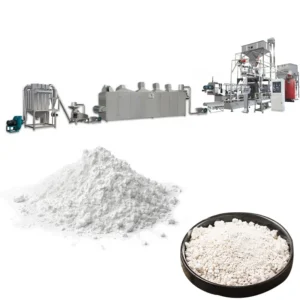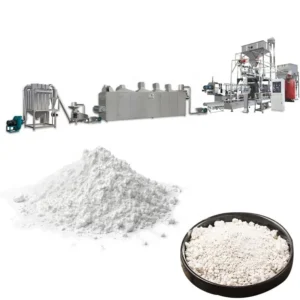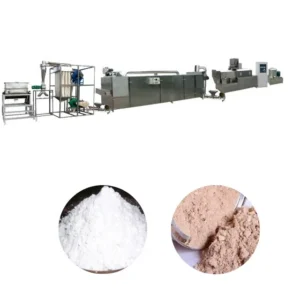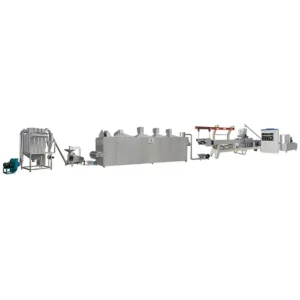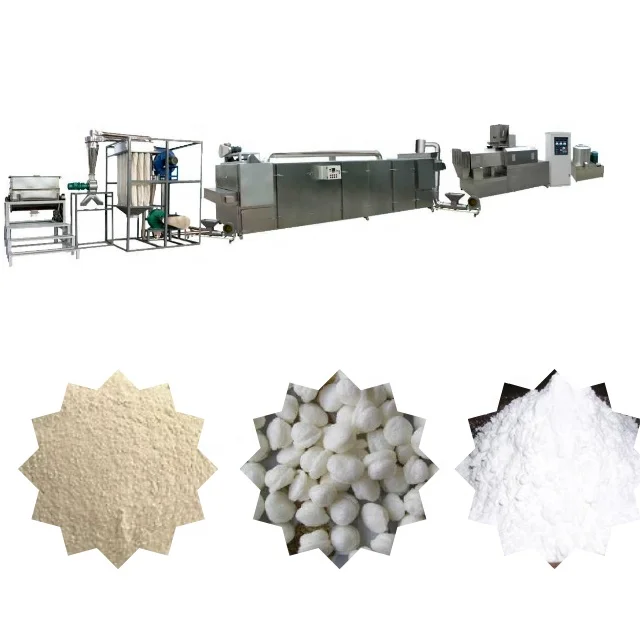
Integrated line throughput — Every station from the mixer through the packing end is capacity-matched so that no single unit chokes the output when processing starch at your target moisture and gelatinisation point.
Technical Specifications
| Parameter | Value |
|---|---|
| Product Type | Modified Starch Twin Screw Extrusion Line |
| Models Available | MT65, MT70, MT85 |
| Screw Configuration | Twin-screw, configuration matched to starch type |
| Line Sequence | Mixing → Extrusion → Drying → Grinding → Blending → Packing |
| MT65 Power Consumption | 60 kW |
| MT65 Output | 100–150 kg/h (basis not stated in source — confirm raw material / moisture / product type) |
| MT65 Overall Dimensions (L×W×H) | 24000 × 1200 × 2200 mm |
| MT70 Power Consumption | 80 kW |
| MT70 Output | 200–250 kg/h (basis not stated in source — confirm raw material / moisture / product type) |
| MT70 Overall Dimensions (L×W×H) | 26000 × 1500 × 2200 mm |
| MT85 Power Consumption | 145 kW |
| MT85 Output | 300–500 kg/h (basis not stated in source — confirm raw material / moisture / product type) |
| MT85 Overall Dimensions (L×W×H) | 29000 × 3500 × 4300 mm |
| Control System | Available with PLC or MCC control |
| Automation Level | High automation with intellectualized operation |
| Raw Materials Processed | Corn starch, cassava starch, potato starch, maize starch, tapioca starch, rice flour, corn flour, soybean flour |
| Certifications | CE, ISO |
Application Suitability
| Application | Material or Output |
|---|---|
| Food-grade modified starch production | Corn starch, potato starch, tapioca starch processed into pre-gelatinized starch for bakery and sauce applications |
| Industrial starch for textile sizing | Maize starch and cassava starch modified for warp yarn coating |
| Oil drilling fluid starch | Corn flour and maize starch extruded into drilling-grade starch with controlled viscosity |
| Paper coating and corrugation starch | Potato starch and tapioca starch modified for surface sizing and adhesive formulation |
| Nutritional and infant formula base | Rice flour and soybean flour processed into pre-gelatinized starch for instant porridge and weaning food |
Why Your Starch Type Changes the Whole Machine Conversation
A modified starch processing line equipment manufacturer quoting you a fixed capacity number before seeing your raw material is quoting blind.
The gelatinisation temperature and amylose ratio of your specific starch dictate screw speed, barrel zone temperatures, and die geometry — not the other way around.
I remember a project where a buyer sent a purchase order for a twin-screw line based on a spec sheet calibrated for corn starch. Their actual feedstock was cassava starch with a noticeably lower gelatinisation onset. On arrival, the barrel temperature profile had to be completely reworked and the screw elements rearranged before the line could produce anything close to specification. That delay cost them weeks of production time before a single saleable kilogram left the floor. [NEED_CITE: starch gelatinisation temperature ranges by botanical source]
When evaluating a modified starch processing line equipment manufacturer, the first question should always be whether they will run your actual material before the machine ships.
How Screw Geometry Responds to Different Starch Chemistries
Twin-screw extrusion works by forcing starch through a controlled shear and heat environment, breaking granule structure and re-forming it into a modified or pre-gelatinized state. The screw element sequence — conveying, kneading, and reverse-conveying sections — must be arranged to match the residence time your specific starch needs. A high-amylose corn starch requires longer dwell under shear than a waxy tapioca starch, and the die opening must be sized to control expansion accordingly. A modified starch processing line equipment manufacturer that ships a generic screw build will leave you adjusting parameters on the factory floor instead of producing from day one.
Matching Dryer and Grinder Capacity to the Extruder Output
The extruder is only one station in the sequence. If the dryer cannot remove moisture fast enough to keep up with the extruder discharge rate, wet product backs up and the entire line slows. Similarly, the grinder downstream must handle the throughput the dryer delivers in the particle size your end market demands. Each station on the MT65, MT70, and MT85 lines is specified so that the mixer feed rate, extruder throughput, dryer evaporation rate, and grinder capacity align. [NEED_CITE: industrial starch drying rate requirements for pre-gelatinized products]
Reading the Specification Sheet Beyond the Headline Numbers
The power consumption across the three line sizes ranges from 60 kW on the MT65 to 145 kW on the MT85, and these figures represent the total connected load across all stations. The MT65 footprint at 24 metres in length requires a straight-run workshop bay, while the MT85 at 29 metres with a 3.5-metre width and 4.3-metre height demands both floor space and overhead clearance for maintenance access. The twin-screw configuration is standard across all models, which matters because single-screw extruders struggle with the viscosity swings that different starch types introduce. The PLC and MCC control architecture allows operators to lock in barrel zone temperatures and screw RPM per recipe, reducing batch-to-batch variation when switching between, say, a corn starch run and a potato starch run on the same line.
The Hidden Cost of Skipping the Trial Run
When a line arrives at your facility and the screw configuration has never touched your actual raw material, you inherit the entire product development burden. Temperature profiles that worked on the supplier’s test material may overshoot or undershoot your starch’s gelatinisation window. Die openings calibrated for one expansion ratio may produce a product too dense or too porous for your specification. The rework cycle involves swapping screw elements, re-tuning barrel heaters, and re-testing until the output meets your quality standard — all while your downstream customers wait. [NEED_CITE: typical commissioning delays when extrusion lines are not pre-tested on buyer material]
What Distinguishes This Modified Starch Processing Line Equipment Manufacturer
Screw configuration and die design are specified to your raw material and target modified starch product rather than copied from a generic template. The in-house testing workshop runs trial batches on your actual starch before the line is cleared for shipment, so you receive a trial run report alongside the hardware. Every station — mixer, extruder, dryer, grinder, blender, and packing — is sourced and balanced under one supplier, eliminating the throughput mismatches that arise when stations are assembled from separate vendors. Voltage, frequency, and control language are confirmed against your site conditions before production begins, avoiding commissioning delays caused by incompatible electrical supply. Wear parts including screws and dies are documented in a dedicated list, with recommendations for two to three years of operation based on your projected run hours.
Documentation & Verification
- Line layout and capacity calculation verified against your specific starch type and target moisture content
- Screw and die configuration record matched to your raw material and final product specification
- Electrical schematic with voltage and frequency confirmed for your local power supply before production
- Trial run report produced on your starch sample in the testing workshop before shipment
- CE declaration of conformity and ISO certificate included with every line dispatch
- Wear parts list with recommended spare quantities covering two to three years of operation
Installation, Commissioning & Support
- Floor plan review confirming the MT65, MT70, or MT85 footprint fits your workshop bay length and overhead clearance
- Dedicated power circuit sized to the line’s total connected load, from 60 kW up to 145 kW depending on model
- Barrel zone temperature profiles and screw RPM settings established during on-site commissioning with your raw material
- Operator training covering PLC and MCC interface navigation, recipe storage, and alarm response procedures
- Spare screw elements and die plates staged on site before the first scheduled wear-part changeover
- Scheduled maintenance intervals documented for dryer heat exchanger cleaning and grinder screen replacement
What to Prepare Before Requesting a Quotation
To size the right line and configure the screw geometry accurately, we need to know your starch botanical source, the target modification type, and your planned daily output. Share your local voltage and frequency standard so the electrical package can be specified before production starts. If you have an existing packing system or upstream storage silo, provide the interface dimensions so the line endpoints can be matched. Sending a raw material sample for a trial run in the testing workshop allows us to verify output capacity and product quality before the quotation is finalised.
Frequently Asked Questions
Q: How is the output capacity verified against my specific starch raw material and moisture level?
A: We run your actual starch sample in the in-house testing workshop using the screw configuration and barrel temperature profile intended for your line. The trial produces a documented report showing achievable throughput and product quality on your material, so the capacity figure in your quotation reflects real conditions rather than a generic baseline.
Q: What voltage, frequency, and control language options are available for my target market?
A: The electrical package is configured to your local supply standard before production begins. Voltage and frequency are confirmed during the specification stage, and the PLC interface language is set to your operator preference. This confirmation step prevents commissioning delays caused by mismatched power supply or unintelligible control screens.
Q: How do I choose the right line size based on my production target?
A: The MT65, MT70, and MT85 span different power and footprint envelopes. Selection depends on your target output verified against your actual raw material, your available workshop length, and your electrical infrastructure capacity. We review these factors during the proposal stage and recommend the model that matches your throughput requirement without oversizing.
Q: What screw configuration and die design will be specified for my modified starch product?
A: The screw element sequence and die geometry are determined by your starch type, target modification, and desired product density. A configuration record is produced for your line and included in the documentation package, so you have a reference for future wear-part replacements and product changeovers.
Q: Which spare wear parts are included, and what is recommended for the first few years of operation?
A: Each line ships with a matched set of wearing parts. The wear parts list details screw elements, die plates, and grinder screens, with recommended spare quantities calculated for two to three years of operation based on your projected annual run hours and material abrasiveness.