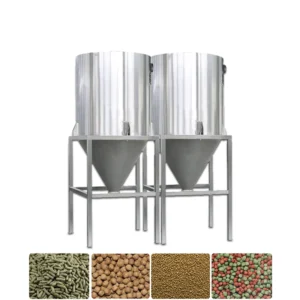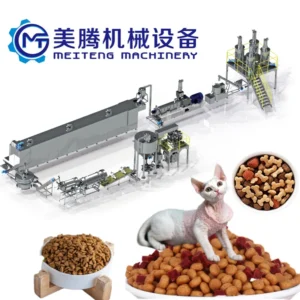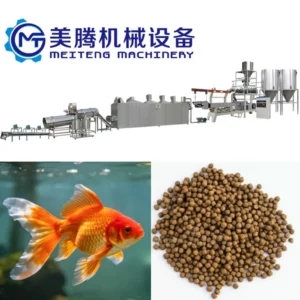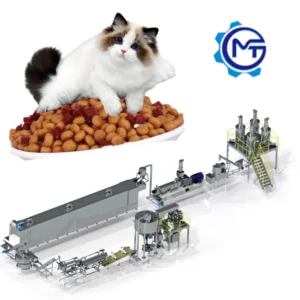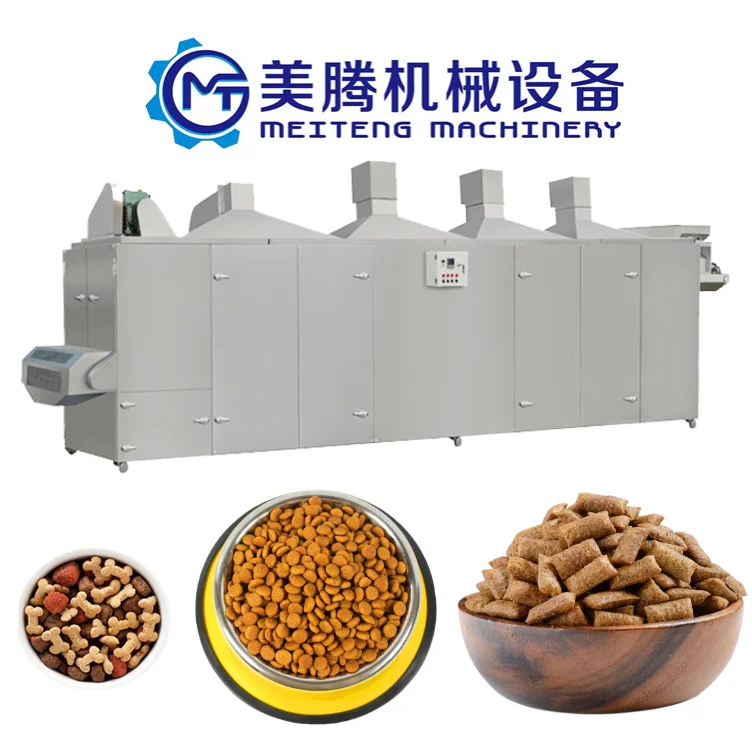
Matched Throughput Across All Stations — Every MT85 station from the mixer to the packer is sized so that no single unit bottlenecks the pet food processing line equipment for sale, keeping actual output aligned with your formula and kibble target.
Technical Specifications
| Parameter | Value |
|---|---|
| Model | MT85 |
| Product Type | Pet Food Processing Line |
| Output Capacity | 500 kg/h (basis not stated in source — confirm raw material, moisture content, kibble size) |
| Rated Power | 45 kW |
| Voltage & Frequency | 380V 50Hz Three Phase (configurable for export markets) |
| Control System | PLC and MCC available |
| Screw Type | Twin-screw |
| Automation Level | Full automation from batching to packaging |
| Line Stations | Raw material mixing, extrusion, drying, flavouring, packaging |
| Construction Material | Food-grade contact materials throughout |
| Product Formats | Dry kibble, semi-moist pet food, pet treats |
| Standards | CE, FDA, ISO certified |
Application Suitability
| Application | Material or Output |
|---|---|
| Dry kibble for dogs and cats | Corn, poultry meal, fish meal, grain blends |
| Semi-moist pet food | High-meat-content formulas with humectants |
| Small-breed kibble and treats | Fine die openings, lower expansion targets |
| Aquatic-adjacent pet treats | Starch-protein blends requiring controlled density |
| Prescription and functional diets | Heat-sensitive additives introduced post-extrusion |
Why "500 kg/h" Means Nothing Without the Raw Material
The stated capacity only holds when your formula, moisture level, and kibble geometry match the test basis.
I once watched a customer receive a twin-screw line rated for a certain throughput, only to find their actual recipe — higher protein, lower starch — cut real output nearly in half. The screw configuration and die plate had been copied from a generic build, and the dryer was sized for a volume the extruder could no longer sustain. That mismatch is the most common reason pet food processing line equipment for sale disappoints after installation. When raw material behaviour is not confirmed before shipment, the entire line becomes an expensive experiment [NEED_CITE: common causes of extrusion line underperformance in pet food manufacturing].
Matching Dryer and Coating Stations to Real Extruder Output
An extruder does not run in isolation. If the dryer cannot handle the moisture load that your specific recipe introduces, kibble exits with residual water and spoils in the bag. The MT85 line pairs each station so that drying residence time and coating drum volume reflect the actual throughput your formula produces, not a catalogue maximum.
How Screw Profile and Die Geometry Shape the Kibble
The twin-screw configuration on the MT85 allows operators to adjust shear, residence time, and compression along the barrel. Different screw element arrangements — conveying, kneading, reverse-flight — change how starch gelatinises and protein denatures inside the barrel. The die plate then controls expansion ratio and kibble density. When these are specified to your raw material rather than copied from a standard build, the pet food processing line equipment for sale produces the texture and sink-float behaviour your market expects [NEED_CITE: twin-screw element arrangement effects on extruded pet food density].
Reading the Specs That Actually Matter
The 45 kW rated power determines how much mechanical energy the screws can deliver to the product, directly influencing gelatinisation degree and expansion. The 380V 50Hz three-phase supply must match your facility’s electrical infrastructure; running this machine on a different voltage or frequency alters motor speed and heating profiles. The PLC and MCC control system gives operators repeatable batch parameters — barrel temperature zones, screw speed, feeder rate — so that the first bag and the ten-thousandth bag are identical. Food-grade contact materials at every product-touching station prevent contamination across formula changes.
The Cost of Skipping a Pre-Shipment Trial
Lines shipped without a trial run on the buyer’s actual material arrive with screw and die settings that reflect the manufacturer’s test recipe, not yours. Commissioning then becomes product development — weeks of adjusting barrel temperatures, swapping screw elements, and resizing dryer belts while raw material sits on the warehouse floor. Every day spent tuning is a day without saleable output [NEED_CITE: financial impact of post-installation commissioning delays in food extrusion].
Why Buyers Specify the Full Line Here
Every station — mixer, extruder, dryer, flavouring drum, cooler, packer — is sourced under one supplier, so throughput calculations are coordinated rather than left to the buyer to reconcile across separate vendors. Screw and die configurations are built around your raw material and target kibble, not pulled from a generic template. The in-house testing workshop runs your formula before the line ships, confirming capacity, expansion, and density. Electrical schematics and voltage are confirmed for your market before production begins. Wear parts lists and maintenance schedules are delivered with the machine so that the first screw or die replacement does not halt production.
Documentation & Verification
- Machine specification sheet listing capacity range and utility requirements for each MT85 station
- Line layout drawing showing throughput matching between extruder, dryer, and packer
- Electrical schematic with voltage and frequency confirmed for your destination market
- Factory test record from the in-house testing workshop using your raw material
- CE declaration of conformity and ISO certificate included with shipping documents
Installation, Commissioning & Support
- Foundation and floor-load plan reflecting the 45 kW extruder and full-line footprint
- Dedicated three-phase circuit layout matching confirmed voltage and frequency
- On-site mechanical assembly and belt alignment for dryer and conveying stations
- First-run parameter logging — barrel zones, screw speed, feeder rate — saved in PLC
- Operator training on die changes, screw element swaps, and HMI language settings
- Wear parts kit with spare screws and dies sized to your formula’s abrasion profile
What to Include in Your Inquiry
To size each station correctly, share your target kibble format, raw material composition, and moisture content. Confirm your facility’s available voltage, frequency, and control language preference. If you have existing upstream mixers or downstream packing equipment, note their throughput so the MT85 pet food processing line equipment for sale can be matched to your current floor layout.
Frequently Asked Questions
Q: How do I match dryer capacity to the extruder output on this line?
A: Dryer sizing depends on the moisture your recipe introduces and the residence time needed to reach safe packaging levels. We calculate dryer belt length and airflow based on trial-run data from your raw material, not on a generic throughput figure, so that kibble exits within your target moisture range.
Q: What supporting stations are available beyond the extruder?
A: The full range includes raw material mixing and batching systems, screw conveyors, multi-layer dryers, rotating flavouring drums, cooling conveyors, and automated packing stations. Each is selected to match the MT85 extruder output so no single station bottlenecks the line.
Q: How do I choose the right extruder model for my kibble format?
A: Selection starts with your target kibble size, density, and formula composition. The MT85 twin-screw configuration handles a wide range of starch-to-protein ratios, but if your recipe demands very high meat content or unusual expansion targets, a different barrel diameter or screw profile may suit better.
Q: What voltage and frequency options are available for export markets?
A: The standard configuration is 380V 50Hz three-phase, but voltage and frequency are confirmed during the quotation stage to match your facility’s electrical supply. Control panel labelling and HMI language are set to your specification before shipment.
Q: How does modular station design affect maintenance?
A: Food-grade contact parts on the MT85 — screws, die plates, dryer belts, flavouring drum liners — are designed for removal without full-line disassembly. This reduces cleaning downtime between formula changes and lets operators replace wear components using standard tools.