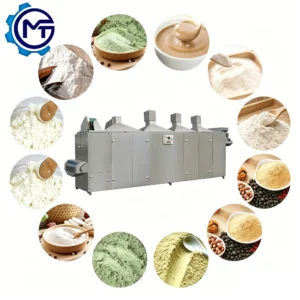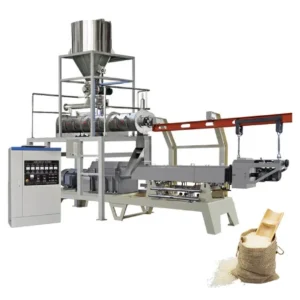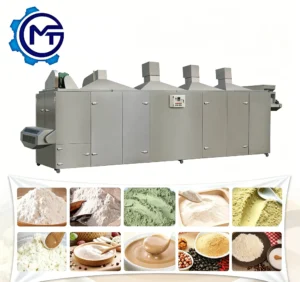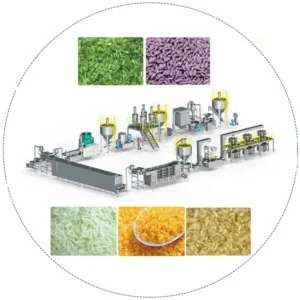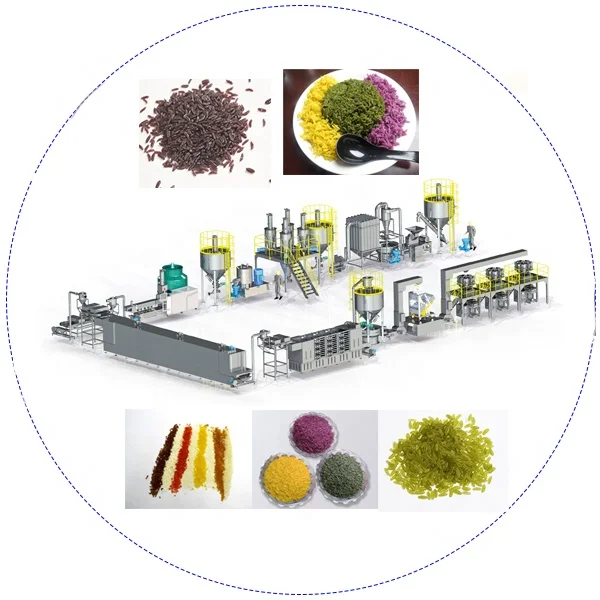
Complete Station Matching — throughput across mixing, extrusion, drying, and packing is calculated together so no single station bottlenecks the nutritional rice line.
Technical Specifications
| Parameter | Value |
|---|---|
| Model | MT65 / MT70 / MT85 / MT75 / MT95 |
| Product Type | Fortified Rice Extrusion Machine |
| Screw Type | Twin-screw extruder |
| Output Capacity (MT65) | 80-100 kg/h (basis not stated in source — confirm raw material / moisture content) |
| Output Capacity (MT70) | 100-120 kg/h (basis not stated in source — confirm raw material / moisture content) |
| Output Capacity (MT85) | 200-300 kg/h (basis not stated in source — confirm raw material / moisture content) |
| Output Capacity (MT75) | 300-500 kg/h (basis not stated in source — confirm raw material / moisture content) |
| Output Capacity (MT95) | 800-1000 kg/h (basis not stated in source — confirm raw material / moisture content) |
| Rated Power (Installed) | 85 kW (MT65) / 120 kW (MT70) / 235 kW (MT85) / 180 kW (MT75) / 260 kW (MT95) |
| Power Consumption | 60 kW (MT65) / 85 kW (MT70) / 165 kW (MT85) / 135 kW (MT75) / 195 kW (MT95) |
| Overall Dimensions (L×W×H) | 28×1.2×2.2 m (MT65) / 30×1.5×2.2 m (MT70) / 34×3.5×4.3 m (MT85) / 32×3.5×4.3 m (MT75) / 36×3.5×4.3 m (MT95) |
| Control System | Frequency speed control, automated |
| Heating System | Equipped (extruding system) |
| Drying Oven Heating Source | Electric or gas |
| Line Stations | Mixing, Extruding, Vibrating, Low temperature drying, Cooling, High temperature roasting, Cooling, Packing |
| Assembly State | Complete processing line |
| Certification | CE |
Application Suitability
| Application | Material or Output |
|---|---|
| Nutritional Fortified Rice Production | Rice flour, corn, millet, and oat blends with added vitamins and minerals |
| Artificial Rice Kernel Processing | Broken rice, rice bran, and starch reconstituted into uniform grain shapes |
| Multigrain Fortified Rice Formats | Buckwheat, wheat, and bean mixes targeted at nutrition programme specifications |
| Grain Product Diversification | Cereal producers expanding into vitamin-enriched rice kernel formats |
What "Rated Capacity" Means When Your Premix Changes Everything
A capacity figure only holds true on the exact raw material and moisture level used to measure it.
I have watched a nutritional powder processing line run smoothly during factory trials on standard rice flour, then stall completely when the buyer switched to a high-fiber buckwheat and bran premix back at their own facility. The extruder barrel pressure spiked, the die blocked, and the downstream dryer could not keep up with the irregular output. [NEED_CITE: twin-screw extrusion behavior on high-fiber grain formulations] Selecting a Fortified Rice Extrusion Machine full equipment range requires validating every station against your actual ingredient list, not a generic test formula.
Barrel Zones and Screw Segments Dictate Gelatinisation
The twin-screw extruder in this line uses multiple heating zones along the barrel, each independently controlled. Starch gelatinisation in rice-based formulations demands a precise temperature gradient — too low and the kernels remain brittle after drying, too high and the vitamins degrade before the product even reaches the die. Frequency speed control adjusts screw rotation to match material viscosity, keeping residence time consistent even when the premix includes coarse bran particles that resist flow.
Die Geometry Controls Kernel Density and Cooking Behavior
The die plate determines the final shape and internal density of each fortified rice kernel. A dense kernel survives transport and storage but takes longer to cook at the consumer end, while a lighter, more expanded kernel rehydrates quickly but may fracture during packing and handling. The die design and screw configuration must be specified together against the buyer’s target rehydration time and nutritional density. [NEED_CITE: die design influence on extruded rice kernel cooking properties] This is where a Fortified Rice Extrusion Machine full equipment range proves its value — the extruder output must align with the vibrating conveyor speed and the low-temperature drying cycle.
Reading the Power and Dimension Data Correctly
The installed power ranges from 85 kW on the MT65 to 260 kW on the MT95, while actual consumption sits lower — 60 kW to 195 kW respectively — reflecting the difference between peak motor draw and steady-state operation. Buyers planning electrical infrastructure should design for installed capacity with adequate headroom, not average consumption. The line footprint stretches from 28 meters for the smallest configuration to 36 meters for the MT95, with width expanding from 1.2 meters to 3.5 meters as supporting stations scale up. These dimensions determine workshop layout, utility routing, and maintenance access corridors.
When Stations Are Mismatched, the Line Chokes
A common failure mode in grain extrusion projects is an extruder rated for a certain throughput feeding into a dryer that cannot remove moisture fast enough. The result is a backlog of semi-dried kernels accumulating on the vibrating conveyor, sticking together and blocking the cooling stage. [NEED_CITE: throughput mismatch consequences in food extrusion lines] This is why the Fortified Rice Extrusion Machine full equipment range specifies each station — mixing, extruding, vibrating, low-temperature drying, cooling, high-temperature roasting, second cooling, and packing — as a matched set rather than independent selections.
Procurement Advantages Grounded in Process Matching
Each line configuration is calculated so the extruder throughput balances with dryer belt speed and roasting chamber capacity, eliminating bottlenecks before they occur. Screw configuration and die design are specified against the buyer’s raw material formulation, not copied from a standard build. An in-house testing workshop runs trial production on the customer’s actual premix before shipment, revealing density and expansion issues early. Twin-screw expertise covers the full range of grain and starch behaviors encountered in fortified rice production. Pre-sales consultation extends through engineer design, on-site installation, commissioning, and operator training.
Documentation & Verification
- Line layout and capacity calculation showing throughput at mixing, extrusion, drying, and packing stations
- Screw and die configuration record matched to your grain premix and target kernel density
- Trial run report produced on your raw material in the testing workshop before dispatch
- Electrical schematic with voltage and frequency confirmed for your facility’s power supply
- CE declaration of conformity covering the complete processing line
- Operation and maintenance manual with wear parts list for screws, dies, and dryer belts
Installation, Commissioning & Support
- Foundation requirements calculated from the 28 to 36-meter line length and station weights
- Dedicated electrical circuits sized for 85 to 260 kW installed capacity depending on model selected
- Modular station delivery with assembly sequence planned to fit workshop access constraints
- First-run parameter setting covering barrel temperatures, screw speed, and dryer belt timing
- Operator training on frequency speed control adjustments for different premix formulations
- Wear parts supply covering screws, dies, and mesh belts with replacement schedules documented
What We Need to Configure Your Line
Provide your raw material formulation including grain types, fiber content, and added micronutrients so we can specify screw configuration and die geometry. Confirm your target daily output, workshop dimensions, and ceiling height for line layout planning. Specify local voltage and frequency standards, preferred control language, and whether electric or gas heating suits your dryer.
Frequently Asked Questions
Q: How is output capacity verified against specific raw material formulations?
A: Capacity figures in the specification table are measured on reference materials. Before shipment, we run your actual grain premix through the extruder in our testing workshop, recording barrel pressure, screw speed, and kernel density to confirm achievable throughput on your specific formulation.
Q: What supporting stations are included and how is throughput matched?
A: The line covers mixing, extruding, vibrating, low-temperature drying, cooling, high-temperature roasting, a second cooling stage, and packing. Each station is sized so its processing rate matches the extruder output, preventing material backlog or idle time at any point.
Q: Which dryer heating source suits different production environments?
A: Electric heating offers precise temperature control and simpler installation where power infrastructure is reliable. Gas heating reduces operating costs in regions with affordable natural gas supply and is often preferred for the high-temperature roasting stage where larger thermal input is required.
Q: How are screw configuration and die design selected for kernel density?
A: Screw element arrangement and die aperture geometry are chosen based on your target kernel rehydration time, nutritional density per gram, and mechanical strength for transport. Trial runs on your premix validate these selections before the line ships.
Q: What documentation supports line commissioning and operator training?
A: You receive a line layout with capacity calculations, electrical schematics, a screw and die configuration record, a trial run report on your material, an operation manual, and a wear parts list. On-site commissioning includes parameter setting and operator instruction.