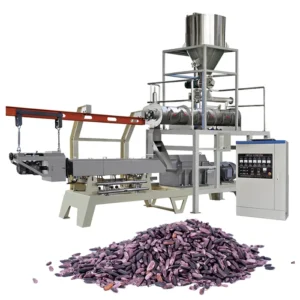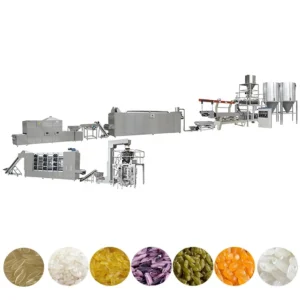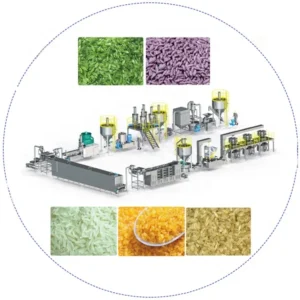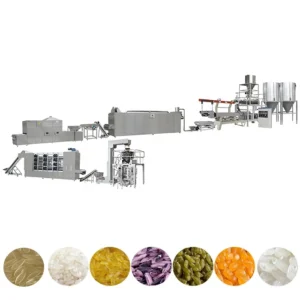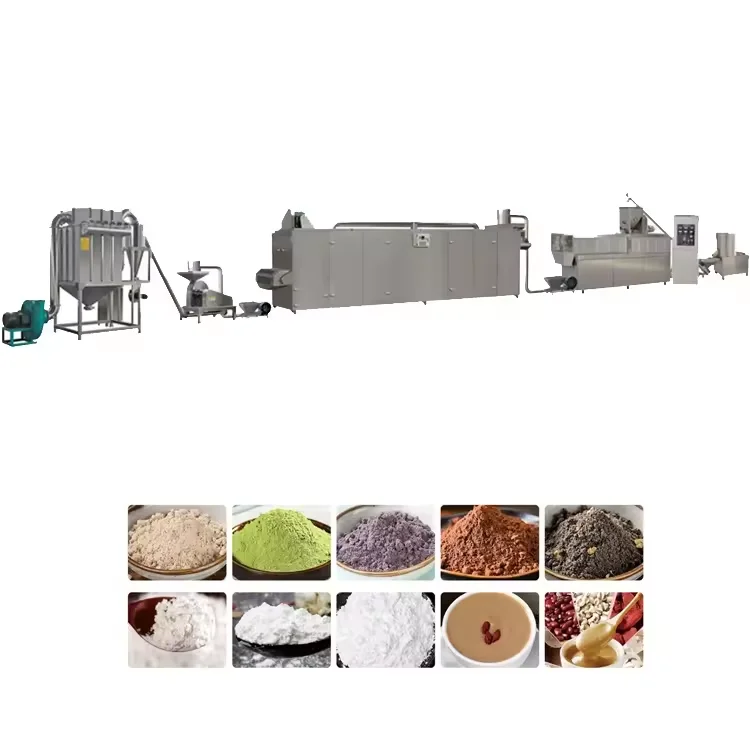
Complete Station Matching — throughput at every stage is calculated against the extruder’s actual output on your raw material, not pulled from a generic catalogue.
Technical Specifications
| Parameter | Value |
|---|---|
| Product Type | Nutritional Powder Processing Line |
| Models Available | MT65 / MT70 / MT75 / MT85 |
| Screw Type | Twin-screw |
| Installed Power (MT65) | 84 kW |
| Installed Power (MT70) | 160 kW |
| Installed Power (MT75) | 190 kW |
| Installed Power (MT85) | 210 kW |
| Power Consumption (MT65) | 59 kW |
| Power Consumption (MT70) | 120 kW |
| Power Consumption (MT75) | 140 kW |
| Power Consumption (MT85) | 150 kW |
| Output Capacity (MT65) | 120–150 kg/h (basis not stated in source — confirm raw material / moisture content) |
| Output Capacity (MT70) | 150–200 kg/h (basis not stated in source — confirm raw material / moisture content) |
| Output Capacity (MT75) | 200–250 kg/h (basis not stated in source — confirm raw material / moisture content) |
| Output Capacity (MT85) | 300–400 kg/h (basis not stated in source — confirm raw material / moisture content) |
| Overall Dimensions (MT65) | 20000 × 1500 × 2200 mm |
| Overall Dimensions (MT70) | 21000 × 1500 × 2200 mm |
| Overall Dimensions (MT75) | 23000 × 1500 × 3200 mm |
| Overall Dimensions (MT85) | 25000 × 1500 × 3500 mm |
| Voltage | 380V 50Hz Three Phase Standard |
| Mixer Contact Material | 304 Stainless Steel |
| Mixer Batch Capacity | 20–30 kg / 70–80 kg / 170–180 kg per batch |
| Mixer Power Options | 4 kW / 7.5 kW / 15 kW |
| Pulse Crusher Power | 11 kW |
| Pulse Crusher Capacity | ~200 kg/h (basis not stated in source — confirm material and mesh size) |
| Pulse Crusher Dimensions | 3000 × 900 × 2200 mm |
| Drying Oven Heating Options | Fuel / Gas / Electricity |
| Standards | CE certified, ISO certified |
Application Suitability
| Application | Material or Output |
|---|---|
| Baby food supplement and infant formula powder | Rice flour, corn flour, wheat flour blends with vitamin and mineral premixes |
| Fortified and artificial rice production | Grain flour feedstock shaped and dried into rice-like granules |
| Functional and nutritional health food powder | Corn grits, oat flour, and multigrain blends for dietary supplements |
| Starch-based functional food processing | Modified and pregelatinised starch from various grain sources |
Why the "Output per Hour" Number Means Nothing Without Your Raw Material
Every capacity figure in a nutritional powder processing line equipment spec sheet is tied to a specific formulation and moisture content.
I remember a buyer who invested in a nutritional powder line sized for standard corn flour. When his team switched to a fortified recipe loaded with milk powder and vitamin premix, the gelatinisation degree dropped far below target and the entire first batch was scrapped. The extruder was never the problem — the line had simply been configured for a different feedstock. [NEED_CITE: how raw material composition affects extrusion gelatinisation and product density] That is why the output ranges listed above for the MT65 through MT85 carry a note: confirm the basis with your actual raw material before treating any number as a production guarantee.
From Flour Infeed to Final Pack — Every Station Sized to the Line
A nutritional powder processing line equipment package is only as reliable as its weakest station. The sequence here runs from flour mixing through twin-screw extrusion, drying, pulse crushing, and packing. Each station is specified so that the mixer batch cycle, the dryer residence time, and the crusher throughput all align with the extruder model you select. If the dryer cannot handle the moisture load coming off the barrel, product backs up and consistency suffers.
Drying and Crushing Configuration That Follows Your Product Spec
The drying oven is configurable in layer count, belt length, and heating source — fuel, gas, or electricity — depending on the moisture reduction your formulation requires. After drying, the pulse crusher reduces the extrudate to the target mesh size for powder packing. [NEED_CITE: typical moisture targets for shelf-stable nutritional and infant formula powders] Choosing the wrong dryer length or crusher screen can push your final powder outside the particle size range your market expects, even when the extruder itself is performing correctly.
Reading the Numbers That Actually Matter for Your Line
The twin-screw configuration on the MT65 through MT85 range is fundamental to nutritional powder work. Twin-screw extruders handle high-moisture and multi-component blends more predictably than single-screw units because the intermeshing screws provide self-wiping action and more uniform shear. Installed power steps up from 84 kW on the MT65 to 210 kW on the MT85, reflecting the additional barrel volume and screw torque required at higher throughputs. The 304 stainless steel contact surfaces on the mixer meet food-grade requirements for infant formula and supplement production. Mixer batch capacity options — from 20 kg to 180 kg per batch — let you match the mixing cycle to the extruder feed rate so the barrel never starves or overflows.
The Hidden Cost of a Mismatched Downstream Station
Buying an extruder rated for your target output and then pairing it with an undersized dryer is one of the most common mistakes in this category. The line appears to run at capacity during the first hour, then moisture builds up in the drying chamber, residence time extends, and powder colour and solubility drift outside specification. [NEED_CITE: consequences of undersized drying capacity in extrusion-based powder lines] Operators start reducing extruder feed rate to compensate, which means you are effectively running a smaller line than the one you paid for. The pulse crusher faces a similar problem: if its screen and motor are not matched to the dried extrudate volume, you get inconsistent particle size that fails downstream sieving.
What This Supplier Brings to the Table
Every station from mixing to packing comes from a single manufacturer, so throughput matching is calculated before the line ships rather than discovered during commissioning. Screw configuration and die design are specified to your raw material and target product rather than copied from a generic build. An in-house testing workshop allows trial runs on your actual formulation before the equipment leaves the factory, so you see real output data — not catalogue estimates. The twin-screw expertise covers pet food, aquatic feed, snacks, cereals, starch, and protein applications, meaning the engineering team has encountered a wide range of formulation behaviours. Pre-sales consultation extends through engineer design, on-site installation, commissioning, and ongoing maintenance support.
Documentation & Verification
- Line layout and capacity calculation confirming every station matches the selected extruder model
- Machine specification sheet with screw and die configuration recorded against your raw material
- Electrical schematic and voltage confirmation for your local 380V or alternative standard
- Trial run report on your actual formulation before shipment from the testing workshop
- CE declaration of conformity and ISO certificate in electronic edition for export clearance
- Operation and maintenance manual with wear parts list specific to your extruder model
Installation, Commissioning & Support
- Floor plan with overall dimensions from 20 m to 25 m length verified against your workshop space
- Dedicated three-phase circuit rated for up to 210 kW installed power on the MT85 configuration
- Drying oven heating source — fuel, gas, or electricity — confirmed before installation to match your utility supply
- First-run parameter setting on your raw material with screw speed, barrel temperature, and feed rate recorded
- Operator training covering mixer batch loading sequence, extruder barrel zone monitoring, and crusher screen changes
- Wear parts list including screws, dies, and crusher screens stocked for your specific model
What to Prepare Before Requesting a Quote
To size a nutritional powder processing line equipment package correctly, we need your target formulation with ingredient ratios and expected moisture content at each stage. Share your daily or shift-based production target so the right extruder model and mixer batch capacity can be selected. Let us know your local voltage and frequency standard, the preferred control language for the operator interface, and whether you want to send raw material for a trial run before shipment.
Frequently Asked Questions
Q: How is output capacity verified for my specific formulation?
A: Output figures for each model are based on reference materials. Before we confirm a capacity number for your line, we run your actual raw material in the testing workshop. The trial run report documents real throughput, gelatinisation degree, and powder quality, so the number you receive reflects your formulation rather than a generic benchmark.
Q: What voltage, frequency, and control language options are available?
A: The standard configuration is 380V 50Hz three-phase, but the electrical schematic is confirmed against your local supply before production. Control language and interface labelling are set to match your operator team’s requirements, preventing commissioning delays caused by mismatched documentation or display settings.
Q: Which extruder model fits my production target?
A: The MT65 through MT85 range covers multiple throughput tiers. Model selection depends on your confirmed raw material, target output per shift, and available workshop footprint. We match the extruder with a correspondingly sized mixer, dryer, and crusher so no single station creates a bottleneck in the nutritional powder processing line equipment package.
Q: How are the drying oven specifications determined for my product?
A: Layer count, belt length, and heating source are selected based on the moisture reduction your formulation requires and the extruder output rate. Fuel, gas, or electric heating is chosen according to your facility’s available utilities. Getting this right ensures consistent powder solubility and colour across every production run.
Q: Can I send my raw material for a trial run before the line ships?
A: Yes. The in-house testing workshop accepts customer raw material for pre-shipment trials. We document output rate, product texture, and powder particle size in a trial run report. This step catches formulation issues early, so product development work happens before installation rather than during commissioning on your factory floor.