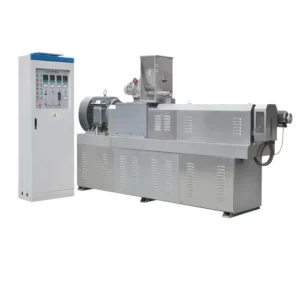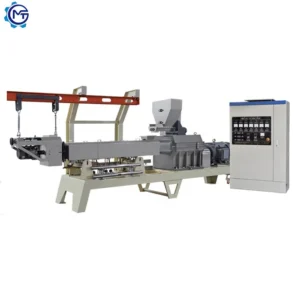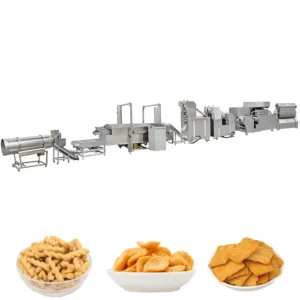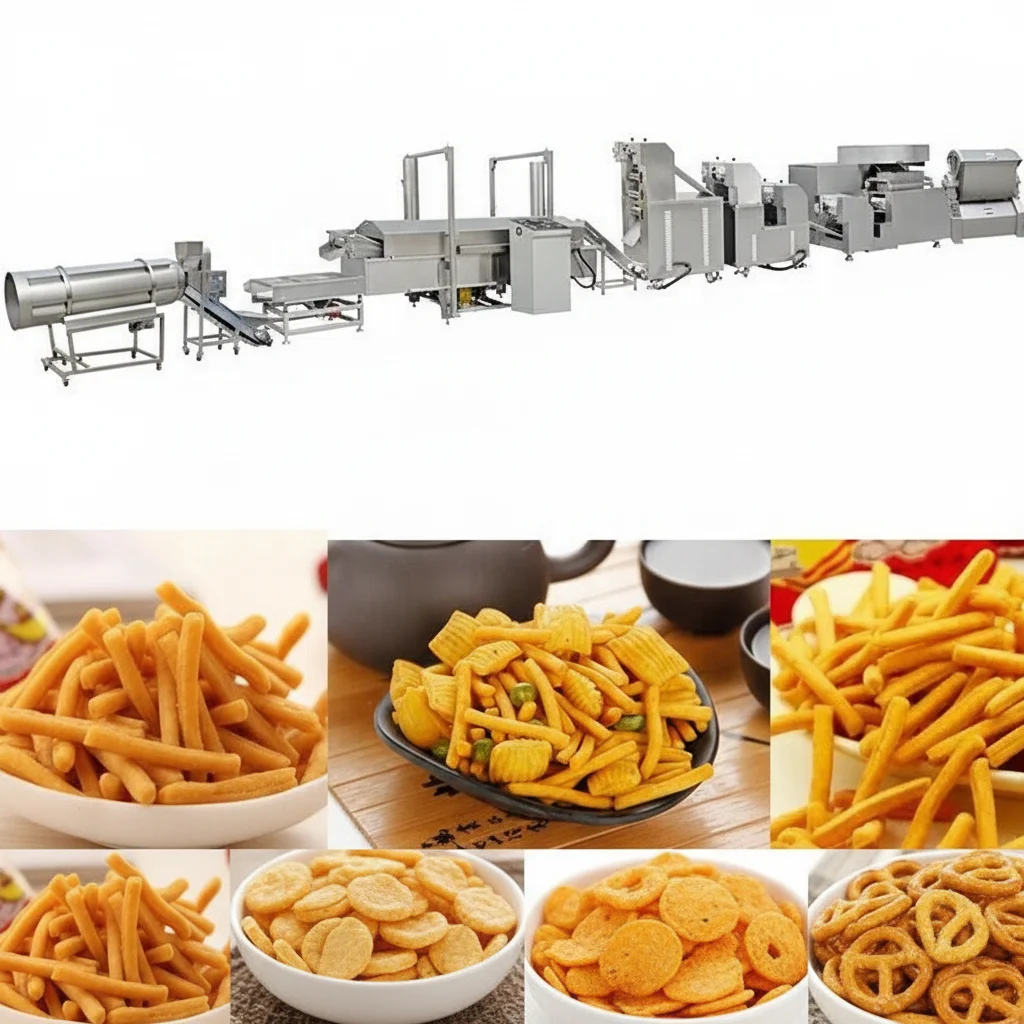
Single-Source Line Matching — Every station from mixing through extrusion, frying and cooling is sized against the same raw material throughput, avoiding the mismatch that plagues multi-vendor setups.
Technical Specifications
| Parameter | Value |
|---|---|
| Model | MT100 / MT120 |
| Product Type | Puffing Snack & Rice Crust Frying Production Line |
| Extruder Type | Single-screw extruder |
| Raw Materials | Wheat flour, corn starch, potato starch |
| Output Capacity | 120 kg/h (basis not stated in source — confirm raw material blend and moisture content) |
| Total Power (Electric) | approx. 100 kW |
| Total Power (Gas / Diesel) | approx. 50–60 kW |
| Voltage & Frequency | Three-phase 380V/50Hz; single-phase 220V/50Hz (customizable to local supply) |
| Control System | PLC controlled |
| Overall Dimensions (L×W×H) | 12,000–26,000 × 1,200 × 2,200 mm |
| Material of Construction | Food-grade stainless steel 201 / 304 |
| Energy Options | Electricity / gas / diesel / steam |
| Motor Brand | Siemens (China) or China top brand; inverter by Delixi or Delta |
| Standards | CE, ISO 9001 |
Application Suitability
| Application | Material or Output |
|---|---|
| Secondary-puffing fried snacks | Bugles, rice crust, golgappa / pani puri from wheat flour and starches |
| Tubular and ring-shaped chips | Screw shell, round tube, square tube, cartoon shapes via die change |
| Street-food format scale-up | Continuous automatic frying of pani puri shells replacing batch fryers |
| Snack distributor turnkey supply | Complete frying chips making machine line for end-user factory installation |
What "120 kg/h" Really Means for a Frying Chips Making Machine Manufacturer
The number on the nameplate only holds if your exact flour-to-starch ratio and moisture content were used to set it.
When I ran after-sales across Latin America, I watched a rice crust line in Chile produce two full batches of dark, oil-soaked scrap because the buyer ordered on sample capacity alone. The actual rice flour moisture ran higher than the test standard, throwing off fryer temperature and conveyor timing together. A snack frying production line for sale at a stated throughput means nothing until the supplier runs your specific formulation through the extruder and fryer as a matched set. [NEED_CITE: raw material moisture impact on extrusion and frying consistency]
Every Station in One Frying Line Under a Single Supplier
A typical secondary-puffing snack line passes product through mixing, single-screw extrusion, pulling and cutting, frying, flavouring and cooling. On this frying chips making machine line, each station is specified together rather than sourced from separate vendors and bolted on later. The pulling and cutting unit is timed to extruder output, and the automatic fryer length is matched to the belt load so product does not pile up or starve the oil bath.
How the PLC Keeps Shape Changes Repeatable
The PLC-controlled extrusion system stores screw speed, barrel zone temperature and die pressure for each product format. When the operator switches from bugles to rice crust, the saved profile brings the single-screw extruder back to the same shear and expansion conditions batch after batch. This matters for a snack frying production line for sale where a slight density shift in the extruded piece changes how much oil it absorbs downstream. [NEED_CITE: PLC recipe management in food extrusion lines]
Reading the Specs That Actually Shape Output
The single-screw extruder here relies on barrel residence time and screw pitch to gelatinise starch. Wheat flour and potato starch behave differently under heat and shear, so the screw configuration must match the blend the buyer will actually run. The die opening controls wall thickness of tubes and rings, which in turn determines whether the fryer produces a crisp shell or a dense, oily piece. Energy input across the line is selectable among electricity, gas, diesel and steam, letting the buyer route the cheapest available fuel to the fryer while keeping electric drives on the extruder and conveyor. The food-grade stainless steel 201/304 contact surfaces resist the corrosive salts carried over from flavouring drums during daily washdown.
The Cost of Skipping the Station-Matching Step
Buyers who source the extruder and fryer separately often discover the fryer cannot hold the extruder’s peak output, creating a backlog of half-dried pieces that stick together and jam the belt. I have seen lines where the flavouring drum was undersized for the fryer discharge rate, forcing the operator to throttle the entire line back. The result is a frying chips making machine setup that never reaches its paid-for capacity and burns extra energy per kilogram of finished product. [NEED_CITE: throughput bottleneck between extrusion and frying stages]
Why Source This Line From One Equipment Range
This snack frying production line for sale keeps every station — mixer, screw conveyor, single-screw extruder, pulling and cutting machine, automatic fryer, flavouring line and cooling — under one engineering responsibility so throughput figures align. Screw and die configurations are written to the buyer’s actual flour and starch blend, not copied from a generic build. The in-house testing workshop runs the buyer’s raw material before shipment, producing a trial report that confirms product shape, expansion and fryer behaviour. Voltage, frequency and PLC language are locked in during the specification stage so commissioning does not stall on a mismatched control panel. The CE and ISO 9001 framework covers the full assembly rather than individual machines bolted together after delivery.
Documentation & Verification
- Line layout drawing showing matched throughput at each station from mixer to cooler
- Screw and die configuration record tied to your flour and starch formulation
- Electrical schematic with confirmed voltage, frequency and PLC language per station
- Trial run report on your raw material from the in-house testing workshop
- Factory test record covering extruder output, fryer temperature profile and flavouring coverage
Installation, Commissioning & Support
- Floor plan for the 12,000–26,000 mm line length with utility drop points marked before foundation work
- Dedicated three-phase 380V/50Hz circuit sized for the approx. 100 kW electric load
- Station-by-station assembly sequence so the single-screw extruder is levelled before fryer connection
- First-run parameter setting for barrel zones, fryer temperature and flavouring drum speed
- Operator training on PLC recipe recall for each die shape from bugles to pani puri
- Wear parts list covering screws, dies and fryer belt links with recommended stock levels
What to Send With Your Frying Chips Making Machine Inquiry
To size the line correctly, share your raw material blend with typical moisture content, the target product shapes you plan to run, and the daily output you need to hit. Confirm the voltage and frequency available at your site along with your preferred energy source for the fryer. If you already have upstream mixing or downstream packing equipment, note the connection points so the line layout accounts for them.
Frequently Asked Questions
Q: How is throughput matched between the extruder, fryer and flavouring stations so no single unit bottlenecks the line?
A: Each station is specified against the same raw material throughput rather than catalogued independently. The pulling and cutting speed is set to extruder discharge, the fryer belt length is calculated to give each piece the required oil contact time at that flow rate, and the flavouring drum volume is matched to fryer output so product moves continuously without queuing.
Q: Which energy source is recommended for each station based on site availability?
A: The extruder and conveyor drives are electric, while the fryer can run on electricity, gas, diesel or steam depending on local cost and supply stability. During specification, each station’s energy input is confirmed against the site’s available utilities so the buyer is not forced to install a separate fuel system after delivery.
Q: What die and screw changes are needed to switch between bugles, rice crust, tubes and other shapes?
A: The single-screw extruder uses interchangeable dies for each shape family — bugles, tubes, rings, rice crust and cartoon forms. The screw configuration may also be adjusted to change shear and residence time for different starch blends. The PLC stores a recipe for each die so the operator recalls the correct barrel temperature and screw speed without manual trial and error.
Q: Can the line be specified with or without drying and packing stations depending on existing plant equipment?
A: Yes. The secondary flow supports a drying system and packing system as optional additions. If the buyer already operates a dryer or packing line, the layout is drawn to connect the cooler discharge directly to the existing equipment, and the throughput calculation accounts for the interface rather than duplicating stations.