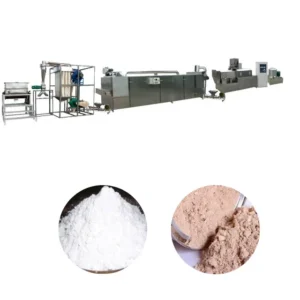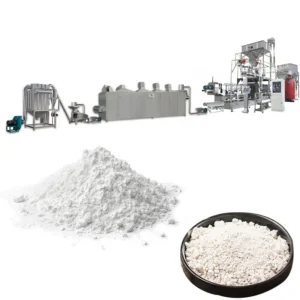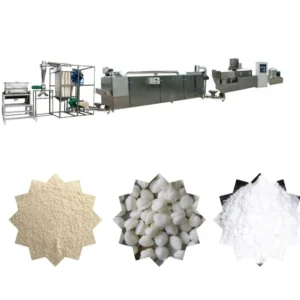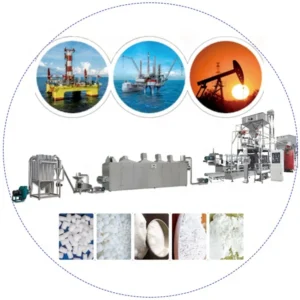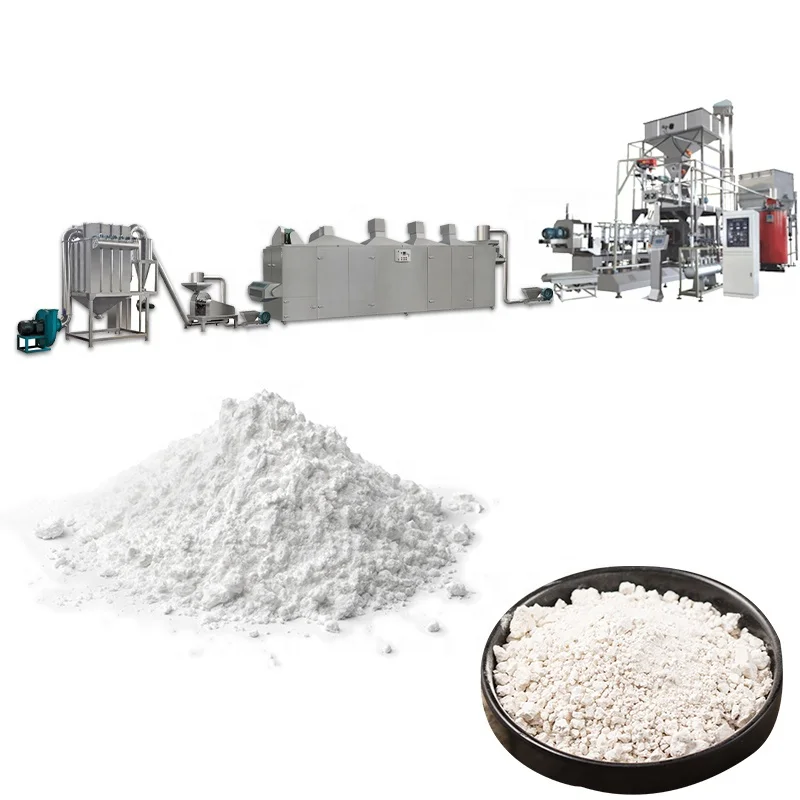
Matching throughput across every station — a modified starch processing line where mixing batch size, extruder output, dryer residence time and grinder capacity are calculated together so no single station bottlenecks the flow.
Technical Specifications
| Parameter | Value |
|---|---|
| Product Type | Pregelatinized Modified Starch Extrusion Line |
| Extruder Type | Twin screw extruder |
| Screw Material | 45 steel with internal barrel screw assembly |
| Contact Material | Food grade stainless steel 304 |
| Frame Material | Stainless steel 201 |
| Output Capacity | 80–500 kg/h (basis not stated in source — depends on raw material type, moisture content and target gelatinisation degree) |
| Total Installed Power | ~100 kW (electricity-heated line); 50–60 kW (gas or diesel heated line) (rated or peak not specified) |
| Voltage & Frequency | 380 V / 50 Hz (three phase); 220 V / 50 Hz (single phase); customizable to local voltage |
| Control System | PLC / inverter driven (Delixi or Delta inverter; Siemens or China top-brand motors) |
| Energy Options | Electricity, gas, diesel, or steam selectable per station |
| Mixer Motor | 4.0 kW |
| Mixer Batch Output | 3.0–4.0 kg per batch |
| Mixer Dimensions (L×W×H) | 1.2 × 0.9 × 1.4 m |
| Screw Conveyor Motor | 1.1 kW |
| Screw Conveyor Output | 0–150 kg/h |
| Screw Conveyor Dimensions (L×W×H) | 2.5 × 0.6 × 2.3 m |
| Process Flow | Mixer → Screw conveyor → Twin screw extruder → Shifter → Air conveyor → Dryer → Air conveyor → Conditioning → Conveyor → Grinder |
| Assembly State | Complete line with batching, extrusion, drying, conditioning and grinding stations |
| Certification | CE (certificate available at factory) |
Application Suitability
| Application | Material or Output |
|---|---|
| Oilfield drilling fluid additives | Pregelatinized starch meeting API-standard viscosity and gelling performance from cassava, corn or potato starch bases |
| Food-grade modified starch | Functional starch ingredients for bakery, sauce and dairy processing requiring controlled stability and gelatinisation degree |
| Industrial starch for paper and textiles | Modified starch with tailored molecular weight and viscosity profile from wheat, corn or potato raw material |
| Nutritional and infant formula bases | Pregelatinized starch with precise expansion and solubility characteristics for powder blending applications |
Why the Raw Material Question Changes Everything on a Modified Starch Processing Line
A capacity figure means very little until you specify which starch source, what moisture level and what gelatinisation target you need.
I have watched lines rated for a comfortable output fall short the moment the buyer switched from corn starch to a cassava-based modified formula. The screw combination that worked perfectly during factory trials produced inconsistent viscosity readings on site, and barrel temperature profiles had to be rebuilt from scratch. Each starch source — corn, wheat, potato, cassava — carries different amylose-to-amylopectin ratios and granule sizes, which changes how the material responds to shear and heat inside the barrel. Procurement teams comparing a modified starch processing line on nominal capacity alone often discover these gaps during commissioning, when time and material costs add up quickly [NEED_CITE: starch gelatinisation behaviour differences by botanical source].
Station Matching from Mixer Through Grinder
Every station in this line is sized against the others rather than pulled from independent catalogues. The mixer delivers 3.0–4.0 kg per batch on a 4.0 kW motor, feeding a screw conveyor rated at 0–150 kg/h into the twin screw extruder. If the dryer or conditioner downstream cannot handle the extruder’s output at the required residence time, the whole line slows to match the bottleneck. Specifying these stations together means the throughput is balanced before the first weld is cut.
Heating Configuration and Barrel Profile Control
Barrel temperature zones, moisture injection points and screw element arrangement are specified to the buyer’s target gelatinisation degree. The twin screw configuration allows operators to adjust the length-to-diameter ratio and shear profile by rearranging screw elements, which directly affects starch granule breakdown and water absorption. Energy sources — electricity, gas, diesel or steam — are selectable per station, so facilities with existing boiler infrastructure can route steam to the dryer while keeping electrical heating on the extruder barrel.
Reading the Specs That Matter
Installed power across the full line ranges from roughly 50–60 kW with gas or diesel heating to around 100 kW on a fully electric configuration. The difference matters for transformer sizing and switchgear specification at the buyer’s facility. The PLC and inverter-driven control manages motor speed at each station independently, which helps maintain consistent feed rates when raw material bulk density varies between batches. Food-grade 304 stainless steel on all contact surfaces prevents iron contamination that could affect starch colour and downstream functionality [NEED_CITE: food contact material regulations for starch processing equipment]. The 201 stainless steel frame provides structural support in humid processing environments without the cost premium of full 304 construction on non-contact parts.
What Happens When Stations Are Specified Separately
Sourcing an extruder from one vendor and a dryer from another creates interface problems that only surface during commissioning. Air conveyor transfer points may not align, moisture extraction rates in the dryer may not match the extruder output temperature, and control systems cannot communicate fault states across stations. When the grinder receives material at a moisture level outside its design range, screen clogging and motor overload trips follow. These problems are solvable, but they add days of on-site rework that a matched-line approach avoids [NEED_CITE: turnkey line integration challenges in food and starch processing].
What This Line Includes That Others Leave to the Buyer
Screw and die configurations are documented against the buyer’s specific starch type and gelatinisation target, not copied from a generic build. The in-house testing workshop runs trial batches on the buyer’s actual raw material before shipment, producing a test report with viscosity, expansion and moisture readings. Electrical schematics confirm voltage, frequency and control language before production starts, so the panel is built for the destination country’s grid rather than adapted on arrival. CE documentation is prepared at the factory, and a wear parts list identifies which screws, dies and seals to stock for the first year of operation.
Documentation & Verification
- Line layout drawing with station dimensions and throughput calculation for your starch source
- Screw and die configuration record matched to your target gelatinisation degree
- Electrical schematic with confirmed voltage, frequency and PLC interface language
- Trial run report on your raw material with viscosity and expansion data
- Factory test record documenting each station’s performance before crating
- CE declaration of conformity and ISO certificate included with shipping documents
Installation, Commissioning & Support
- Floor plan review to confirm dryer and extruder footprint against your workshop dimensions
- Dedicated electrical circuit planning based on confirmed total kW draw and voltage
- Mechanical assembly and barrel alignment by on-site technicians at first startup
- Screw element arrangement verification and barrel temperature profile tuning with your material
- Operator training covering PLC navigation, screw speed adjustment and fault response
- Wear parts list with reorder codes for screws, dies and conveyor seals
What to Include in Your Inquiry
Provide the starch source you plan to use — corn, wheat, potato, cassava or a blend — along with your target gelatinisation degree and end-use viscosity specification. Include your facility voltage and frequency, available energy sources such as steam or gas, and the control language your operators need. If you have existing upstream batching or downstream packing equipment, share the interface requirements so the line layout can accommodate them.
Frequently Asked Questions
Q: How is the 80–500 kg/h capacity range verified for my specific starch type and moisture level?
A: The quoted range depends heavily on raw material characteristics. Before the line is built, we run a trial in our testing workshop using a sample of your actual starch. The trial report records output rate, viscosity, expansion ratio and moisture at the dryer exit, giving you a confirmed capacity figure tied to your material rather than a generic estimate.
Q: What voltage, frequency and control language are confirmed before the line ships?
A: We confirm these details during the specification stage and record them on the electrical schematic. The PLC interface language, motor nameplate data and heater element ratings are all set to match your facility’s grid. This prevents the common problem of arriving on site to find the control panel displays a language your operators cannot read.
Q: How are screw configuration and barrel temperature profile matched to my gelatinisation target?
A: The screw element sequence and die geometry are selected based on your starch source and target degree of gelatinisation. Barrel temperature zones are set during the trial run and documented in the configuration record. If your target viscosity changes later, the screw arrangement can be adjusted and the temperature profile updated accordingly.
Q: How are the dryer and grinder stations sized to avoid bottlenecking the extruder?
A: Dryer residence time and grinder throughput are calculated against the extruder’s confirmed output on your material. The air conveyor transfer points and conditioning station are included in this calculation so moisture reduction happens at a rate that matches the extrusion speed without material backing up at any station.