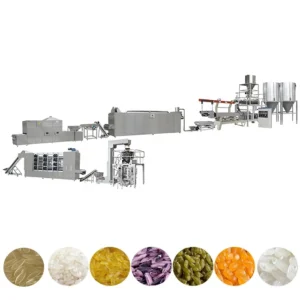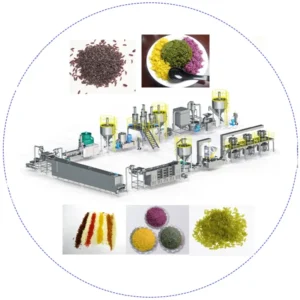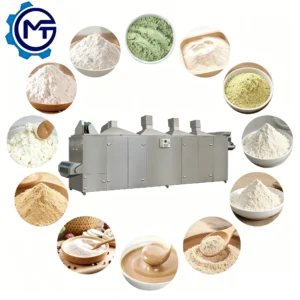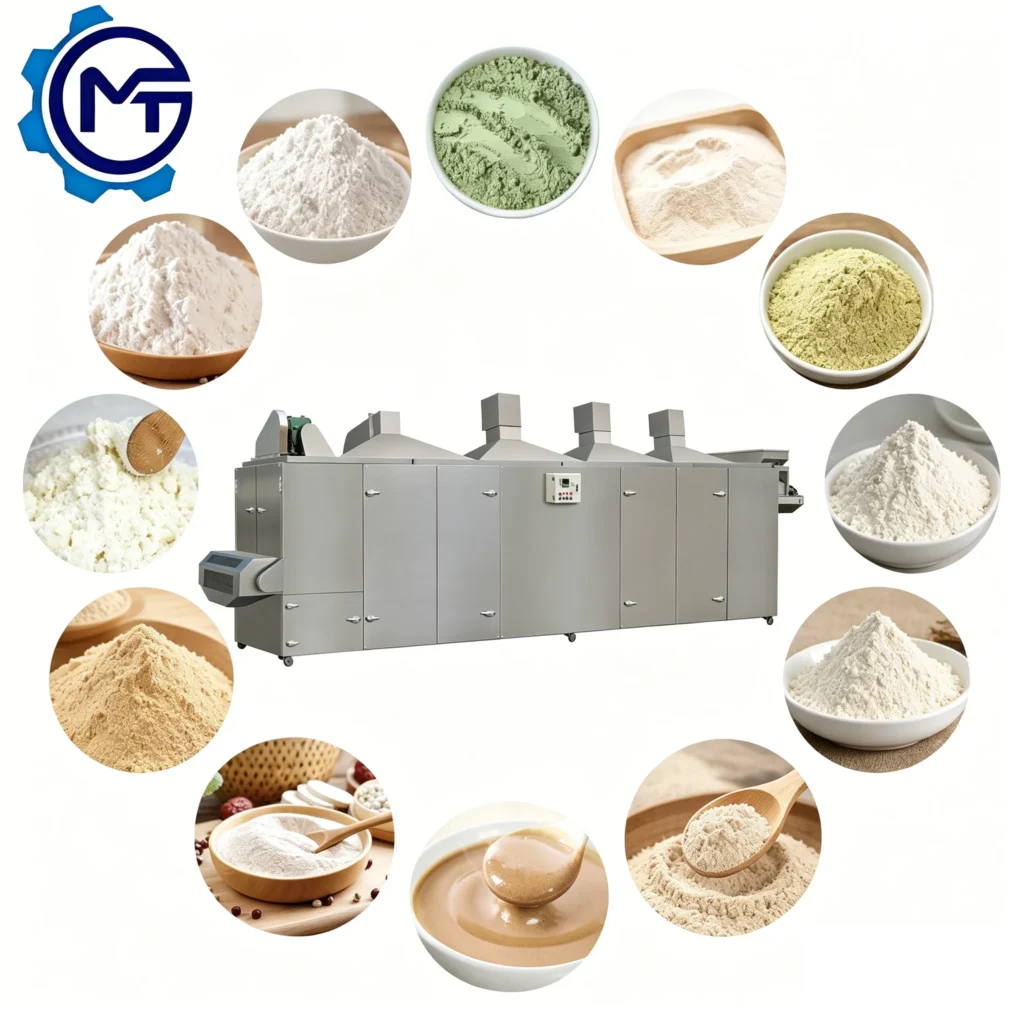
Integrated Line Matching — every station from batching to packing is sized to the same throughput target so no single machine bottlenecks the nutrition powder processing line equipment for sale.
Technical Specifications
| Parameter | Value |
|---|---|
| Product Type | Nutrition Powder Processing Line |
| Output Capacity | 200-500 kg/h (basis not stated in source — confirm raw material, moisture, and formulation) |
| Construction Material | Food-Grade 304 Stainless Steel |
| Control System | PLC with Touch Control Panel & Digital System |
| Heat Source Options | Electric / Gas / Steam |
| Raw Materials Processed | Rice, Corn, Beans, Various Grains |
| Automation Level | Full Automatic |
| Key Line Stations | Baking Ovens, Mixers (complete station list to be confirmed) |
| Screw Type / Configuration | Single or twin screw to be confirmed; L:D ratio dependent on formulation |
| Energy Profile | Low energy consumption design (verify against utility specification sheet) |
| Warranty | 1 Year |
| After-Sales Service | Overseas Engineer Service Available |
Application Suitability
| Application | Material or Output |
|---|---|
| Baby food nutrition powder production | Rice, corn, and blended grain formulations |
| Infant formula powder processing | Vitamin-fortified rice and bean bases |
| Nutritional porridge manufacturing | Multi-grain blends including corn and legumes |
| Grain-based fortified food powder | Various cereals and pulse crops |
What the Nominal Capacity Figure Leaves Out When Sourcing Nutrition Powder Processing Line Equipment for Sale
Capacity numbers mean nothing until they are tied to your exact raw material blend and moisture content.
A line rated at a certain throughput on pure rice flour may behave entirely differently when the formulation includes thirty percent chickpea or mung bean flour. Different starches gelatinise at different temperatures, and the screw profile that works on one blend may leave another undercooked or over-sheared. Buyers often discover this only after the machine is bolted to the factory floor and the first trial batch comes out dense and under-expanded [NEED_CITE: gelatinisation temperature variation across grain and legume starches]. That mismatch between quoted output and real-world output is the most common reason nutrition powder processing line equipment for sale gets returned or renegotiated after delivery.
Matching Every Station from Mixer to Packing
When you survey equipment before specifying a line, the extruder is only one link. The mixer upstream must deliver a consistent batch size at the right moisture level. The dryer downstream must have enough bed area and residence time to bring moisture down to a shelf-stable point without case-hardening the granules. If any single station is undersized, the entire nutrition powder processing line equipment for sale slows to the pace of that bottleneck. Our catalogue lays out every supporting station — mixing, conveying, drying, flavouring, cooling, packing — so buyers can see the full chain and verify that throughput is balanced before placing an order.
Heat Source Flexibility for Different Factory Environments
Factories in different regions have different utility profiles. Some have abundant steam from a central boiler; others rely on electricity or gas. This line supports electric, gas, and steam heating options, allowing the dryer and any conditioning stages to match local infrastructure. Selecting the right heat source early avoids costly retrofitting later and ensures the drying profile remains consistent across seasons [NEED_CITE: industrial drying energy source selection criteria for food processing].
Reading the Specification Sheet Beyond the Headline Numbers
Food-grade 304 stainless steel across all contact surfaces is non-negotiable for infant nutrition products where cleaning validation is part of regulatory compliance. The PLC with touch control panel stores recipes digitally, which means an operator can recall a previous batch’s temperature, screw speed, and feed rate rather than relying on memory. For buyers evaluating screw type and configuration, the L:D ratio and screw element arrangement must be matched to the raw material’s starch content and the target powder particle size — a short barrel may not give enough residence time for full gelatinisation of high-protein legume blends. Flexible heat source compatibility across electric, gas, and steam means the same dryer specification can serve a South Asian plant running on gas and a West African facility on electric, without redesigning the drying chamber.
The Hidden Cost of Skipping the Trial Run
I once watched a client in South Asia lose an entire batch of nutrition powder because the extruder parameters were set for pure rice flour while the actual blend contained a significant share of bean flour. The gelatinisation window was missed, the product came out under-expanded, and the dryer could not salvage it. Skipping a pre-shipment trial run on the buyer’s actual raw material is the fastest way to turn a capital investment into a commissioning headache [NEED_CITE: importance of pre-shipment product trials in food extrusion projects].
Why Procure the Full Equipment Range from One Catalogue
Every station from mixing through extrusion, drying, and packing is available under one supplier, so throughput calculations are done as a system rather than patched together from separate vendor quotes. Screw configuration and die design are specified to the buyer’s raw material and target powder texture rather than copied from a generic build. The in-house testing workshop runs trial batches on the buyer’s actual grain blend before shipment, locking in the process parameters. Electrical schematics and voltage confirmation happen before production begins, so the control language, frequency, and plug type match the destination factory. And documentation — from the CE declaration to the trial run report — travels with the shipment so customs clearance and local compliance are straightforward.
Documentation & Verification
- Line layout and capacity calculation matching throughput at each station for the nutrition powder line
- Screw and die configuration record specific to your grain blend and target powder texture
- Trial run report on your actual raw material from the in-house testing workshop before dispatch
- Electrical schematic and voltage confirmation sheet matched to your factory’s power supply
- CE declaration of conformity and ISO certificate included with each shipment
Installation, Commissioning & Support
- Foundation and floor space planning based on the complete line footprint including dryer and packing stations
- Power circuit specification covering PLC control panel voltage, frequency, and dedicated breaker requirements
- Overseas engineer service for on-site assembly, level alignment, and first-run parameter calibration
- Operator training on recipe recall via the touch control panel and routine screw and die inspection
- Wear parts list covering screws, dies, and mixer blades with reorder lead time guidance
- Scheduled maintenance intervals for bearings, seals, and heating elements based on daily run hours
Before You Request a Quotation
To size the nutrition powder processing line equipment for sale correctly, send the exact grain blend with percentages, the target moisture content of the finished powder, and your daily production goal. Confirm your factory’s voltage, frequency, and preferred control language so the PLC and electrical cabinet are built to match. If you have existing upstream milling or downstream packing equipment, share the interface dimensions so the conveyor heights and discharge chutes are designed to connect without modification.
Frequently Asked Questions
Q: How do I verify the stated capacity figure against my specific raw material and formulation?
A: The 200-500 kg/h range is a starting point. Actual throughput depends on your grain blend, moisture content, and target expansion. We run a trial batch on your raw material in our testing workshop, record the screw speed, temperature profile, and feed rate, and issue a trial run report with the confirmed output before the machine ships.
Q: What is the complete station list, and how is throughput matched between stations?
A: The line covers mixing, extrusion, drying, flavouring, cooling, and packing. Each station is selected so its maximum throughput equals or slightly exceeds the extruder output, preventing bottlenecks. The line layout document shows the capacity calculation for every station based on your formulation.
Q: How do I select the correct voltage, frequency, and control language for my target market?
A: Share your factory’s electrical specification during the inquiry stage. The PLC and control panel are built to your voltage and frequency, and the touch screen interface language is set before shipment. The electrical schematic confirms all parameters before production begins.
Q: Can I source individual stations such as a dryer or mixer separately?
A: Yes. Every station in the catalogue is available individually. When ordering a standalone unit, we confirm the interface dimensions and throughput compatibility with your existing line to ensure it integrates without requiring additional conveyor modifications.
Q: What spare wear parts are included, and how are replacements supplied after the first cycle?
A: The initial shipment includes a wear parts list specifying screws, dies, and mixer blades. Replacement parts are manufactured to the same configuration record and shipped on a quoted lead time. We recommend ordering the first replacement set before the original parts reach end of life to avoid production downtime.