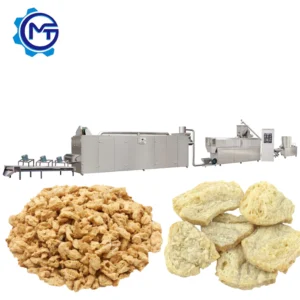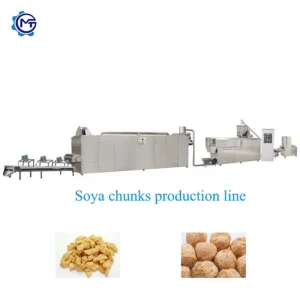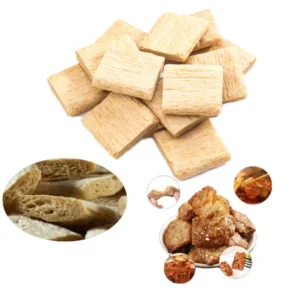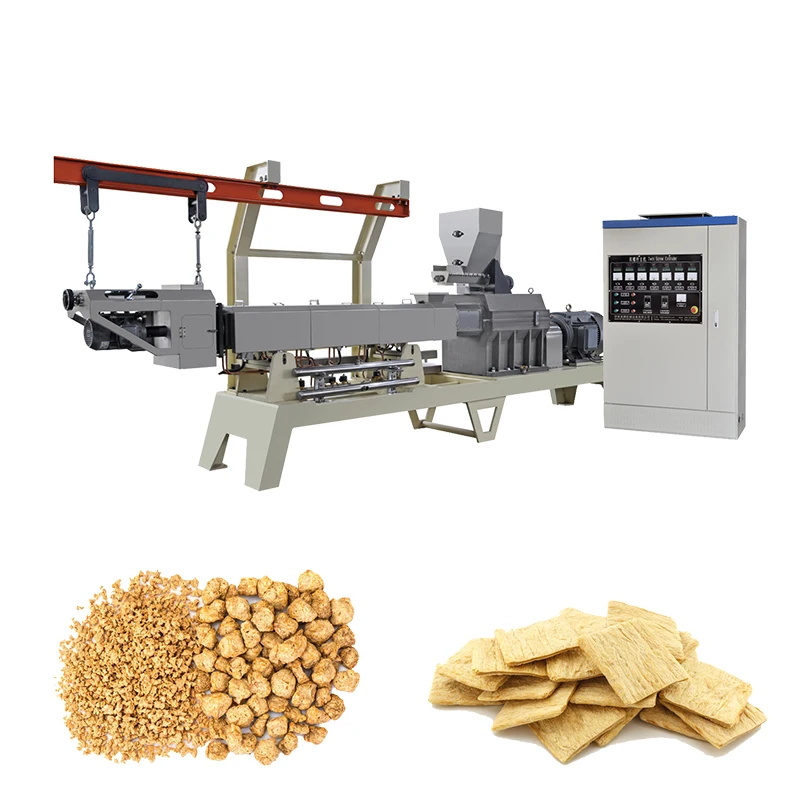
Screw-Configured Extrusion — Every twin-screw element and die plate is matched to the buyer’s actual soy or peanut meal before the machine ships, not copied from a generic build.
Technical Specifications
| Parameter | Value |
|---|---|
| Product Type | Textured Vegetable Protein Production Line |
| Models Available | MT65 / MT70 / MT85 |
| Screw Type | Twin-screw |
| Installed Power | 85 kW (MT65) / 120 kW (MT70) / 195 kW (MT85) |
| Real Power Consumption | 65 kW (MT65) / 90 kW (MT70) / 165 kW (MT85) |
| Output Capacity | 150–200 kg/h (MT65, basis to be confirmed) / 200–300 kg/h (MT70, basis to be confirmed) / 600–800 kg/h (MT85, basis to be confirmed) |
| Overall Dimensions | 18000×1300×2300 mm (MT65) / 20000×1500×2400 mm (MT70) / 24000×3500×4300 mm (MT85) |
| Powder Mixer Tank Volume | 150 kg per batch |
| Powder Mixer Mixing Time | 10 min per batch |
| Powder Mixer Rotary Speed | 385 rpm |
| Powder Mixer Power | 4 kW |
| High-temperature Roaster Belt Length | 3.5 m effective |
| High-temperature Roaster Heating | Far infrared 3.9 kW × 24 elements, gas option available |
| Roaster Gas Consumption | 6.8 m³ (basis to be confirmed) |
| Construction Material | Stainless steel throughout |
| Line Stations | Mixing → conveying → extrusion → conveying → drying → cooling → packing |
| Warranty | 1 year complete, life-time maintenance |
Application Suitability
| Application | Material or Output |
|---|---|
| Soy chunks and soybean meat | Low-temperature defatted soybean meal |
| Peanut-based protein pieces | Peanut meal |
| Vegetarian and plant-based meat alternatives | Blended plant protein meals |
| Ham, sausage and canned food ingredients | Textured protein chunks as meat extender |
| Quick-frozen and fast food components | Rehydratable TVP granules and chunks |
What "600 kg/h Output" Leaves Out About Your Raw Material
Capacity numbers mean nothing unless the soy protein concentrate you actually buy behaves the same way in the barrel as the standard meal we tested with.
I have watched lines stall at commissioning because the buyer’s local soybean meal had higher fiber or different moisture than the specification sheet assumed. The extruder ran, but the fiber structure came out flat and dense — not the spongy, layered chunks the market expected. Throughput dropped because operators had to slow the feed rate to salvage texture. This textured vegetable protein production line full equipment range addresses that by running your actual raw material in our testing workshop first, then adjusting screw pitch and die geometry to match. [NEED_CITE: effects of protein content and fiber ratio on extrusion expansion]
How Screw Elements Shape Fiber Structure in Plant Protein
The twin-screw configuration inside these extruders is what creates the layered, meat-like fiber that defines textured vegetable protein. As the meal passes through alternating conveying and kneading zones, shear forces align the protein molecules while moisture and heat denature them into a continuous matrix. The MT65, MT70 and MT85 models span different barrel lengths and screw diameters, giving each a distinct residence time profile suited to different production scales.
Matching Every Station So No Single Machine Holds Back the Line
A textured vegetable protein production line full equipment setup only works when the mixer output, extruder throughput, roaster belt speed and cooling capacity are all sized to the same target. If the roaster cannot dry what the extruder pushes out, wet chunks pile up on the belt and stick together. This range lists each station with individual dimensions and output ranges so layout engineers can verify station-to-station flow before installation begins. [NEED_CITE: bottleneck analysis in multi-station food processing lines]
Reading the Power and Dimension Specs for Layout Planning
The installed versus real power split across MT65, MT70 and MT85 tells you the actual thermal and mechanical load the line will draw once running — critical for sizing your transformer and dedicated circuits. The overall line dimensions, stretching from 18 meters for the MT65 to 24 meters for the MT85, define the minimum workshop length needed in a straight layout. The powder mixer’s 150 kg tank volume and 10-minute batch cycle mean you need to plan raw material staging so the extruder never starves between batches. Roaster selection between far infrared electric heating and gas combustion depends on your facility’s available utility supply and local energy cost structure.
The Hidden Cost of Skipping the Trial Run
When a TVP extruder ships without being tested on the buyer’s specific meal, the first week of production becomes an expensive experiment. Screw elements get swapped, die plates get re-cut, and operators guess at moisture levels while burning raw material. I spent a full week on-site once reconfiguring an entire screw sequence because the customer’s high-protein concentrate expanded differently than the standard defatted meal we had factory-tested. Every batch that fails texture checks is product you cannot sell and time you cannot recover. [NEED_CITE: commissioning delays caused by untested raw material variation]
Why Sourcing the Full Line From One Supplier Matters Here
Every station — mixer, extruder, roaster, cooler, packing — is specified together so throughput matches across the entire sequence rather than being assembled from separate vendors with mismatched capacities. Screw configuration and die design are documented against your raw material, not borrowed from a generic build. The in-house testing workshop runs your soybean meal or peanut meal before shipment, producing a trial run report you can review before the crate is sealed. Stainless steel construction across all machinery means food-grade compliance is consistent at every contact point. Documentation covers line layout, electrical schematics and voltage confirmation matched to your market, reducing the chance of a delayed commissioning.
Documentation & Verification
- Line layout with capacity calculation for each station matched to your target output
- Machine specification sheet per station listing power, dimensions and throughput
- Electrical schematic and voltage confirmation for your local utility supply
- Trial run report on your soybean or peanut meal before shipment
- CE declaration of conformity and ISO certificate included with dispatch
- Wear parts list covering screws, dies and heater elements for first replacement
Installation, Commissioning & Support
- MT85 line requires a minimum 24-meter straight workshop length with level concrete flooring
- Power supply must match confirmed voltage and frequency; dedicated circuits required for 195 kW installed load
- All stations ship partially assembled; extruder barrel sections and roaster belt need on-site alignment
- Commissioning includes screw speed, barrel temperature profile and moisture adjustment on your raw material
- Operator training covers batch mixing timing, extruder feed rate and roaster belt speed coordination
- Spare screws, die plates and infrared heater elements listed in the wear parts schedule for first-year maintenance
What We Need to Configure Your Line Accurately
Share the specific type of protein meal you plan to run — soybean, peanut or a blend — along with its protein content and typical moisture level. Tell us your target daily output and whether you need the line to run continuously or in shifts. Confirm your workshop’s available voltage and frequency, plus the control language your operators prefer. If you already have upstream milling or downstream packing equipment, let us know the interface points so the line stations connect cleanly.
Frequently Asked Questions
Q: How is output capacity verified before the line ships?
A: We run your actual raw material — soybean meal or peanut meal — through the extruder in our testing workshop. The trial documents the screw configuration, barrel temperature profile and moisture level that produced acceptable fiber structure. Output is recorded under those specific conditions, so the kg/h figure you receive reflects your material, not a generic standard.
Q: What voltage and control options are confirmed before production?
A: Before the order enters production, we confirm your facility’s voltage, frequency and phase requirements. The electrical schematic is drawn to match, and the control language on the operator interface is set to your preference. This avoids rewiring or reprogramming delays during commissioning.
Q: How do you prevent one station from bottlenecking the others?
A: Each station — mixer, extruder, roaster, cooler — is selected with its throughput matched to the same target output. The line layout document shows station-by-station capacity so you can verify the sequence before installation. No single machine is oversized or undersized relative to its neighbors.
Q: Can I order individual stations instead of the complete line?
A: Individual stations such as the powder mixer, twin-screw extruder or high-temperature roaster can be supplied separately to upgrade an existing setup. We still confirm throughput compatibility with your current equipment so the new station integrates without creating a bottleneck upstream or downstream.