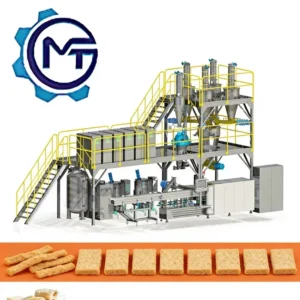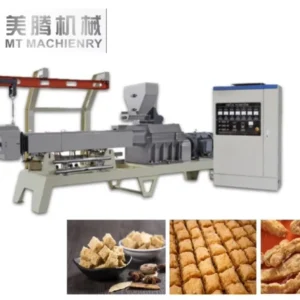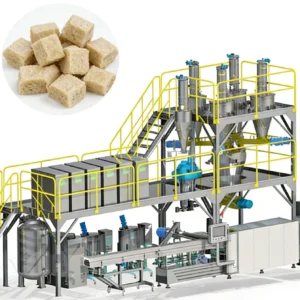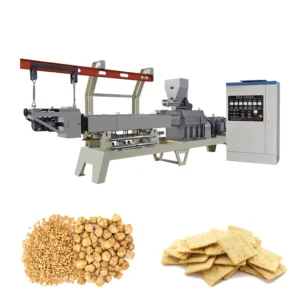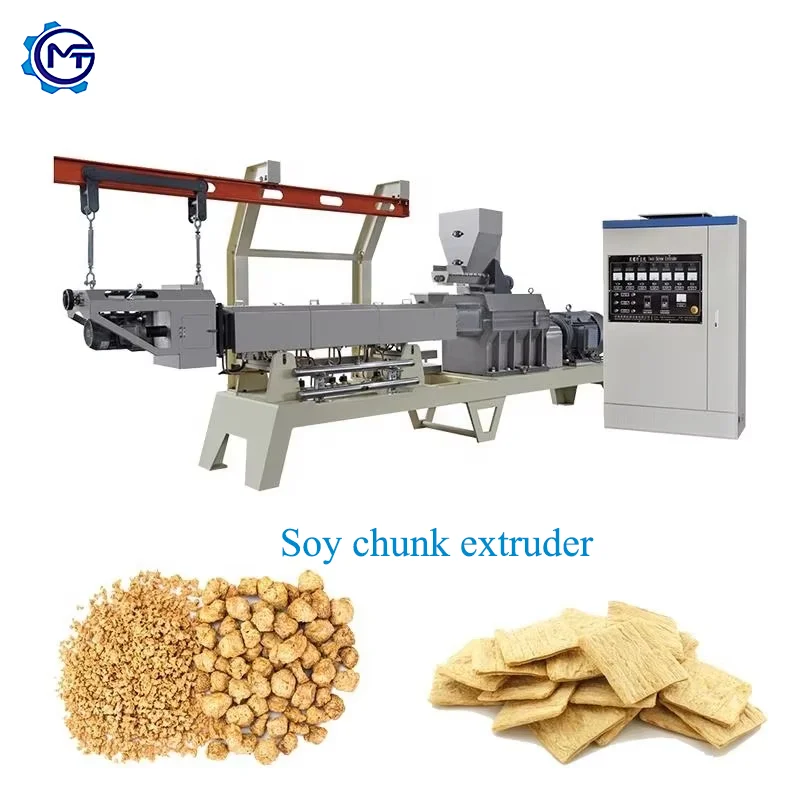
Capacity-Matched Stations — Every mixer, extruder, roaster, and cooler in this TVP line is sized so no single station bottlenecks the others.
Technical Specifications
| Parameter | Value |
|---|---|
| Product Type | Textured Vegetable Protein (TVP) Extrusion Production Line |
| Screw Type | Twin-screw (Double Screw Extruder) |
| Model Options | MT65 / MT70 / MT85 |
| Installed Power | 85 kW (MT65) / 120 kW (MT70) / 195 kW (MT85) |
| Actual Power Consumption | 65 kW (MT65) / 90 kW (MT70) / 165 kW (MT85) |
| Output Capacity | 150–200 kg/h (MT65) / 200–300 kg/h (MT70) / 600–800 kg/h (MT85) (basis not stated in source — confirm raw material type, moisture content and target TVP format) |
| Extruder Main Motor Power | 30 kW |
| Powder Mixer Tank Volume | 150 kg |
| Powder Mixer Rotary Speed | 385 rpm |
| Powder Mixer Mixing Time | 10 min per batch |
| High-temperature Roaster Effective Belt Length | 3.5 m |
| Roaster Far Infrared Heater Power | 3.9 kW × 24 |
| Cooling Machine Temperature Range | 0–260°C (source value — verify against manufacturer catalog) |
| Overall Dimensions (Line) | 18000×1300×2300 mm (MT65) / 20000×1500×2400 mm (MT70) / 24000×3500×4300 mm (MT85) |
| Material of Construction | Stainless steel (food-grade contact parts) |
| Control System | PLC / MCC (available upon confirmation) |
| Standards | CE certified, ISO certified |
Application Suitability
| Application | Material or Output |
|---|---|
| Plant-based meat analogue production | TVP chunks, strips, and granules from low-temperature soybean meal |
| Meat extender and filler manufacturing | Textured protein from peanut meal for sausage and canned food processing |
| Quick-frozen food ingredient supply | Hydrated TVP pieces for dumpling, patty, and ready-meal formulations |
| Ham and deli product fortification | Fine-grade textured soy protein for moisture retention and bite improvement |
What "Rated Capacity" Leaves Out About TVP Lines
A textured vegetable protein production line only runs at its slowest station — not the number on the extruder nameplate.
I have watched buyers focus entirely on extruder throughput, only to discover the downstream roaster cannot dry the output fast enough. Wet TVP fibers pile up on the cooling belt, lose their structure, and spoil before packaging. That mismatch does not show up in a brochure [NEED_CITE: throughput matching principles in multi-station food extrusion lines]. The textured vegetable protein production line you evaluate must present capacity figures for every station — mixer, extruder, roaster, cooler — measured against the same raw material and moisture content, not just the extruder in isolation.
Matching Every Station to the Extruder Output
The powder mixer cycles a 150 kg batch every 10 minutes at 385 rpm, timed to feed the twin-screw extruder continuously without starvation or overflow. When the mixer falls behind, the extruder runs partially empty, producing inconsistent fiber structure. When it runs ahead, material sits and absorbs ambient moisture, altering the extrusion profile.
The high-temperature roaster uses 24 far-infrared heating elements across a 3.5 m effective belt length, removing surface and internal moisture from extruded TVP fibers at a rate matched to extruder discharge. This station is where most TVP lines fail — undersized dryers force operators to slow the entire textured vegetable protein production line to prevent product degradation.
Drying and Cooling as a Single Thermal Stage
TVP fibers exit the die at high temperature and moisture. The roaster must reduce moisture to a stable level while preserving the open fiber structure that gives plant-based meat its chew. If drying is too aggressive, fibers become brittle and shatter during packing. If too gentle, residual moisture invites microbial growth in storage [NEED_CITE: moisture content thresholds for shelf-stable textured protein].
The cooling machine then brings product temperature down to a safe range for packaging. Its 0–260°C operating range allows operators to set the cooling curve based on the specific TVP format being run — coarse chunks retain heat longer than fine granules and need a slower cooldown profile.
Reading the Specs That Matter for Fiber Quality
Twin-screw extrusion gives operators independent control over shear, residence time, and temperature across multiple barrel zones. Single-screw designs cannot achieve the same level of control when processing low-temperature soybean meal, which requires precise moisture injection and gradual protein alignment to form coherent fibers.
The installed power spread — from 85 kW on the MT65 to 195 kW on the MT85 — reflects motor sizing matched to barrel volume and screw configuration. Higher power alone does not guarantee better TVP; the screw element arrangement and die geometry must suit the raw material. A configuration designed for soybean meal will produce different results on peanut meal, which has a different fat and protein ratio.
Stainless-steel food-grade contact surfaces across every station prevent corrosion from the mildly acidic environment that soy protein creates during mixing and extrusion. This material choice also simplifies washdown between product changeovers.
The Hidden Cost of an Undersized Auxiliary Station
When the roaster cannot keep pace, operators face a choice: slow the extruder and miss production targets, or let wet product accumulate and deal with waste. Neither option is acceptable in a commercial plant. The loss is not just material — it includes labor hours, energy consumed by an idling extruder, and delayed shipments [NEED_CITE: production bottleneck impact on food processing profitability].
Equally problematic is a mixer that batches too slowly. The extruder then cycles between full and starved conditions, producing TVP with alternating density bands that customers reject for inconsistent hydration behavior.
Why Source a Complete TVP Line Here
Every station is specified under one supplier, so throughput calculations account for the actual material flow between mixer, extruder, roaster, cooler, and packing conveyor rather than treating each as an independent purchase.
Screw configuration and die design are matched to the buyer’s raw material and target TVP fiber format, not copied from a generic build.
An in-house testing workshop allows trial runs on the buyer’s actual soybean meal or peanut meal before the line ships, confirming fiber structure and capacity figures.
Full stainless-steel construction on food-contact parts is standard across all stations, not an optional upgrade.
Pre-sales engineering covers line layout, utility planning, and voltage confirmation, with on-site installation, commissioning, and operator training included in the project scope.
Documentation & Verification
- Line layout and capacity calculation showing throughput at every station for your raw material
- Screw and die configuration record matched to your soybean or peanut meal specification
- Trial run report from in-house testing on your actual raw material before dispatch
- Electrical schematic with confirmed voltage, frequency, and control language for your market
- CE declaration of conformity and ISO certificate for the complete line
- Operation and maintenance manual covering all stations from mixer to packing conveyor
Installation, Commissioning & Support
- Foundation and floor space planning based on line dimensions up to 24000×3500×4300 mm for the MT85 configuration
- Dedicated electrical circuit sized for installed power up to 195 kW with confirmed local voltage and frequency
- Modular station delivery with on-site assembly, belt alignment, and thermal calibration of the roaster
- First-run parameter setting including barrel temperature profile, screw speed, and roaster belt speed
- Operator training covering batch mixing cycles, die changes, and roaster temperature adjustment
- Wear parts list including screws, dies, and roaster belts with replacement sourcing guidance
What to Share When Requesting a Quote
To configure a textured vegetable protein production line that matches your facility, please provide your raw material type and its protein and moisture content, your target TVP format (chunks, strips, or granules), your required daily output, your workshop dimensions and ceiling height, and your local voltage and frequency standard. If you have existing upstream or downstream equipment that the new line must integrate with, include those specifications as well. A raw material sample for trial runs in the testing workshop will allow us to confirm screw configuration and capacity before the quotation is finalized.
Frequently Asked Questions
Q: How do I ensure the mixer, extruder, roaster, and cooler are all capacity-matched?
A: Request a line layout and capacity calculation that lists throughput for every station based on your specific raw material and target TVP format. Each station must be sized so none becomes a bottleneck. The powder mixer batch cycle, extruder output, roaster drying rate, and cooler capacity should all align within the same production window.
Q: What screw and die configurations are available for soybean meal versus peanut meal?
A: Screw element arrangement and die geometry are specified to the buyer’s raw material. Soybean meal and peanut meal differ in fat content, protein ratio, and fiber-forming behavior. The configuration record is documented before production, and a trial run in the testing workshop confirms the result on your actual material.
Q: Which voltage, frequency, and control language options can the line support?
A: Electrical specifications are confirmed during the quotation stage to match your local grid standard. The control system is available with PLC or MCC options, and the interface language is set to your operator preference before the electrical schematic is finalized and production begins.
Q: Can I send my raw material for a trial run before the line ships?
A: Yes. The in-house testing workshop accepts buyer-supplied raw material for trial extrusion. This confirms screw and die configuration, fiber structure, and capacity figures before the line leaves the factory, so product development does not start only after installation at your facility.
Q: What spare and wear parts are included, and how are replacements handled?
A: A wear parts list covering screws, dies, mixer blades, and roaster belts is provided with every line. Initial spare sets can be included in the shipment. Replacement parts are manufactured to the same specification and sourced directly, with documentation to ensure compatibility when the first replacement cycle arrives.