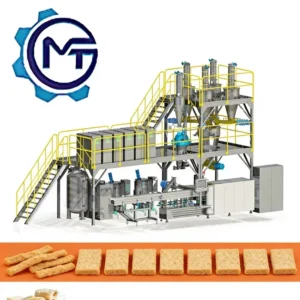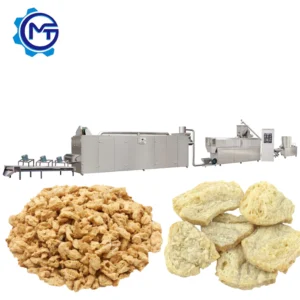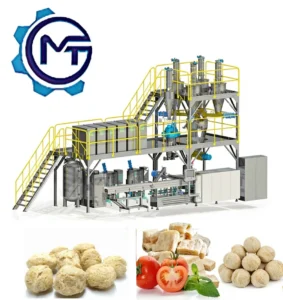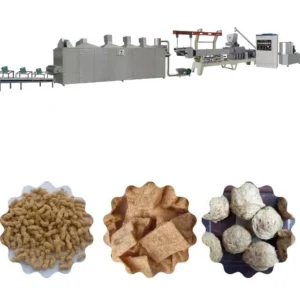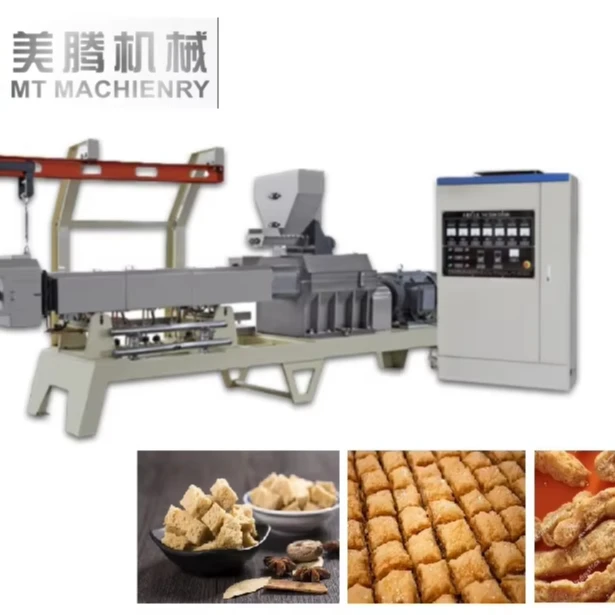
Matching throughput across every station — from the vertical mixer through the twin-screw extruder to the multi-layer dryer, each unit in this plant-based meat line is sized to the same capacity target so no single machine becomes a bottleneck.
Technical Specifications
| Parameter | Value |
|---|---|
| Model | MT65 / MT70 / MT75 / MT85 |
| Product Type | Twin Screw Extruder for High Moisture Vegetarian Meat / Textured Soy Protein Production Line |
| Screw Type | Twin Screw (Double-screw) |
| Installed Power | MT65 84 kW / MT70 160 kW / MT75 190 kW / MT85 210 kW |
| Actual Power Consumption | MT65 59 kW / MT70 120 kW / MT75 140 kW / MT85 140 kW |
| Output Capacity | MT65 100–150 kg/h (basis to be confirmed) / MT70 150–200 kg/h (basis to be confirmed) / MT75 150–200 kg/h (basis to be confirmed) / MT85 250–300 kg/h (basis to be confirmed) |
| Main Motor Power | 22 kW / 30 kW / 45 kW (model-dependent) |
| Overall Dimensions (L×W×H) | MT65 40,000×1,200×2,200 mm / MT70 41,000×1,500×2,200 mm / MT75 43,000×1,500×3,200 mm / MT85 45,000×1,500×3,500 mm (source value — verify whether line total or single machine footprint) |
| Rotary Cutting Motor | 0.75 kW |
| Feeding Motor | 0.75 kW |
| Pump Motor | 0.37 kW |
| Heating Power | 10 kW / 14 kW / 14 kW (model-dependent) |
| Screw Length | 1,050 mm / 1,520 mm (model-dependent) |
| Mixer Type | Vertical mixing machine, SS304 mixing ruler, carbon steel shelf |
| Mixer Power Options | 4 kW / 7.5 kW / 15 kW |
| Mixer Capacity Options | 20–30 kg / 70–80 kg / 170–180 kg |
| Dryer Type | Multi-layer dryer, double pitch roller chain drive, round-trip drying |
| Dryer Heating Options | Fuel / Gas / Electricity (selectable) |
| Line Sequence | Mixer → Screw Conveyor → Twin Screw Extruder → Air Conveyor → Multi-layer Dryer → Cooling Machine |
| Die Configuration | Adjustable moulds for soya nuggets, TVP, TSP, soya chunks |
| Assembly State | Complete line configuration |
| Delivery Time | 5–10 days if in stock; 20–35 working days if not |
| Certifications | CE (since 2014); ISO certified |
Application Suitability
| Application | Material or Output |
|---|---|
| Textured Vegetable Protein (TVP/TSP) | Defatted soya flour, low-temperature soya flakes |
| Soya nuggets and soya chunks | Soya protein isolate blended with starch carriers |
| High-moisture vegetarian meat analogues | Pea-wheat or soya-wheat blends at elevated moisture |
| Meat product industry input material | Layered fiber structures for oil and water absorption |
| Deep-frozen food production | TVP chunks sized for rehydration and freezing |
| Cereal and snack formats | Adjusted screw configuration and die geometry |
What "Rated Capacity" Actually Means on a Plant Based Meat Processing Line
A quoted throughput figure only holds when the raw material formula and moisture content match the screw configuration running at the time of measurement.
I watched a Colombian buyer’s high-moisture vegetarian meat line stall for two full weeks after commissioning. We had trialled on standard soy isolate, but their actual pea-wheat blend demanded a completely different screw speed and barrel temperature profile. That gap between the quoted plant based meat processing line equipment capacity and the real output is almost always traceable to a formula mismatch that was never surfaced before the deposit was paid. Buyers need to see trial-run data on their own material before signing off on any capacity claim [NEED_CITE: importance of pre-shipment material trials for extrusion lines].
How Screw Configuration Determines Product Fibre Structure
The twin-screw configuration on this extruder platform is adjustable in element arrangement, pitch, and kneading block count. For TVP chunks, a shorter residence time with aggressive shear produces a dense, layered fibre that holds shape during deep-frying. High-moisture vegetarian meat requires longer barrel sections and gentler kneading to develop an elongated, meat-like texture without destroying the protein matrix. Each target product demands its own screw and die record.
Dryer Sizing and the Hidden Bottleneck Risk
The multi-layer dryer uses a double-pitch roller chain for round-trip drying, and its heating source is selectable between electricity, gas, or fuel. A plant based meat processing line equipment set where the dryer cannot evaporate moisture fast enough will force the extruder to slow down, capping real throughput below nameplate. Matching the dryer belt area and thermal input to the extruder’s water-evaporation load is the step most often skipped in generic line builds.
Reading the Power and Dimension Specs
Installed power across the four models ranges from 84 kW on the MT65 to 210 kW on the MT85, yet actual consumption drops to roughly 70 percent of that figure under normal running conditions — the difference reflects motor start-up peaks and heating element cycling. Main motor options span 22 kW to 45 kW, and the screw length choices of 1,050 mm versus 1,520 mm directly influence material residence time and starch gelatinisation completeness. Overall dimensions listed run beyond 40 metres in length for the full line sequence, so workshop length, column spacing, and overhead clearance must be confirmed before foundation work begins [NEED_CITE: industrial equipment installation spatial planning requirements].
The Cost of Skipping Pre-Shipment Verification
When a line ships without a factory test on the buyer’s exact raw material, the commissioning phase becomes the first real experiment. Screw elements are swapped, barrel zones are re-mapped, and die geometry is re-cut while production hours tick away. The downtime during that period is difficult to quantify but consistently pushes market launch dates back by weeks. Voltage and control-language mismatches discovered after arrival only compound the delay [NEED_CITE: common causes of extrusion line commissioning delays].
Why This Line Is Built Station by Station
Throughput matching across the mixer, extruder, dryer, and cooling machine means no single station starves or floods the next. Screw configuration and die design are specified to the buyer’s raw material rather than copied from a generic build. An in-house testing workshop allows trial runs on customer-supplied formula before shipment, reducing on-site commissioning time. The twin-screw platform covers TVP, high-moisture vegetarian meat, soya nuggets, and soya chunks from one extruder family. Pre-sales engineering, on-site installation, and operator training are handled by the same team that designed the line.
Documentation & Verification
- Line layout drawing showing throughput balance at every station across the complete plant based meat processing line equipment set
- Machine specification sheet with screw and die configuration record tied to your raw material formula
- Electrical schematic with voltage, frequency, and control-language confirmation before production begins
- Trial-run report on customer-supplied raw material produced in the in-house testing workshop
- CE declaration of conformity and ISO certificate included with shipping documents
- Operation and maintenance manual covering every station from mixer to cooling machine
Installation, Commissioning & Support
- Confirm workshop length exceeds 40 metres with column-free span to fit the full line footprint
- Provide dedicated three-phase circuit matching confirmed voltage and frequency for main motor loads up to 45 kW
- Line ships in modular sections; assembly sequence documented to prevent rework during erection
- First-run parameter setting conducted by Meiteng engineers covering screw speed, barrel zones, and dryer temperature
- Operator training on screw element changes, die swaps, and daily cleaning of SS304 mixer components
- Wear parts list with screw elements, die inserts, and dryer chain links for first-year maintenance planning
What to Share When Requesting a Line Proposal
To size each station correctly, provide your raw material formula including protein source, starch carriers, and target moisture percentage at the extruder inlet. Specify daily output targets in finished-product weight and confirm your workshop’s usable length, ceiling height, and available voltage and frequency. If you already run upstream batching or downstream packing equipment, share interface dimensions so the conveyor connections align.
Frequently Asked Questions
Q: How do the four extruder models differ in capacity and motor rating?
A: The MT65 through MT85 models cover progressively higher throughput ranges, with main motor options from 22 kW to 45 kW. Installed power rises accordingly, but actual consumption remains roughly 70 percent of that figure. The right model depends on your target daily output and the specific protein blend running through the barrel.
Q: Which supporting stations are included, and how is throughput matched?
A: The sequence runs from vertical mixer through screw conveyor, twin-screw extruder, air conveyor, multi-layer dryer, and cooling machine. Each station’s capacity is calculated against the extruder’s output at your confirmed formula, so no unit starves or overflows the next.
Q: Can the dryer use different heating sources?
A: Yes. The multi-layer dryer accepts electricity, gas, or fuel heating depending on your factory’s utility infrastructure. The thermal input is sized to match the moisture load leaving the extruder at the agreed throughput.
Q: How is screw and die configuration chosen for different end products?
A: TVP chunks need short residence time and high shear; high-moisture vegetarian meat needs longer barrel sections and gentler kneading blocks. Die moulds are adjustable for nugget, chunk, or fibrous strip formats, and each configuration is recorded against your material.
Q: What is the difference between installed power and actual consumption?
A: Installed power reflects the sum of all motor and heating element ratings at peak draw. Actual consumption under normal running conditions sits lower because heating elements cycle on and off and motors rarely run at full rated load simultaneously.