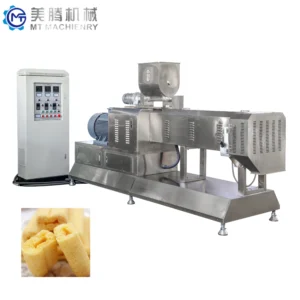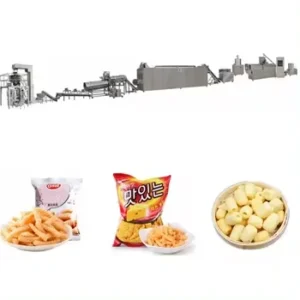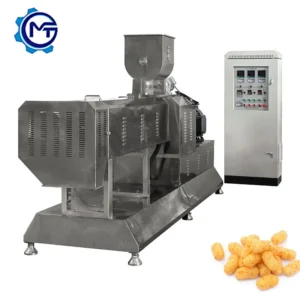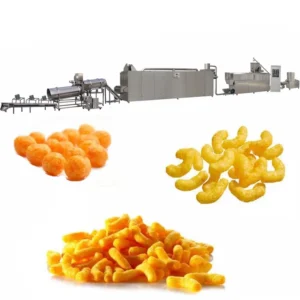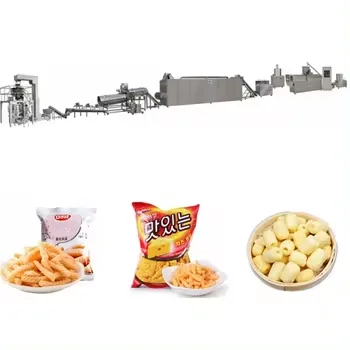
Throughput matching across every station — each MT65 through MT100 extruder is paired with dryer, flavoring, and packing units sized to the same output basis, eliminating the bottleneck that appears when an extruder runs ahead of its downstream equipment.
Technical Specifications
| Parameter | Value |
|---|---|
| Product Type | Twin Screw Puffed Snack Food Extrusion Line |
| Models Available | MT65, MT70, MT85, MT100 |
| Screw Type | Twin-screw |
| Installed Power (MT65) | 130 kW |
| Installed Power (MT70) | 180 kW |
| Installed Power (MT85) | 220 kW |
| Installed Power (MT100) | 240 kW |
| Real Consumption (MT65) | 95 kW |
| Real Consumption (MT70) | 120 kW |
| Real Consumption (MT85) | 130 kW |
| Real Consumption (MT100) | 160 kW |
| Output Capacity (MT65) | 120–150 kg/h (basis not stated in source — confirm raw material / moisture / product shape) |
| Output Capacity (MT70) | 200–300 kg/h (basis not stated in source — confirm raw material / moisture / product shape) |
| Output Capacity (MT85) | 300–500 kg/h (basis not stated in source — confirm raw material / moisture / product shape) |
| Output Capacity (MT100) | 600–800 kg/h (basis not stated in source — confirm raw material / moisture / product shape) |
| Control System | Frequency speed controlling system (PLC / MCC options available on request) |
| Die Configuration | Interchangeable dies — ball, tube, stick, ring, fruit loop, star, wheel, flower, heart |
| Core Filling | Available with added core filling machine and cutting machine |
| Dryer Heating Source | Electric, steam, or gas (configurable to local utility) |
| Flavoring System | Double drum with sugar melting, oil spraying, liquid/flour coating |
| Lubrication | Automatic lubricating and cooling system |
| Raw Materials | Corn, rice, wheat, oat, barley flour, and similar grain-based materials |
| Packing Machine | Automatic weighing, sealing, marking, coding; vibration feeding with electronic pad weighing |
| Standards | CE, ISO |
| Warranty | 1 year |
Application Suitability
| Application | Material or Output |
|---|---|
| Corn puff and cheese ball production | Corn flour, rice flour, grain blends with oil and seasoning coating |
| Core-filled snack manufacturing | Grain-based shell with cream, chocolate, or fruit paste center |
| Ring, tube, and stick snack formats | Wheat, oat, and barley flour blends with varied moisture content |
| Fruit loop and star-shaped cereals | Multi-grain formulations requiring precise die and screw matching |
| Startup or expansion snack lines | Full station integration from batching through packing under one supplier |
What a Nominal Capacity Figure Leaves Out About Your Puffed Snack Extrusion Line
The real output depends on your actual raw material, moisture level, and target shape — not the number on the spec sheet.
When a buyer receives a puffed snack extrusion line full equipment range quoted at a fixed hourly tonnage, that number usually assumes a standard corn grit recipe at a specific moisture percentage. Swap in a higher-fat oat blend or a denser rice formulation, and the barrel fill factor changes, the screw combination may need reconfiguration, and the expansion ratio drops. I learned this the hard way on a Middle East project where the trial ran perfectly on standard corn flour, but the customer’s local supplier delivered a coarser grind with different starch content — expansion collapsed on the first production day, and the screw setup had to be rebuilt from scratch. [NEED_CITE: effect of raw material particle size on extrusion expansion]
That is why every twin screw puffed snack extrusion line we ship goes through an in-house testing workshop trial on the buyer’s actual material before the crate is sealed. Parameters get locked, the screw combination gets recorded, and the die selection gets confirmed against the target shape and density the buyer’s market expects.
How Each Station in the Equipment Catalogue Fits Together
A puffed snack extrusion line full equipment range is only as reliable as its weakest throughput match. The extruder may push product at a steady rate, but if the dryer belt is too short for the moisture load, product backs up and the coating drum receives material still too wet for seasoning adhesion. The MT65 through MT100 models are each paired with a dryer, double-drum flavoring system, and cooling conveyor whose capacity is calculated against the same output basis, so material flows continuously without intermediate buffers piling up.
Where the Die and Screw Configuration Meets Your Product Shape
The interchangeable die system across all four models supports shapes from cheese balls to fruit loops, but switching formats is not just a die swap. The screw combination inside the barrel must be adjusted to deliver the correct shear profile and residence time for each shape’s expansion requirement. A ring shape needs a different moisture-to-expansion balance than a solid stick, and core-filled products add a third variable with the cream injection rate. The testing workshop locks these variables before dispatch, so the operator on site starts with a documented baseline rather than experimenting during the first production week. [NEED_CITE: twin-screw extrusion screw element arrangement for varying product density]
Reading the Power and Capacity Figures Across the Model Range
The installed power steps from 130 kW on the MT65 up to 240 kW on the MT100, while real consumption runs roughly 25–35 percent lower — a reflection of the motor headroom needed for startup torque and viscosity spikes when feed moisture fluctuates. The capacity spread across the four models covers small-batch specialty production through high-volume commodity snack runs, but those figures must be confirmed against your specific flour blend and target product density. Barrel length-to-diameter ratio across the range determines residence time, which directly controls starch gelatinisation completeness — under-gelatinised starch produces a dense, uneven puff that breaks during coating, while overworked material burns at the die face. The frequency speed control system allows the operator to fine-tune screw RPM in response to real-time expansion observations, maintaining batch-to-batch consistency once the baseline is set from the trial run.
The Hidden Cost of an Undersized Dryer or Flavoring Drum
When a line is assembled from separate vendors, the extruder supplier quotes their machine in isolation, and the buyer is left to source a dryer and coating system independently. The result is a dryer that cannot keep up on humid production days, or a single flavoring drum that creates a bottleneck while the extruder idles. On one project I supported, the buyer saved money sourcing a smaller dryer from a different supplier, then spent weeks fighting moisture-related clumping in the packing station downstream. [NEED_CITE: importance of throughput balancing in extrusion line design] Matching every station under one supplier eliminates that mismatch from the start.
Why Source the Full Puffed Snack Line from One Equipment Catalogue
Throughput matching is calculated at the engineering stage, not guessed on the floor — the dryer belt length, flavoring drum volume, and packing speed are each specified against the extruder model you select. The screw configuration and die design are recorded against your raw material and target shape during the in-house trial, giving you a documented starting point for production day one. Every contact surface uses food-grade materials across the line, from the batching hopper through the packing conveyor. Pre-sales consultation carries through to on-site installation, commissioning, operator training, and ongoing wear parts supply — so the team that configured your line is the same team answering the phone when the first screw replacement is due. Electrical schematics and voltage are confirmed for your target market before production begins, preventing the commissioning delays that occur when a control panel arrives wired for the wrong frequency. [NEED_CITE: CE machinery directive compliance for food extrusion equipment]
Documentation & Verification
- Line layout and capacity calculation showing station-by-station throughput match for your selected model
- Screw and die configuration record locked to your raw material and target snack shape
- Trial run report from the testing workshop using your actual flour blend before shipment
- Electrical schematic with voltage, frequency, and control language confirmed for your market
- CE declaration of conformity and ISO certificate covering the full line scope
- Operation and maintenance manual with wear parts list for screws, dies, and dryer belting
Installation, Commissioning & Support
- Foundation and floor space planning based on the full line footprint from batching through packing station
- Dedicated electrical circuit sized to the real consumption figure of your selected model (95–160 kW depending on unit)
- Dryer heating source configured to your local utility — electric, steam, or gas — before the unit ships
- First-run commissioning with screw RPM and barrel temperature profile set from the trial run baseline
- Operator training covering die changeover procedure between snack shapes and core-filled formats
- Wear parts stock recommendation covering screws, dies, and dryer belt sections for the first replacement cycle
Preparing Your Inquiry
To configure the right puffed snack extrusion line full equipment range for your facility, share your target product shape, the grain flour blend you plan to run, and the daily output volume your market demands. Include your workshop’s available floor area and ceiling height, along with the local voltage and frequency standard, so the electrical package and line layout arrive correct from the start. If you have existing upstream milling or downstream packing equipment, note the interface points so the new line integrates without redundant stations.
Frequently Asked Questions
Q: How is the output capacity of each model verified before shipment?
A: Each extruder model from MT65 to MT100 is run in our testing workshop using the buyer’s actual raw material at the specified moisture level. The trial run locks the screw combination, die selection, and barrel temperature profile, and a full report is provided before the line is packed for dispatch.
Q: Which supporting stations are matched to each extruder model?
A: The dryer belt length, double-drum flavoring system volume, cooling conveyor speed, and packing machine throughput are each calculated against the extruder’s confirmed output on your material, so no single station creates a bottleneck during continuous production.
Q: What electrical and control options are confirmed before production begins?
A: Voltage, frequency, and control panel language are specified to match your facility’s local standard. The frequency speed controlling system is standard, with PLC and MCC options available depending on your automation preference and integration requirements.
Q: How does die and screw setup change between snack shapes?
A: Switching from a ball to a tube or core-filled product requires both a die change and a screw element rearrangement to adjust shear and residence time. The correct configuration for each shape is documented during your pre-shipment trial run.
Q: Can individual stations be ordered to upgrade an existing line?
A: Yes. Each station — extruder, dryer, flavoring drum, cooling conveyor, or packing machine — is available separately. Provide your current line’s throughput and interface dimensions so the new station is sized to match without creating a bottleneck.