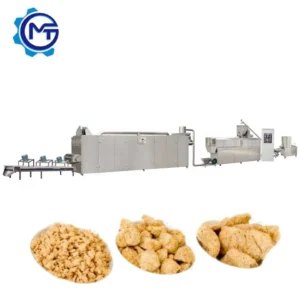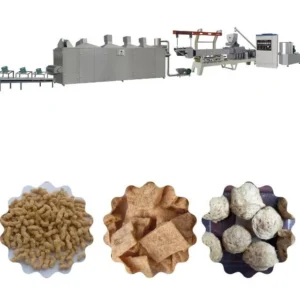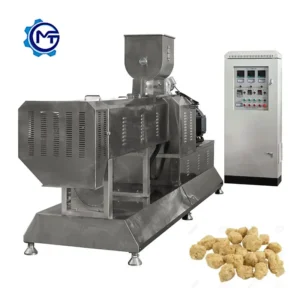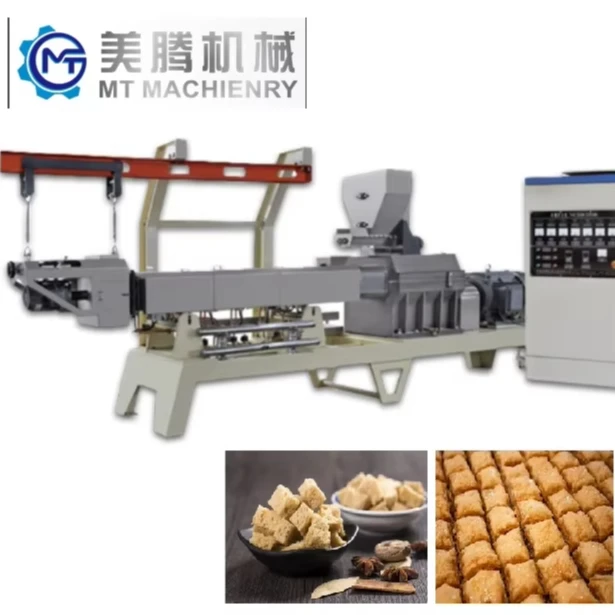
Screw Geometry Expertise — die and screw profiles are matched to your specific defatted soya flour or soya flakes before the twin screw extruder ships, not borrowed from a generic catalogue.
Technical Specifications
| Parameter | Value |
|---|---|
| Product Type | Twin Screw Extruder Production Line for Textured Soy Protein / Plant Based Meat |
| Models Available | MT65 / MT70 / MT75 / MT85 |
| Screw Type | Twin Screw |
| Installed Power | MT65: 84 kW; MT70: 160 kW; MT75: 190 kW; MT85: 210 kW |
| Power Consumption | MT65: 59 kW; MT70: 120 kW; MT75: 140 kW; MT85: 140 kW |
| Output Capacity | MT65: 100–150 kg/h; MT70: 150–200 kg/h; MT75: 150–200 kg/h; MT85: 250–300 kg/h (basis to be confirmed with raw material and moisture level) |
| Main Motor Power | 22 kW / 30 kW / 45 kW |
| Screw Length Options | 1050 mm / 1520 mm |
| Heating Power | 10 kW / 14 kW |
| Mixer Type | Vertical mixer with stainless steel 304 mixing ruler |
| Mixer Power | 4 kW / 7.5 kW / 15 kW |
| Mixer Batch Capacity | 20–30 kg / 70–80 kg / 170–180 kg per batch (basis to be confirmed) |
| Dryer Type | Multi-layer dryer, double pitch roller chain drive, round-trip drying |
| Dryer Energy Options | Fuel / Gas / Electricity (selectable) |
| Line Stations | Mixer → Screw Conveyor → Twin Screw Extruder → Air Conveyor → Multi-layer Dryer → Cooling Machine |
| Overall Dimensions (L×W×H) | MT65: 40000×1200×2200 mm; MT70: 41000×1500×2200 mm; MT75: 43000×1500×3200 mm; MT85: 45000×1500×3500 mm |
| Standards | CE (since 2014), ISO certified |
Application Suitability
| Application | Material or Output |
|---|---|
| Textured vegetable protein production | Defatted soya flour, low temperature soya flakes |
| Soya chunks and vegetarian beef substitutes | Soya flour blends shaped through specific die configurations |
| Plant based meat ingredient supply | TVP/TSP for meat analogue and fast food manufacturers |
| Maigre snacks and vegetarian food products | Peanut dregs, soybean dregs processed into puffed formats |
| Cereal and snack production | Reconfigured screw setup on the same extruder platform |
Why "Rated Capacity" Means Nothing Without Your Raw Material
A plant based meat processing line only hits its nameplate output when the screw configuration and die geometry match the exact protein source and moisture level you will actually run.
Many extruder quotations list a single output figure derived from a standard test material like corn starch or generic defatted soya flour. When a buyer switches to a blend of pea protein and wheat gluten, the material behaves differently inside the barrel — different gelatinisation temperatures, different shear requirements, different expansion ratios. The result is a plant based meat processing line that cannot hold the quoted throughput, or produces a fibrous structure that collapses instead of holding the layered texture the market expects. I have spent weeks on site adjusting screw element sequences after a buyer changed their raw material blend post-delivery, because the original configuration was never tested against their actual recipe [NEED_CITE: raw material variability in high-moisture extrusion].
Barrel Zones and Protein Fibre Alignment
The twin screw extruder in this plant based meat processing line uses sectional barrel heating with independent temperature control across multiple zones. For texturized soy protein, the barrel profile must hold the dough above the protein denaturation threshold long enough for fibre strands to align under shear, then cool before the die to lock the structure. A flat temperature profile produces a spongy mass rather than the layered, meat-like texture buyers expect from soya chunks and vegetarian beef substitutes.
Screw Length, Residence Time, and Shear History
Choosing between the 1050 mm and 1520 mm screw length options determines how long the material stays inside the barrel and how much mechanical energy it absorbs. Low temperature soya flakes require a longer residence time to fully hydrate and unfold their protein chains before reaching the die. Peanut dregs, which contain more residual oil, need a shorter barrel with higher shear to prevent oil separation inside the dough. The screw element sequence — conveying, kneading, reverse — is configured per raw material and target product format, not pulled from a default build [NEED_CITE: screw element configuration for protein texturization].
Reading the Power and Dimension Data
The installed power range from 84 kW on the MT65 to 210 kW on the MT85 reflects the mechanical energy available for shear inside the barrel, not just motor size. Higher installed power supports higher throughput on dense protein blends that resist conveying. The power consumption figures are lower than installed power because heating elements and feed motors cycle on and off. Overall line length stretches from 40 metres on the MT65 to 45 metres on the MT85, driven mainly by the multi-layer dryer section which must be long enough for round-trip drying at the throughput the extruder delivers. Mixer batch capacity must match the extruder feed rate: the 170–180 kg batch option pairs with the MT85 to avoid starvation, while the 20–30 kg batch suits the MT65 for smaller production runs or recipe trials.
The Cost of Mismatched Downstream Stations
An extruder that outpaces its dryer creates a backlog of wet, hot product that clumps together before cooling, destroying the fibrous structure you paid for. Conversely, an oversized dryer running half-empty wastes energy and dries the product unevenly, creating hard spots that ruin mouthfeel. When stations are sourced from separate vendors, nobody guarantees the throughput match — each supplier tests their machine in isolation. The full six-station line from mixer through cooling machine is configured so that every station handles the output the one before it delivers, eliminating bottlenecks that only appear during continuous production [NEED_CITE: line integration and throughput balancing in food extrusion].
What This Equipment Range Covers
The MT65 through MT85 extruder range spans four capacity tiers, allowing selection matched to your actual production target rather than forcing a single model to cover every scenario. Screw configuration and die design are specified to your raw material and target product — defatted soya flour for TVP, or a pea-and-gluten blend for vegetarian beef substitutes — and recorded before production begins. The in-house testing workshop runs trial batches on your actual raw material before the line ships, so product development happens at the factory, not on your floor after installation. Complete line integration under one supplier means throughput is matched across mixing, extrusion, drying, and cooling rather than assembled from separate vendors. Pre-sales engineering covers line layout, utility planning, and electrical confirmation for your target market before the order enters production.
Documentation & Verification
- Line layout and capacity calculation showing throughput match across all six stations
- Screw and die configuration record specific to your raw material and target product format
- Trial run report produced on your defatted soya flour or soya flakes before dispatch
- Electrical schematic with voltage, frequency, and control language confirmed for your market
- CE declaration of conformity and ISO certificate for import and compliance requirements
- Operation and maintenance manual with wear parts list for screws, dies, and seals
Installation, Commissioning & Support
- Line footprint from 40 to 45 metres requires level concrete floor with utility trenches for the multi-layer dryer exhaust
- Power supply must match confirmed voltage and frequency; dedicated circuits required for the main extruder motor up to 45 kW
- Line ships as pre-assembled stations; on-site connection of conveyors, electrical panels, and dryer ducting during commissioning
- First production run includes screw speed, barrel temperature, and dryer time calibration against your raw material batch
- Operator training covers screw element changeover procedures for switching between TVP, soya chunks, and snack formats
- Initial spare parts package includes replacement screw elements, die plates, and seals sized to your production schedule
Preparing Your Inquiry
To configure a plant based meat processing line that matches your production target, provide your raw material specification including protein content and moisture level, your target product format such as soya chunks or fine TVP granules, and your intended daily output. Include your workshop dimensions and ceiling height so the line layout accounts for the multi-layer dryer footprint and air conveyor routing. Confirm your local voltage, frequency, and preferred control language early so the electrical schematic is finalised before the build starts.
Frequently Asked Questions
Q: How is output capacity verified against my specific raw material and moisture level?
A: The testing workshop runs trial batches using your actual defatted soya flour or protein blend at your specified moisture content. Output is measured during a sustained run, not a short burst, and documented in a trial run report that accompanies the shipment. This confirms the capacity figure applies to your material, not a generic test substrate.
Q: What screw configuration and die design do I need for soya chunks versus TVP versus nuggets?
A: Soya chunks require a die with larger openings and a screw profile that builds moderate shear for an open, layered structure. Fine TVP granules use smaller die holes and higher shear to create dense, compact fibres. Nuggets fall between the two. The screw element sequence and die plate are selected and recorded for your target product before the extruder is built.
Q: Can the same line also produce cereal or snacks if I change the screw setup?
A: The twin screw platform supports screw element reconfiguration, allowing the same extruder to process starch-based cereal or snack recipes after a changeover. The dryer and cooling stations remain compatible. You will need a different die plate and a revised barrel temperature profile, both of which can be prepared in advance and swapped during a planned changeover.
Q: What spare wear parts should I order with the initial shipment?
A: Screw elements in the kneading and reverse sections wear fastest, particularly when processing abrasive soya flakes. A recommended initial package includes one full replacement set of high-wear screw elements, two spare die plates, and a set of barrel liner seals. The wear parts list provided with your documentation identifies exact part numbers for reordering.