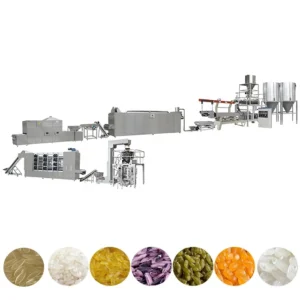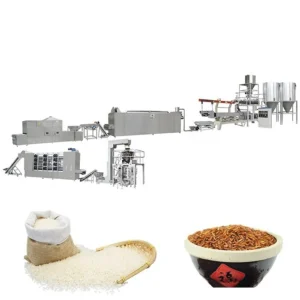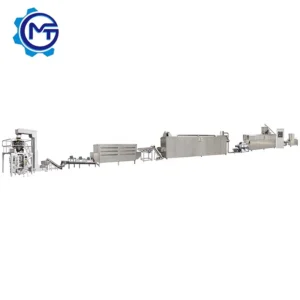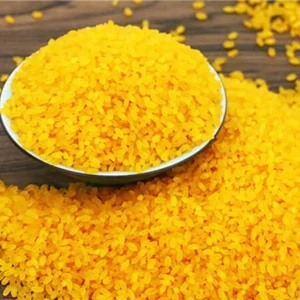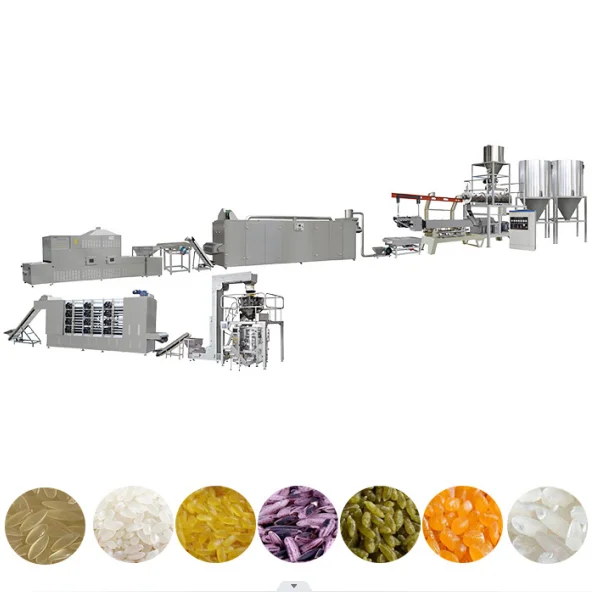
Throughput-Matched Stations — Every mixer, extruder, dryer and packer in this line is sized against the next, so no single station throttles your fortified rice output.
Technical Specifications
| Parameter | Value |
|---|---|
| Model | MT65 |
| Product Type | Fortified Rice Production Line |
| Installed Power | 85 kW |
| Power Consumption | 60 kW |
| Capacity | 80–100 kg/h (basis to be confirmed on actual formula and moisture) |
| Overall Dimensions | 28 × 1.2 × 2.2 m |
| Extruder Type | Twin Screw |
| Control | Frequency speed control with high automation |
| Line Sequence | Mixing → Extruding → Vibrating → Low-temp drying → Cooling → High-temp roasting → Cooling → Packing |
| Drying Heat Source | Electric or gas |
| Drying Method | Circulation drying with variable mesh belt speed |
Application Suitability
| Application | Material or Output |
|---|---|
| Nutritional program rice kernels | Broken rice, rice bran, vitamin and mineral premix |
| Instant artificial rice | Corn, millet, wheat, oats, starch blends |
| Fortified grain products | Buckwheat, bean flour, micro-nutrient additives |
Why "80–100 kg/h" Means Nothing Without the Formula
Capacity is a function of your raw material, not our nameplate.
I remember a buyer who flew in for a factory acceptance test on a nutrition line. The trial ran smoothly on our standard rice flour recipe, but their production formula carried a higher fat ratio from added lipid-based vitamins. Once they shipped the line home and loaded their own blend, the screws slipped and expansion dropped. Every parameter had to be re-tuned on site, costing them two weeks of commissioning time [NEED_CITE: importance of raw material trial runs before shipment]. That is why every Fortified Rice Production Line for sale from our workshop now starts with your actual material running through the extruder before the machines leave Shandong.
Full Line Station Matching
A twin screw extruder running at peak output is useless if the dryer cannot remove moisture fast enough to keep the kernels stable. On this line, the circulation drying oven is selected so its belt speed and thermal capacity follow the extruder discharge rate without creating a material pile-up. The low-temperature drying stage removes surface and internal moisture gently, while the high-temperature roasting step sets kernel structure. Frequency motor control on the mesh belt lets operators fine-tune residence time as the formula changes.
Screw Geometry and Kernel Density
Screw configuration directly controls shear, residence time and starch gelatinisation inside the barrel. For fortified rice, the goal is partial gelatinisation so kernels hold shape during cooking yet still release nutrients when eaten. We adjust screw element spacing and barrel temperature zones to match the grain blend and vitamin carrier you specify. When buyers send real samples, we record the screw and die configuration that produces the target kernel density and keep that record on file so replacements are ordered correctly [NEED_CITE: screw configuration impact on extruded food texture].
Reading the Specs Beyond the Nameplate
The MT65 draws 60 kW in normal operation against an 85 kW installed ceiling, leaving headroom for startup surges and heavier formulations. The twin screw design handles fibrous bran and sticky starch blends that would stall a single screw at similar throughput. Line length at 28 m includes cooling conveyors between drying stages; plan your workshop layout so operators can walk both sides for cleaning and screw inspection. Electric or gas heating on the drying oven affects utility hook-ups, so confirm your site gas pressure and electrical tariff before finalising the heat source.
The Hidden Cost of Skipping a Pre-Shipment Trial
When a nutrition rice line arrives overseas with the wrong screw profile for the local grain supply, production stalls while replacement screws are manufactured and air-freighted. The downtime often stretches across multiple weeks, and the first batches after restart still need lab testing before product reaches market [NEED_CITE: lead times for custom extrusion screw replacements]. Shipping a few kilograms of raw material to Shandong for a trial run is a fraction of the cost of idle commissioning crews sitting in a half-finished plant.
Why Source This Line Here
We run the entire line — mixer through packer — under one supplier, so throughput at each station is calculated against the others rather than assembled from disconnected vendors. Screw and die sets are specified to your grain blend and nutrient carrier before the extruder is built. An in-house testing workshop lets us run your material and document kernel density, expansion ratio and moisture loss before the machines are crated. Twin screw expertise across rice, starch and protein formulations means we have seen most ingredient combinations before. Electrical schematics are confirmed to your local voltage and frequency before panel wiring starts.
Documentation & Verification
- Line layout drawing with station throughput calculations for your target kernel output
- Screw and die configuration record matched to your grain and nutrient blend
- Electrical schematic confirming voltage, frequency and control language for your market
- Trial run report on your actual raw material showing kernel density and moisture data
- CE declaration of conformity and ISO certificate copies for customs clearance
- Packing photographs taken at crating stage for damage reference at destination
Installation, Commissioning & Support
- 28 m line footprint requires level concrete floor with clearance on both sides for screw access
- 85 kW installed power needs dedicated circuit; confirm local voltage and phase before wiring
- Machines ship in sectional crates; extruder barrel and dryer modules reassembled on site
- First-run parameter setting covers barrel temperature zones and belt speed calibration
- Operator training includes screw removal, die change and daily cleaning routines
- Wear parts list covers screws, dies and barrel liners with reorder codes for future supply
Before You Send the Inquiry
Tell us the grain base you plan to run — broken rice, corn, millet or a blend — along with the vitamin and mineral premix ratio. Share your workshop length and ceiling height so we can adjust the 28 m layout, and confirm your local voltage and frequency. If you already have a packing machine upstream or downstream, let us know its speed so we match the line discharge to it.
Frequently Asked Questions
Q: How is the 80–100 kg/h capacity verified?
A: We run your exact grain blend and nutrient premix through the MT65 in our testing workshop, record actual discharge weight over a timed period and document moisture content before and after drying. The resulting trial report becomes your baseline capacity figure.
Q: What voltage and frequency configurations are available?
A: Electrical panels are wired to your site supply before shipment. We confirm phase, voltage and frequency during the specification stage and label every component in your preferred language, so commissioning does not stall on mismatched breakers or untranslated HMI screens.
Q: How are screw and die sets chosen for my grain blend?
A: Different starch and fibre ratios need different screw element spacing and die land lengths. We test your raw material in Shandong, adjust the screw profile until kernel density and expansion meet your target, then record the configuration so replacement parts are always matched.
Q: What footprint and utilities does the full line require?
A: The 28 × 1.2 × 2.2 m line needs level flooring, side access for maintenance, a dedicated 85 kW power circuit, and either gas supply or sufficient electrical capacity for the drying oven. We provide a layout drawing with utility connection points before installation starts.