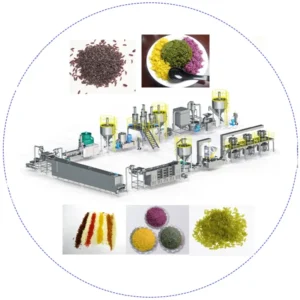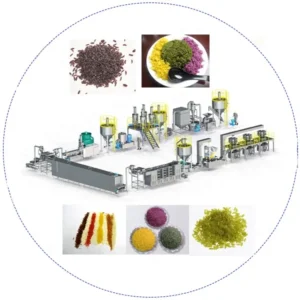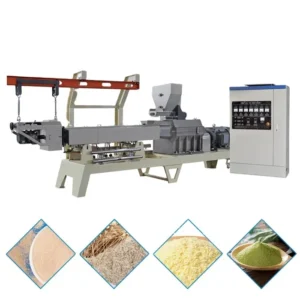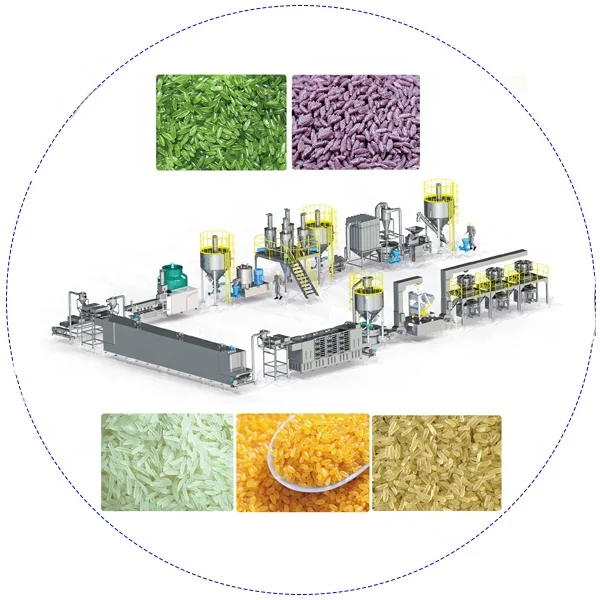
Matched Throughput Across Stations — Every unit in this artificial rice extrusion line equipment range is rated individually, so the mixer batch size, extruder output, dryer belt area and cooling length align without creating a bottleneck downstream.
Technical Specifications
| Parameter | Value |
|---|---|
| Product Type | Artificial Rice Extrusion Production Line |
| Extruder Type | Twin-screw, co-rotating, sectional modules |
| Screw Length | 2500 mm |
| Extruder Motor Power | 110 kW (frequency control) |
| Feeder Motor Power | 1.5 kW (frequency control) |
| Cutting Motor Power | 2.2 kW (frequency control) |
| Oil Pump Power | 0.75 kW |
| Mixing Machine Power | 15 kW |
| Mixing Machine Capacity | 130–150 kg per batch |
| Mixing Machine Dimensions | 1450 × 1550 × 980 mm |
| Mixing Machine Weight | Approx. 200 kg |
| Mixing Tank Thickness | 1.5 mm |
| Stainless Steel Cover Thickness | 1.2 mm |
| Vibrating Screen Power | 0.2 kW |
| Vibrating Screen Dimensions | 1700 × 1210 × 740 mm |
| Cooling Dryer Power | 2.2 kW |
| Cooling Dryer Dimensions | 5000 × 1500 × 1900 mm |
| Dryer Heating Type | Electric (gas, diesel, steam optional) |
| Control System | Frequency control on main drives |
| Raw Material Scope | Rice powder, corn powder, vitamin and mineral additives |
| Line Stations | Mixing → Twin-Screw Extrusion → Vibrating Screen → Low Temperature Dryer → Cooling Dryer |
| Standards | CE |
Application Suitability
| Application | Material or Output |
|---|---|
| Fortified artificial rice for nutrition programmes | Rice flour and corn flour base with vitamin and mineral premix |
| Extruded rice kernel production | Rice powder, corn powder blends shaped through twin-screw forming die |
| Breakfast cereal and grain expansion into rice formats | Grain flour blends processed into uniform kernel geometry |
| Machinery distributor equipment survey | Full station catalogue for quoting line configurations to end buyers |
Why "400 kg per Hour" Is Only Half the Story When Sourcing Artificial Rice Extrusion Line Equipment
A single extruder output figure means nothing until every downstream station is checked against it.
I spent years specifying lines across Southeast Asia and learned this the hard way. A client running a fortified rice powder line had the extruder dialed in at a comfortable rate, but the dryer could not pull moisture down fast enough on a humid day. The material clumped on the cooling belt and the whole line shut down for rework. When you survey artificial rice extrusion line equipment, the question is not just what the twin-screw extruder produces — it is whether the vibrating screen, low-temperature dryer and cooling conveyor each handle that same volume without queuing [NEED_CITE: throughput matching principles in continuous food processing lines].
How the Co-Rotating Twin-Screw Barrel Handles Rice and Corn Flour
The extruder uses sectional screw modules that can be arranged for forward transport, reverse mixing, liquid injection, de-gassing and forming within a single continuous barrel. Rice flour and corn flour differ in starch gelatinisation temperature and moisture absorption, so the screw profile must match the exact ratio in your formulation. Frequency control on the 110 kW main drive lets the operator tune screw speed independently of the feeder, which matters when switching between a high-corn blend and a predominantly rice-based mix. This flexibility is central to what makes a fortified rice processing machine for sale genuinely adaptable across product variations.
Dryer and Cooling Conveyor Sizing Against Extruder Output
The low-temperature dryer measures 5000 × 1500 × 1900 mm with a belt designed to carry the extrudate through a controlled moisture reduction zone. Heating is available in electric, gas, diesel or steam configurations depending on local utility infrastructure. After drying, the cooling dryer further stabilises kernel moisture before packing. If either station is undersized relative to the extruder throughput, surface moisture remains trapped inside the kernel and causes cracking or spoilage in storage. Matching belt area and residence time to the extruder output on your specific flour blend is where most line imbalances originate [NEED_CITE: moisture migration in extruded rice kernels during drying].
Reading the Spec Sheet Against Your Actual Formulation
The 2500 mm screw length provides sufficient residence time for starch gelatinisation across rice-corn blends, but the exact screw configuration and die design must be set after testing your raw material. The mixing machine handles 130–150 kg per batch with a 15 kW motor, which sets the upstream batching rhythm. The vibrating screen between extrusion and drying prevents kernel adhesion before the material enters the dryer — a station that is often omitted in basic line quotes. The 0.2 kW screen motor and 1700 × 1210 × 740 mm frame are sized to handle the full extruder discharge without overflow. Frequency control on the feeder and cutter motors allows fine adjustment of feed rate and cut length, which directly affects kernel uniformity and final packing weight consistency.
What Happens When Stations Are Mismatched
When the dryer capacity falls short of the extruder discharge rate, kernels leave the belt with residual moisture above the safe storage threshold. In humid tropical workshops this problem compounds quickly — surface condensation forms on the cooling conveyor, and the starch-rich material sticks and accumulates. Operators end up running the extruder at reduced speed to compensate, which wastes the installed motor capacity and shifts the screw shear profile away from the intended gelatinisation point. The line technically runs, but actual output drops well below the rated figure and product quality varies batch to batch [NEED_CITE: effects of residual moisture on extruded rice shelf stability].
Why Sourcing the Full Range From One Supplier Matters Here
The line includes every station from the 15 kW mixer through the twin-screw extruder, vibrating screen, dryer and cooling conveyor, so throughput calculations are done across the entire chain rather than per unit in isolation. Screw configuration and die design are set to your rice-corn flour ratio and additive type after in-house testing on your raw material. Electrical schematics and voltage confirmation are prepared before production so the 110 kW extruder drive and all frequency-controlled motors match your facility supply. Factory trial runs on customer-supplied material verify kernel shaping, moisture output and station-to-station flow before the equipment ships. Documentation covers line layout, machine specifications for each station, screw and die configuration records, and operation manuals — all tied to your specific formulation.
Documentation & Verification
- Line layout drawing showing station spacing and throughput calculation for your target output
- Machine specification sheet per station covering motor power, dimensions and rated capacity
- Screw and die configuration record matched to your rice-corn flour ratio and additive blend
- Electrical schematic with voltage and frequency confirmation for your facility supply
- Factory trial run report with photographs taken on your supplied raw material
- CE declaration of conformity covering the complete assembled line
Installation, Commissioning & Support
- Foundation planning based on the 5000 × 1500 mm dryer footprint and extruder vibration isolation
- Power distribution layout for the 110 kW extruder drive and individual frequency-controlled motor circuits
- Assembly sequence from mixer through cooling conveyor with station-by-station alignment checks
- First-run parameter setting on your flour formulation including screw speed, barrel temperature and dryer residence time
- Operator training covering frequency drive adjustment, screen maintenance and belt tensioning
- Wear parts list for screw modules, die plates and dryer belt components with reorder specifications
Before You Send an Enquiry
When evaluating artificial rice extrusion line equipment, the most useful information you can provide upfront includes your exact flour formulation and moisture target, the daily production volume you need, your facility voltage and frequency, and whether you prefer electric, gas, diesel or steam heating for the dryer. If you already have upstream batching or downstream packing equipment, note the interface dimensions so the line can be configured to connect without modification.
Frequently Asked Questions
Q: How is the output capacity of each station measured and on what raw material basis?
A: Each station is rated individually based on specific operating conditions. The mixer handles 130–150 kg per batch, and the extruder throughput depends on the flour formulation, moisture content and screw configuration. We confirm actual output through a trial run on your supplied raw material before finalising the line specification, rather than quoting a single generic number that may not apply to your blend.
Q: What drive and frequency control options are available on the extruder, feeder and cutter?
A: The 110 kW extruder motor, 1.5 kW feeder and 2.2 kW cutter all feature independent frequency control. This allows operators to adjust screw speed, feed rate and cutting speed separately, which is important when switching between different rice-corn flour ratios or adjusting kernel length. Control parameters can be saved per recipe for repeatable production across shifts.
Q: How do I select between electric, gas, diesel or steam heating for the dryer?
A: The choice depends on your local utility availability and energy cost structure. Electric heating is straightforward to install but may carry higher operating costs in some regions. Gas and diesel offer lower per-unit energy cost where supply is reliable. Steam is common in facilities that already operate a boiler for other processes. We confirm the heating type during the specification stage before production begins.
Q: What is the screw configuration and die design process for a new flour formulation?
A: We start with your raw material sample and target kernel specification. The co-rotating sectional screw modules are arranged to match the gelatinisation behaviour of your rice-corn blend, and the die is designed for the required kernel geometry. A trial run in our testing workshop confirms shaping, texture and moisture levels before the configuration is locked and documented in your screw and die record.
Q: Can I order individual stations or only the complete line?
A: Individual stations from the mixer to the cooling dryer can be specified and quoted separately for integration into existing lines. Each unit ships with its own machine specification sheet, electrical documentation and operating manual. When ordering standalone, we confirm interface dimensions, voltage requirements and throughput compatibility with your upstream and downstream equipment before production.