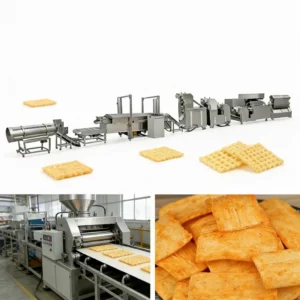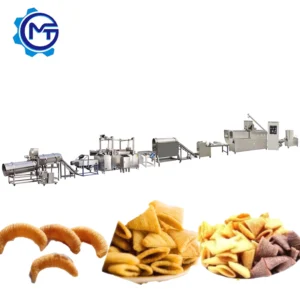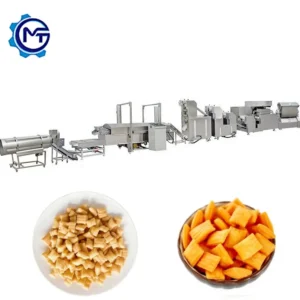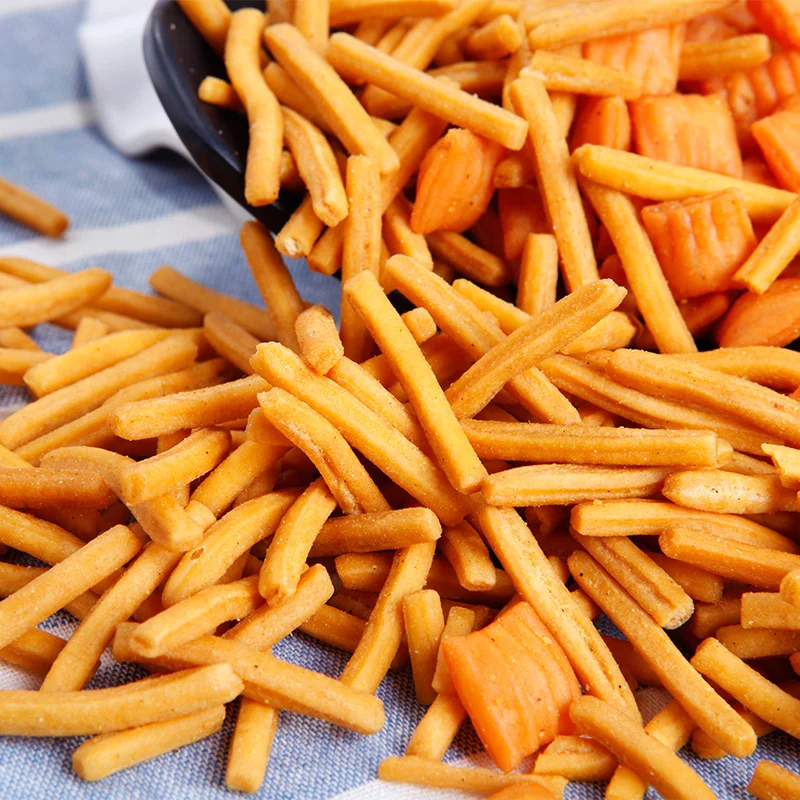
Full Equipment Integration — Every station from the mixer to the fryer is capacity-matched within one line build, preventing the bottleneck that appears when a fryer is sourced separately from the extruder upstream.
Technical Specifications
| Parameter | Value |
|---|---|
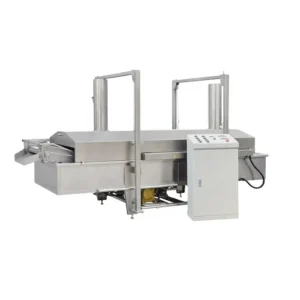
| Product Type | Continuous Deep Frying Machine for Snack Food Processing |
| Heating Power | 60 kW |
| Oil Capacity | 320 L |
| Voltage & Frequency | 380V / 50Hz (configurable for site requirements) |
| Control System | PLC |
| Capacity Range | 100–1000 kg/h (basis not stated in source — confirm product type, moisture, and oil content) |
| Overall Dimensions (L×W×H) | 6700 × 2200 × 1200 mm |
| Net Weight | 2000 kg |
| Construction Material | Food-grade 304 Stainless Steel |
| Heating Method | Electric heating (gas heating option available) |
| Conveyor System | Upper and lower double-layer mesh belt, frequency conversion stepless speed regulation |
| Oil Filtration | Continuous circulation filtration system |
| Slag Discharge | Bottom-mounted automatic slag discharge system |
| Lifting System | Automatic lifting for upper hood and mesh belt |
| Warranty | 1 Year (core components: 1 Year) |
| Assembly State | Complete unit, fully assembled |
Application Suitability
| Application | Material or Output |
|---|---|
| Extruded fried sticks production | Wheat flour dough extrudates cut to stick format before frying |
| Pellet chip processing | 3D and 2D starch-based pellets expanded through hot oil immersion |
| Puffed snack finishing | Corn or rice-based extrudates fried for surface crispness and color |
| Core-filled snack lines | Filled extrudates requiring controlled oil temperature to seal outer shell |
Why the Frying Station Bottleneck Appears Before You Notice
A Continuous Deep Frying Machine for sale is only as effective as its throughput match to the extruder feeding it.
I once spent two weeks on a snack line in Bogotá where the extruder pushed out product faster than the batch fryer could handle it. Half-cooked pellets piled up on the cooling belt while the fryer caught up. The operator kept raising the belt speed, which shortened frying time and sent pale, under-expanded chips to the flavouring drum. [NEED_CITE: throughput mismatch between extrusion and frying stations in snack food lines] When every station comes from one equipment supplier, the fryer oil volume, belt length, and heating capacity are calculated against the upstream extruder’s actual output on the buyer’s raw material — not against a catalog number that assumes ideal conditions.
Double-Layer Mesh Belt and Density Control
Extruded snack pellets and cut sticks vary in density depending on the raw material’s starch content and the moisture leaving the extruder die. A single-layer belt lets low-density product float to the oil surface, frying only the top while the bottom steams against submerged oil. The double-layer mesh belt on this unit clamps the product at a fixed depth, so every piece receives the same thermal exposure regardless of whether it is a dense wheat stick or a lighter pellet chip.
Oil Circulation and Acid Value Management
During a continuous production run, fine particulate from the extrudate accumulates in the oil. Without filtration, that particulate carbonizes and raises the free fatty acid level, which darkens the product surface and shortens the oil’s usable life. The continuous circulation filtration system on this fryer pulls oil through a filter stage and returns it to the tank, keeping particulate load down across long shifts. [NEED_CITE: oil degradation rates in continuous snack frying operations]
Reading the Specifications That Matter
The 60 kW heating power determines how fast the 320 L oil volume recovers temperature after cold product enters the fryer. A higher thermal load means shorter recovery and more consistent color across the belt width. The frequency conversion stepless speed regulation on the mesh belt lets the operator set frying time independently of belt tension, which matters when switching between a dense wheat flour stick that needs a longer fry and a thin pellet chip that expands in seconds. The PLC control stores these speed and temperature profiles so that changeovers between product formats do not require manual recalibration each shift. The food-grade 304 stainless steel construction throughout the fryer body, hood, and mesh belt prevents corrosion from salted seasoning carry-over and allows washdown with alkaline cleaning agents without surface pitting.
The Hidden Cost of a Mismatched Fryer
When the fryer capacity is specified against a generic snack formula rather than the buyer’s actual extrudate, the result shows up weeks after commissioning. The oil temperature drops below setpoint every time the belt loads, producing a band of under-fried product that the downstream flavouring drum cannot mask. Operators compensate by slowing the line, which leaves the extruder running idle and wastes the throughput the buyer paid for. [NEED_CITE: impact of frying temperature fluctuation on final snack texture and oil absorption]
Why Source This Station From the Same Supplier
The fryer is throughput-matched to the extruder and de-oiling station within a single line calculation, so no station waits on another. Screw configuration and die design on the upstream extruder are specified to the buyer’s raw material, which determines the moisture and density entering the fryer. An in-house testing workshop runs trial batches on the customer’s actual extrudate before shipment, confirming frying time and oil temperature against the target product specification. The twin-screw expertise across snack, cereal, and starch applications means the fryer parameters are set by engineers who understand what the extruder produces. Pre-sales consultation extends through on-site installation, commissioning, and operator training at the buyer’s facility.
Documentation & Verification
- Line layout drawing confirming fryer position relative to extruder and de-oiling conveyor
- Electrical schematic with voltage and frequency locked to site supply before production starts
- Machinery test report showing oil temperature stability across a full production cycle
- Trial run record on customer extrudate verifying frying time and final product color
- Video outgoing inspection of mesh belt alignment and hood lifting mechanism before crating
Installation, Commissioning & Support
- Floor plan showing 6700 mm length clearance plus operator access on both sides of the fryer
- Dedicated 380V circuit sized for 60 kW heating load plus 2.6 kW conveyor and pump motors
- Unit ships fully assembled; hood and belt lifting system tested before dispatch
- PLC program loaded with frying profiles for buyer’s confirmed snack format at commissioning
- Mesh belt segments, heating tubes, and filtration elements listed as spare wear parts with sourcing details
What to Include in Your Inquiry
Provide the extrudate type, raw material formulation, and target hourly output so the fryer belt speed and oil volume can be matched to upstream extrusion. Confirm the site voltage, frequency, and control language preference. Specify whether the fryer integrates into an existing line or a new build, and whether a trial run on your raw material is required before shipment.
Frequently Asked Questions
Q: How is frying capacity verified against the extruder’s actual output?
A: The upstream extruder is run on the buyer’s raw material in the testing workshop, and the output rate, moisture, and density are measured. The fryer belt speed, oil volume, and heating power are then set so that every piece receives the correct frying time without the line slowing down or product accumulating between stations.
Q: What voltage configurations are available for different export markets?
A: The standard configuration is 380V / 50Hz, but the heating elements, motor windings, and PLC power supply can be wound for other industrial voltages. The buyer confirms site voltage and frequency during the specification stage, and the electrical schematic is locked before production begins.
Q: How does the PLC handle temperature and speed changes between snack formats?
A: The PLC stores separate recipes for each product format, each containing the oil temperature setpoint, mesh belt speed, and filtration cycle interval. When the operator selects a recipe at the touchscreen, the system adjusts all parameters simultaneously without manual recalibration.
Q: What spare wear parts are included with the initial shipment?
A: The standard spare package includes replacement mesh belt segments, heating tubes, and filtration elements. The wear parts list in the documentation identifies each item by part number and material grade so that replacements can be sourced locally or ordered directly.
Q: Can the fryer be commissioned as part of a full snack line?
A: Yes. The fryer is commissioned alongside the extruder, dryer, de-oiling conveyor, and flavouring drum as a single integrated line. Throughput at each station is verified on the buyer’s raw material during on-site commissioning, and operator training covers the full process from batching to packing.