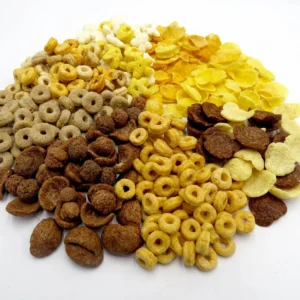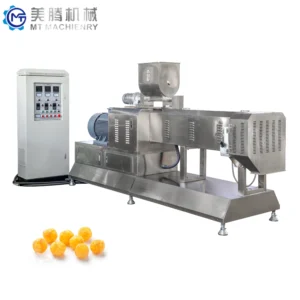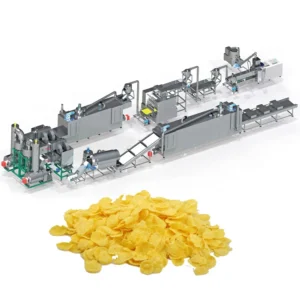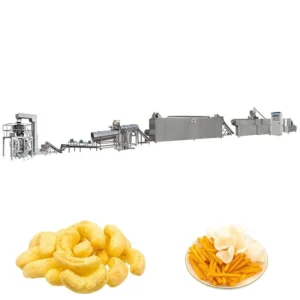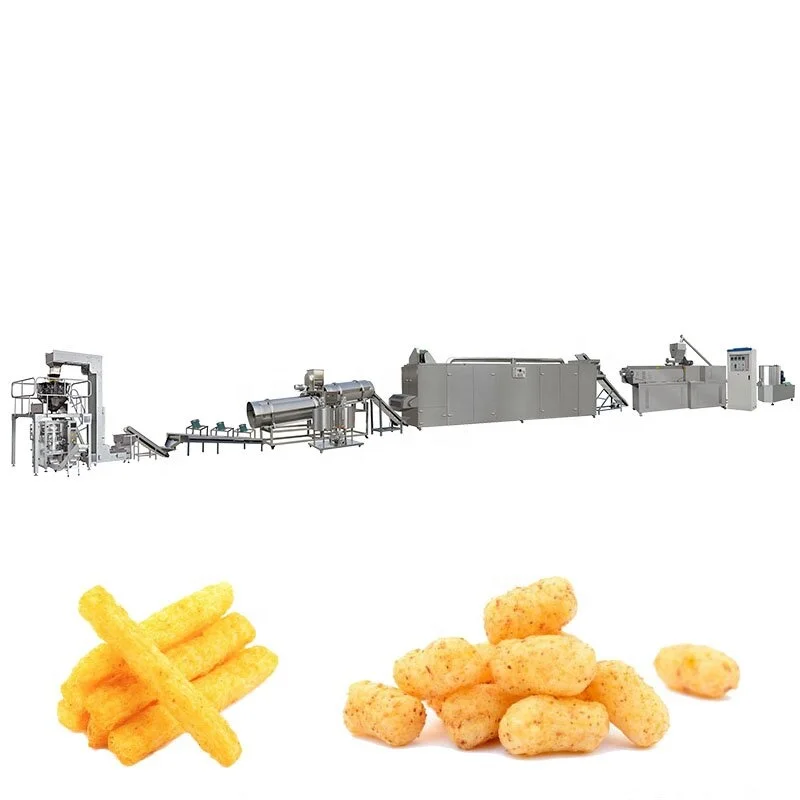
Matched Throughput Across Every Station — Every mixer, extruder, cooler and packer in this line is balanced so no single unit bottlenecks your corn crisp or maize chip output.
Technical Specifications
| Parameter | Value |
|---|---|
| Product Type | Twin Screw Food Extrusion Production Line |
| Screw Type | Twin Screw |
| Contact Material | Food Grade Stainless Steel 201/304 |
| Voltage & Frequency | Three Phase 380V/50Hz; Single Phase 220V/50Hz (customizable to local voltage) |
| Motor Brand | Siemens (China) or China Top Brand |
| Inverter | Delixi or Delta |
| Control System | PLC with MCC |
| Installed Power | Approx. 100 kW (electricity); 50–60 kW (gas or diesel) |
| Energy Options | Electricity / Gas / Diesel / Steam |
| Line Stations | Mixer → Extruder → Vibrate Cooler Machine → Roasting Machine → Packing Machine |
| Standards | CE, ISO |
Application Suitability
| Application | Material or Output |
|---|---|
| Corn crisps and maize chips | Corn grits, corn flour, degerminated maize |
| Corn sticks and cheese balls | Corn, rice, millet blends with seasoning |
| Core-filled snacks | Cereal dough with cream or chocolate filling |
| Artificial and fortified rice | Rice flour, buckwheat, brown rice blends |
| Puffed breakfast cereals | Oat, wheat, multi-grain formulations |
Why the Raw Material Test Must Happen Before You Commit to a Line Configuration
Your actual corn or maize flour behaves nothing like the standard test batch.
I have stood on factory floors in Lagos watching an extruder push out collapsed, dense sticks because the local maize had higher oil content than the trial grain used during the build phase. The screw combination that produced perfect expansion in Shandong turned the buyer’s raw material into something the local market would reject. A Twin Screw Food Extrusion Production Line manufacturer must verify screw pitch, die geometry and barrel temperature zones against the exact flour or grit you will feed into the hopper. Skipping that step shifts all process development onto your site, where downtime and wasted material compound fast [NEED_CITE: variability in maize starch and fat content across sourcing regions].
Every Station Sized to the Same Throughput
A mixer that batches faster than the extruder can process creates idle labor and spoilage. A roaster that runs slower than the cooler upstream turns into a choke point where product backs up on the belt. This line is configured so the mixer capacity, twin-screw extruder feed rate, vibrating cooler belt speed and roasting drum volume all align to the same target throughput. The result is continuous flow without buffer hoppers overflowing or operators waiting on the next station.
Energy Source Flexibility for Unstable Grids
Many snack producers in South Asia and Sub-Saharan Africa run plants where three-phase electricity drops out several times a week. This line is available with electric heating, gas-fired, diesel or steam thermal options, so you can select the energy source that matches your facility infrastructure. The PLC and MCC control panel adapts to whichever heating method is chosen, keeping barrel temperature profiles stable regardless of the energy input [NEED_CITE: industrial energy infrastructure reliability in emerging markets].
Screw Geometry and Barrel Zones Decoded for Snack Expansion
The twin-screw configuration gives you two intermeshing screws that shear, mix and convey cereal dough simultaneously — a critical difference from single-screw designs when you need uniform starch gelatinisation across corn or rice blends. The barrel is divided into independently controlled heating zones, each set to a different temperature so the dough transitions from hydration through gelatinisation to expansion in stages rather than all at once. Die aperture size and shape determine the cross-section of your corn sticks or crisps, while moisture content at the feed point governs how much the product expands after leaving the die. The Delta or Delixi inverter adjusts screw speed precisely, letting operators tune shear input without stopping the line.
The Cost of Skipping Voltage and Control Language Confirmation
A 380V/50Hz motor wired into a 415V/60Hz supply will overheat and fail within weeks, and replacing a Siemens-class drive motor on-site is neither cheap nor fast. I have seen entire commissioning schedules slip because the HMI language was locked to a script the local operators could not read, turning a simple parameter adjustment into a multi-day troubleshooting call. These are not design flaws — they are communication gaps that a Twin Screw Food Extrusion Production Line manufacturer should close before the machine leaves the factory [NEED_CITE: electrical standards and voltage variations across export destinations].
What the Factory Test Actually Covers Before Dispatch
A complete equipment range is only valuable if each unit performs as specified with your material. The in-house testing workshop runs your actual corn, rice or millet blend through the assembled line, documenting expansion ratio, product density and surface texture. Screw and die combinations are adjusted during this trial until the output meets your target specification. You receive a trial run report with the shipment, so your team knows the baseline parameters before installation day. Every food-contact surface uses 201 or 304 stainless steel, matching hygiene expectations in snack and cereal production. Documentation including the electrical schematic, screw configuration record and CE declaration travels with the machine, not buried in a follow-up email.
Documentation & Verification
- Line layout and capacity calculation matched to your snack product format
- Screw and die configuration record specific to your corn or rice blend
- Electrical schematic with voltage and frequency confirmed for your country
- Trial run report on your raw material before shipment leaves the factory
- CE declaration of conformity and ISO certificate included in shipping documents
Installation, Commissioning & Support
- Foundation must support the combined weight of extruder, cooler and roaster on level concrete
- Dedicated three-phase circuit required matching confirmed voltage and frequency at your site
- Line ships in modular sections for container loading and reassembly on your floor
- First-run parameter setting includes barrel zone temperatures and screw speed tuning
- Operator training covers PLC interface navigation and emergency stop procedures
- Wear parts list identifies screws, dies and seals with replacement intervals
What to Prepare Before Requesting a Quotation
Share your target product format — whether corn sticks, maize chips or core-filled snacks — along with the specific cereal flour or grit you plan to use and its moisture and fat content. Confirm your facility voltage, frequency and whether you need the control interface in a language other than English. If you have existing upstream milling or downstream packing equipment, provide the model and throughput so the line can be matched at the connection points.
Frequently Asked Questions
Q: What stations are included in the full line and how is throughput matched?
A: The line runs from mixer through twin-screw extruder, vibrating cooler, roasting machine and packing station. Each unit is selected so its maximum processing rate aligns with the others, preventing bottlenecks. The Twin Screw Food Extrusion Production Line manufacturer calculates capacity based on your specific product format and raw material before finalizing the configuration.
Q: Can the voltage, frequency and control language be configured for my market?
A: Yes. The standard offering covers three-phase 380V/50Hz and single-phase 220V/50Hz, but the motor, inverter and transformer can be specified to match your local supply. The PLC interface language is set before shipment so your operators can read all menus and alarms in their working language from day one.
Q: Which energy source is recommended for my corn crisp or maize chip line?
A: The choice depends on your plant infrastructure and local energy costs. Electric heating offers precise zone control, while gas or diesel options suit locations with unreliable grid power. Steam integration works if your facility already runs a boiler. The Twin Screw Food Extrusion Production Line manufacturer will advise based on your utility profile.
Q: What raw materials can the twin screw extruder handle beyond corn?
A: The twin-screw design processes rice, millet, brown rice, buckwheat and multi-grain blends in addition to corn. Different cereal formulations require specific screw configurations and barrel temperature profiles, which are determined during the pre-shipment trial run on your actual raw material to ensure consistent expansion and texture.
Q: What spare wear parts are included and how are replacements supplied?
A: The initial shipment includes a wear parts list identifying screws, dies and seals that require periodic replacement. A set of spare screws and dies matching your configuration is typically included. Replacement parts are manufactured to the same specification and can be ordered directly, ensuring compatibility with your installed line.