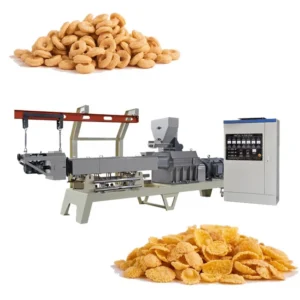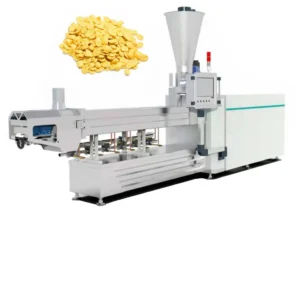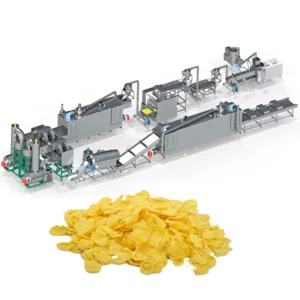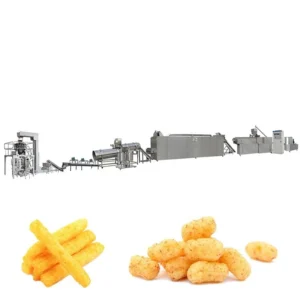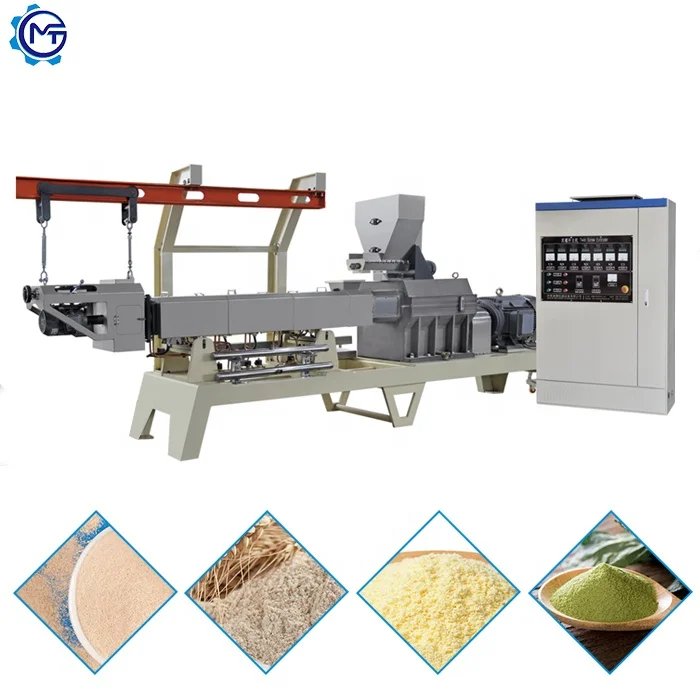
Integrated Extruder to Flaker Design — Every station on this corn flakes line is matched for throughput, validated with trial runs on the buyer’s own raw material before dispatch.
Technical Specifications
| Parameter | Value |
|---|---|
| Product Type | Corn Flakes Breakfast Cereal Production Line |
| Model Options | MT70 / MT85 / MT75 |
| Extruder Type | Twin Screw |
| Installed Power | 160 kW (MT70) / 190 kW (MT85) / 210 kW (MT75) |
| Power Consumption | 120 kW (MT70) / 140 kW (MT85) / 150 kW (MT75) |
| Output Capacity | 150–200 kg/h (MT70) / 300–400 kg/h (MT85) / 300–500 kg/h (MT75) (basis not stated in source — confirm raw material type, moisture content, and flake thickness) |
| Overall Dimensions (L×W×H) | 41 × 1.5 × 2.2 m (MT70) / 43 × 1.5 × 3.2 m (MT85) / 45 × 1.5 × 3.5 m (MT75) |
| Control System | PLC and MCC integrated |
| Flaking System | Hydraulic double rollers with independent motor drives and infrared sensor temperature control |
| Dryer Heating Source | Gas or Electric (configurable) |
| Roasting Oven | Hot air with dual circulating fans, vibrating pan, high temperature spraying tubes, and cyclone dust removal |
| Coating System | Double tumble sugar melting, elevator, coating drum, spraying nozzle |
| Screw Material | Wear-resistant alloy (specifications to confirm against application) |
| Voltage & Frequency | Configurable per facility (commonly 415V 50/60Hz, 440V 50/60Hz, 220V 60Hz) |
| Certifications | CE / ISO |
Application Suitability
| Application | Material or Output |
|---|---|
| Natural corn flakes breakfast cereal | Corn, rice, wheat, oat, barley powder — toasted and flaked |
| Sugar-coated breakfast flakes | Corn base with sugar syrup glazing through double tumble drum |
| Multi-grain cereal shapes | Rings, balls, tubes, stars, fruit loops by extruder die adjustment |
| Fortified instant porridge and baby cereal | Vitamin-mineral premix blended with corn, rice, or oat base |
Why Nominal Capacity Figures Mislead Corn Flakes Buyers
A corn flakes production line equipment manufacturer quoting capacity without specifying the raw material basis, moisture percentage, and flake thickness leaves the buyer with an unverifiable number that rarely holds up after commissioning.
Capacity is only meaningful when tied to a specific formulation, moisture content, and final product geometry.
I have walked through facilities where extruder output was rated at one figure on a starch-rich formulation, then dropped noticeably when the buyer switched to a higher-fibre multigrain blend. The dryer, originally sized to the higher number, became the constraint rather than the extruder. Without a documented trial on the buyer’s actual recipe, every number on the spec sheet remains a guess. This is why every line configuration must begin with a raw material conversation, not a capacity demand. [NEED_CITE: twin-screw extrusion throughput variables on cereal grain blends]
How Screw and Die Geometry Shape Your Final Flake
The twin-screw extruder sits at the centre of the line, and its screw configuration determines the degree of starch gelatinisation that the raw material achieves before it ever reaches the flaking rolls. Screw element arrangement, barrel temperature profiling, and die aperture collectively decide whether the extrudate arrives at the flaker with the right plasticity and moisture distribution. A poorly matched screw build produces either an under-cooked pellet that shatters during flaking or an over-expanded piece that refuses to compress into a flat, uniform flake. The screw and die configuration is therefore documented to each buyer’s target raw material before production begins.
What the Flaking Station Actually Controls
Flake thickness, surface integrity, and cooking behaviour in the toasting oven all trace back to the double-roller flaking system. The hydraulic pressure between the rollers, combined with independent motor drives on each roller, allows the operator to adjust nip gap and differential speed to dial in flake weight per unit area. Infrared sensor temperature control across the roller surface prevents localised moisture loss that would otherwise cause edge cracking. Consistent flake thickness is critical because uneven flakes toast at different rates, producing a final product with mixed colour and texture across the same batch. [NEED_CITE: hydraulic roller flaking parameters for cereal grain pellets]
Reading the Specification Sheet Beyond the Headline Numbers
Installed power across the three model options ranges from 160 kW to 210 kW, but actual power consumption during steady-state production sits at roughly 70–75% of that figure, depending on the raw material’s resistance to shear inside the barrel. The extruder’s automatic lubricating and cooling function manages bearing temperature during extended runs, which matters because cereal doughs generate sustained friction loads unlike short-run snack trials. The roasting oven uses two separate circulating fans and a cyclone dust removal device — this arrangement keeps fines from recirculating onto the flake surface while maintaining uniform hot air distribution for consistent blistering. PLC and MCC control integration means that start-up sequences, speed ratios between the extruder and flaker, and fault responses are coordinated rather than left to individual station operators reacting independently.
The Hidden Cost of Mismatched Station Capacity
An extruder that outpaces its downstream dryer forces the operator to either throttle back throughput or accept product with residual moisture that fails shelf-life testing. A coating drum undersized for the roasting oven’s output creates a queue of flakes cooling unevenly while waiting for sugar application. These mismatches rarely appear on the quotation because each station is often sourced or specified separately without a whole-line throughput calculation. The result shows up weeks after commissioning as chronic bottlenecks and product inconsistency that no amount of operator adjustment can resolve. [NEED_CITE: production line station matching in food extrusion systems]
Why Buyers Specify This Line Configuration
Each station from mixing through packing is designed under one engineering scope, so extruder output, flaker nip rate, dryer residence time, and roasting oven throughput are calculated together rather than assembled from independent vendor specifications. Screw configuration and die design are specified to the buyer’s raw material formulation and target flake density before manufacturing begins. The in-house testing workshop runs the buyer’s actual cereal blend through the extruder and flaker before shipment, so product development starts with verified data rather than post-installation guesswork. The hydraulic flaking system with infrared temperature control and the dual-fan roasting oven with cyclone dust removal address the two stations where corn flake quality most commonly drifts. Documentation covers the full chain — line layout, screw configuration record, electrical schematic, and trial run report — so the buyer’s engineering team has a complete reference at commissioning.
Documentation & Verification
- Line layout drawing with throughput matching calculations for each station
- Screw and die configuration record specific to the buyer’s cereal formulation
- Trial run report on buyer’s raw material conducted in the testing workshop
- Electrical schematic with confirmed voltage and frequency for the target facility
- Factory test record documenting steady-state output and flake geometry
- Packing photographs and customs documentation support for export shipment
Installation, Commissioning & Support
- Overall line footprint of 41–45 m length requires a clear-span bay with 2.2–3.5 m ceiling clearance depending on model
- Power supply must match the confirmed voltage and frequency configuration with dedicated circuit protection for the 160–210 kW installed load
- Equipment ships in modular sections for reassembly; flaker and roaster alignment verified on site
- PLC and MCC control language and interface configured to the operator’s preferred language before commissioning
- Wear parts inventory including screws, dies, and flaking roller sleeves provided with recommended reorder intervals
- Maintenance schedule covers hydraulic system inspection on the flaker and circulating fan bearing service on the roasting oven
What to Share When Requesting a Line Proposal
To move from an initial inquiry to a workable configuration, the most useful information includes the raw material formulation with moisture percentages, the target flake thickness and whether the end product is natural or sugar-coated, the facility’s available floor space and ceiling height, and the local voltage and frequency standard. If the line will replace or connect to existing upstream mixing or downstream packing equipment, sharing those interface details avoids integration surprises. A small sample of the raw material enables the testing workshop to validate extruder behaviour and flaking characteristics before any engineering commitment is made.
Frequently Asked Questions
Q: How is line capacity verified on my specific raw material before shipment?
A: A trial run is conducted in the in-house testing workshop using a sample of the buyer’s actual cereal formulation. The extruder screw configuration, die design, and flaker settings are adjusted during the trial to document achievable output, flake thickness, and surface quality. The resulting trial report accompanies the shipment and serves as the commissioning baseline.
Q: How do you ensure extruder output matches downstream station capacity?
A: Every station — flaker, dryer, roasting oven, coating drum, and cooler — is sized based on the extruder’s verified throughput on the target formulation. The line layout document shows throughput calculations for each station so the buyer’s engineering team can confirm the balance before production begins, eliminating post-installation bottleneck discoveries.
Q: What voltage, frequency, and control language options are confirmed before production?
A: The buyer’s facility voltage and frequency are confirmed during the proposal stage, and the electrical schematic reflects the agreed standard. PLC and MCC control interfaces are configured to the operator’s preferred language. Common configurations include 415V and 440V at 50 or 60 Hz, but other standards are accommodated.
Q: Can the line produce both natural and sugar-coated flakes and other cereal shapes?
A: Yes. Natural corn flakes follow the mixing, extruding, flaking, drying, roasting, and cooling sequence. Sugar-coated variants add sugar spraying, tumble coating, and secondary drying stations. By changing the extruder die, the same platform produces rings, balls, tubes, stars, and other multi-grain cereal shapes for product diversification.
Q: What spare wear parts are included and how is reordering handled?
A: The initial shipment includes a wear parts set covering extruder screws, dies, and flaking roller sleeves sized to the line configuration. The wear parts list documents each component’s part number and material specification. Reorder lead times are confirmed at the proposal stage so buyers can plan maintenance intervals without unplanned line stoppages.