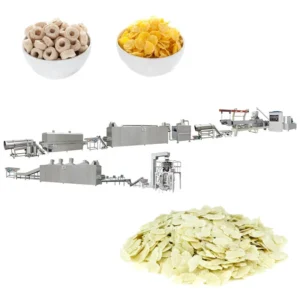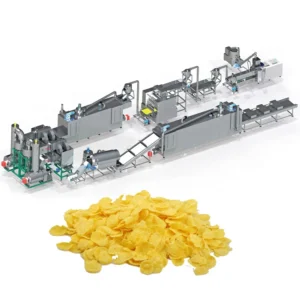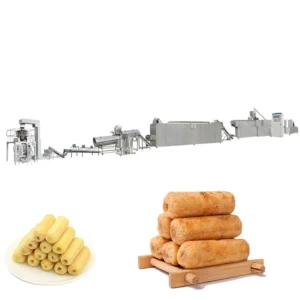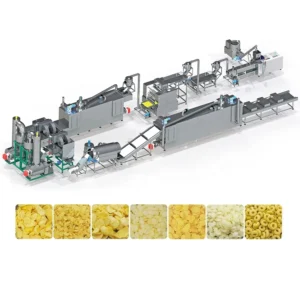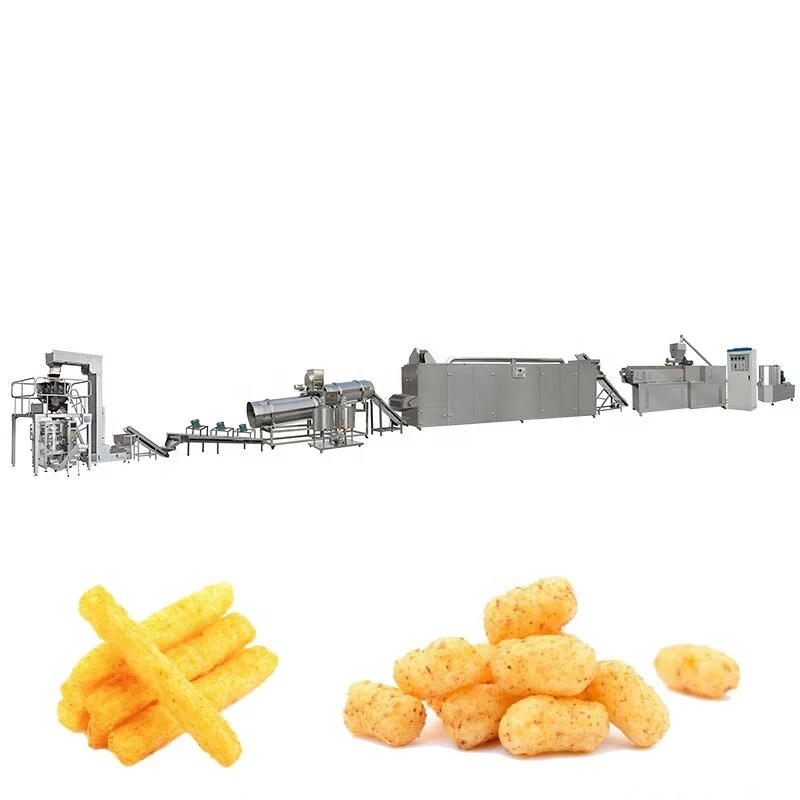
Extruder-to-packing throughput matching — Every station from mixer to roasting oven is sized against the twin-screw extruder’s real output on your grain blend, not a catalogue number.
Technical Specifications
| Parameter | Value |
|---|---|
| Product Type | Corn Flakes Extrusion Production Line |
| Models Available | MT70, MT75, MT85 |
| Screw Type | Twin Screw |
| Installed Power | 160 kW (MT70) / 210 kW (MT75) / 190 kW (MT85) |
| Power Consumption | 120 kW (MT70) / 150 kW (MT75) / 140 kW (MT85) |
| Output Capacity | 150–200 kg/h (MT70) / 300–500 kg/h (MT75) / 300–400 kg/h (MT85) (basis not stated in source) |
| Overall Dimensions | 41 × 1.5 × 2.2 m (MT70) / 45 × 1.5 × 3.5 m (MT75) / 43 × 1.5 × 3.2 m (MT85) |
| Control System | PLC and MCC available |
| Heating Source (Dryer) | Gas or Electric |
| Flaking Drive | Double motors, independent roller driving; hydraulic system |
| Temperature Control (Flaking) | Infrared sensor for uniform pipe temperature |
| Roasting Oven | Hot air, dual circulating fans, cyclone dust removal, conciliation burner |
| Coating System | Double tumble sugar melting, elevator, coating drum, spraying nozzle |
| Line Stations | Mixing → Extruding → Flaking → Drying → Hot Air Roasting → Sugar Coating → Cooling → Packing |
| Screw Material | Wear-resistant special technology |
| Lubrication | Automatic lubricating and cooling |
| Standards | CE, ISO |
Application Suitability
| Application | Material or Output |
|---|---|
| Natural corn flakes production | Corn grits, corn flour |
| Sugar-coated breakfast cereals | Corn, rice, wheat blends with sugar coating |
| Multi-grain flaked cereals | Oat, barley, rice powder mixtures |
| Shape-variant puffed cereals | Grain flour with die changes (rings, balls, stars, fruit loops, wheels) |
| Existing line station replacement | Individual dryer, flaking mill, or roasting oven integration |
What the Nameplate Capacity Hides About Your Breakfast Cereals Corn Flakes Machine Full Equipment Range
A line is only as fast as its smallest station.
I have walked into plants where a twin-screw extruder was rated at a confident throughput figure, yet the downstream flaking mill and hot air roasting oven could not keep pace. The result was extruder idle time, half-loaded dryer belts, and a real output that disappointed everyone at the quarterly review. When evaluating a breakfast cereals corn flakes machine full equipment range, the question is never what the extruder can push — it is whether every station from the mixer to the cooling conveyor can absorb that flow without creating a bottleneck [NEED_CITE: line throughput balancing principles in continuous food processing].
Station-by-Station Equipment Breakdown
The breakfast cereals corn flakes machine full equipment range covers eight sequential stations, each performing a distinct transformation on the grain material. The mixing stage hydrates the flour blend to a precise moisture target before it enters the extruder barrel. The twin-screw extruder then cooks and shapes the dough under controlled temperature and shear. Downstream, the flaking machinery compresses the extrudate into thin sheets using hydraulically driven double rollers, each powered by an independent motor for consistent pressure distribution.
The drying stage removes surface moisture before the product enters the hot air roasting oven, where dual circulating fans and a conciliation burner generate the surface blistering characteristic of crispy corn flakes. An optional sugar coating system follows, using a double-tumble melting unit, a dedicated elevator, and a coating drum with spray nozzles. A cooling conveyor stabilises the product before packing. Every station in this breakfast cereals corn flakes machine full equipment range is specified so that its throughput envelope overlaps with the extruder output, preventing material pile-up or starvation at any transfer point.
How Each Machine in the Range Fits Your Production Target
Selecting the right model within the range depends on your daily volume requirement and the grain flour blend you intend to run. The MT70 suits smaller producers or pilot-scale cereal lines, while the MT75 and MT85 serve higher-volume operations. However, capacity numbers only hold meaning when tied to your specific raw material — corn grits behave differently from oat-barley blends in terms of gelatinisation, expansion, and required screw configuration [NEED_CITE: raw material behaviour in twin-screw extrusion for breakfast cereals].
The flaking machinery uses an infrared sensor to regulate roller pipe temperature, ensuring that the sheet thickness remains uniform regardless of ambient workshop conditions. The roasting oven’s cyclone dust removal device keeps the hot air stream clean, which matters when you are producing lightly coloured natural flakes where surface scorch marks are immediately visible. When surveying the breakfast cereals corn flakes machine full equipment range, buyers often find that specifying the dryer and roasting oven correctly is more consequential for final product texture than the extruder model alone.
Reading the Specs Against Your Raw Material and Flake Format
The installed power figures — ranging from 160 kW to 210 kW across the three models — reflect the combined load of the extruder main drive, feeder, and preconditioner. Power consumption values sit at roughly seventy to seventy-five percent of installed capacity under steady-state operation, though start-up transients and recipe changeovers draw higher peaks. The overall line footprint stretches from forty-one to forty-five metres in length, which means your facility needs a clear production hall with adequate ceiling height for the roasting oven’s exhaust routing.
The twin-screw design allows operators to adjust the screw element sequence — mixing elements, kneading blocks, and reverse-pitch sections — to control residence time and shear intensity inside the barrel. This flexibility matters when switching between a high-starch corn recipe and a higher-protein oat blend, because the gelatinisation window shifts with starch content and particle size. The hydraulic double-roller system on the flaking machinery delivers adjustable nip pressure, letting you dial in flake thickness from under one millimetre up to several millimetres depending on the target crunch profile. Automatic lubricating and cooling on the screw assembly extends service intervals and reduces unplanned stops during long production runs.
The Cost of Undersizing Downstream Stations
When a roasting oven is specified too small for the extruder output, flakes exit the dryer still holding residual moisture and enter a roasting chamber that cannot process them fast enough. Operators compensate by slowing the entire line, which means the extruder runs below its design point and specific energy consumption per kilogram rises noticeably. A flaking mill with insufficient roller pressure produces uneven sheet thickness, and those thick spots do not toast properly in the oven — resulting in a mixed-texture product that fails the quality check [NEED_CITE: impact of downstream bottlenecking on cereal flake uniformity].
Coating systems that cannot match the upstream throughput force batch-holding patterns, where coated flakes sit waiting and absorb ambient humidity, losing the crispness the roasting stage just created. These problems rarely appear during a short factory acceptance test; they surface weeks into production when the line is asked to sustain its quoted output over full shifts.
Why Source the Complete Equipment Range From One Supplier
Throughput matching across every station means the mixer batch size, extruder screw speed, flaking roller width, dryer belt length, and roasting oven volume are all calculated from the same production target rather than picked from separate catalogues. Screw configuration and die design are specified against your actual grain flour blend and target flake density, not copied from a generic build sheet. An in-house machine testing workshop runs your raw material through the extruder before shipment, generating a trial run report that confirms the screw element arrangement and barrel temperature profile work on your recipe.
The PLC and MCC control architecture across the line gives a single operator interface for the entire sequence, reducing the coordination errors that happen when stations from different vendors use incompatible signal protocols. Pre-sales engineering covers line layout, utility planning, and capacity calculation, so you receive a coherent project scope rather than a stack of individual machine quotations.
Documentation & Verification
- Line layout drawing with station spacing matching your workshop dimensions
- Machine specification sheet for each unit confirming installed power and dimensions
- Screw and die configuration record tied to your grain flour blend
- Trial run report from in-house testing on your actual raw material
- Electrical schematic with voltage and frequency confirmed for your market
- CE declaration of conformity and ISO certificate for the complete line
Installation, Commissioning & Support
- Foundation plan specifying load points for the 41–45 metre line footprint
- Dedicated power circuit sized to the 160–210 kW installed load of your chosen model
- Sectional delivery with on-site assembly aligning extruder discharge to flaking mill infeed
- PLC parameter loading and MCC commissioning with operator language confirmed
- Screw element sequence verification and barrel temperature profile tuning on your recipe
- Wear parts list covering screws, dies, and roller surfaces with stocking guidance
What to Prepare Before Requesting a Quote
Send your grain flour formulation, including the percentage split between corn, rice, wheat, oat, or barley, along with the target moisture content at the extruder inlet. Specify whether you need natural flakes, sugar-coated flakes, or shape-variant formats, and confirm the daily output you want to sustain across a full shift. Provide your facility’s available floor length, ceiling height, and the local voltage and frequency so that motor specifications and control panel wiring are correct before production begins.
Frequently Asked Questions
Q: How do I match dryer, flaking and roasting capacity to the extruder so no station bottlenecks the line?
A: Each downstream station is sized against the extruder’s confirmed output on your specific raw material, not a generic catalogue figure. The dryer belt length, flaking roller width, and roasting oven volume are all calculated so material flows continuously without pile-up or starvation at transfer points. Request a capacity calculation sheet that shows the throughput margin at each station.
Q: What voltage, frequency and control language options are available for each machine in the range?
A: Motor and control panel specifications are configured to your local electrical standard before production begins. The PLC interface language and MCC labelling are set to match your operators’ requirements. Confirm your site voltage, phase, and frequency during the specification stage so that commissioning delays from electrical mismatches are avoided entirely.
Q: How are screw configuration and die design selected for different grain flours and target flake densities?
A: The screw element sequence — mixing elements, kneading blocks, and conveying sections — is arranged based on your flour blend’s starch content, particle size, and target gelatinisation degree. Die geometry controls the extrudate shape and expansion ratio before it reaches the flaking mill. A trial run on your raw material in the testing workshop confirms the configuration before shipment.
Q: Can individual stations be ordered separately to upgrade an existing breakfast cereal line?
A: Yes. The flaking machinery, hot air roasting oven, dryer, or coating system can each be specified as standalone equipment to replace a bottleneck station on your current line. Interface requirements such as conveyor height, discharge chute dimensions, and control signal compatibility are reviewed during engineering to ensure the new station integrates with your existing upstream and downstream equipment.
Q: What spare wear parts are stocked and how are they supplied after the first replacement cycle?
A: A wear parts list is provided with the line documentation, covering screw elements, die plates, and flaking roller surfaces. Initial spare sets can be included with the first shipment. Subsequent orders are fulfilled from stock or manufactured to the configuration record held on file, ensuring replacement parts match the screw and die setup originally validated on your raw material.