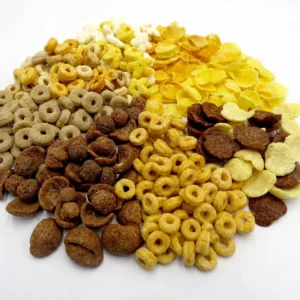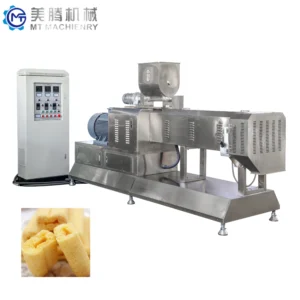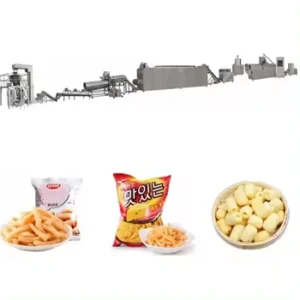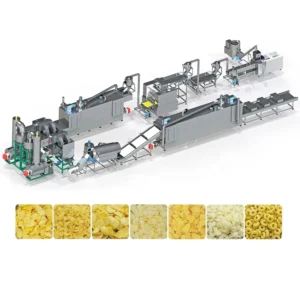
Thermally balanced extrusion stations — Every heating zone and barrel segment is mapped to the moisture curve of puffed corn snacks, preventing scorching or under-gelatinisation across the corn puff processing line full equipment range.
Technical Specifications
| Parameter | Value |
|---|---|
| Product Type | Twin Screw Extruder Corn Puff Processing Line |
| Model Options | MT65 / MT70 / MT85 / MT100 |
| Screw Configuration | Twin-screw |
| Installed Power (MT65 / MT70 / MT85 / MT100) | 130 kW / 180 kW / 220 kW / 240 kW |
| Real Power Consumption (MT65 / MT70 / MT85 / MT100) | 95 kW / 120 kW / 130 kW / 160 kW |
| Output Capacity (MT65) | 120–150 kg/h (basis not stated in source — confirm raw material & moisture) |
| Output Capacity (MT70) | 200–300 kg/h (basis not stated in source — confirm raw material & moisture) |
| Output Capacity (MT85) | 300–500 kg/h (basis not stated in source — confirm raw material & moisture) |
| Output Capacity (MT100) | 600–800 kg/h (basis not stated in source — confirm raw material & moisture) |
| Control System | Frequency speed controlling system (PLC / MCC option to be confirmed) |
| Die Shapes Available | Cheese ball, ball, tube, stick, ring, fruit loop, star, wheel, flower, heart |
| Heating Source Options (Dryer) | Electric / Steam / Gas |
| Flavoring System | Double drum flavoring line with sugar melting and spraying nozzle |
| Packing Machine | Automatic weighing, sealing, marking, coding with vibration feeding |
| Core Filling | Optional add-on core filling machine and cutting machine |
| Lubrication | Automatic lubricating and cooling system |
| Voltage & Frequency | To be confirmed before order |
| Assembly State | Turnkey line layout (OEM/ODM layout available) |
| Standards | CE, ISO |
| Warranty | 1 year free warranty |
| Delivery Time | Approx. 20 working days (standard line); 35 working days (with packing & stacking) |
Application Suitability
| Application | Material or Output |
|---|---|
| Direct-expanded corn snacks | Corn grits, corn flour, rice flour blends |
| Cheese balls and rings | Corn and rice meal with post-extrusion oil and powder coating |
| Fruit loops and stars | Multi-grain flour mixes including oat and barley |
| Core-filled puffed snacks | Corn or wheat base with cream or chocolate center filling |
| Fortified snack formats | Cereal base blended with vitamin and mineral premixes |
What "300 kg/h" Leaves Out About Your Corn Puff Processing Line Full Equipment Range
Capacity numbers without raw material context are marketing fiction.
When a buyer sees an output rating, the first question should be what the line was actually running when that number was recorded. I have watched a line rated at a comfortable mid-range throughput produce half that volume when the buyer switched from corn grits to a high-starch cassava blend on-site. The extruder barrel temperatures, screw speed, and die back-pressure all needed re-mapping for the new material. That mismatch is why the corn puff processing line full equipment range must be specified against your actual formulation before metal is cut. [NEED_CITE: starch gelatinisation temperature ranges across common snack grains]
How Stations Are Sized to Prevent Downstream Choke Points
An extruder that pushes product faster than the dryer can handle moisture removal creates a wet, clumping mass at the dryer inlet. The corn puff processing line full equipment range addresses this by matching the drying belt length, air volume, and heating capacity to the extruder’s real output and the moisture content of the product leaving the die. This station-to-station matching is calculated during the layout phase, not guessed from catalogue defaults.
Flavoring Drum Volume and the Sugar Coating Problem
A double drum flavoring line sounds adequate until the sugar slurry cools too fast in a humid plant and clogs the spray nozzle mid-shift. The sugar melting unit on this line is sized to hold temperature and viscosity for the full batch cycle, and the spray nozzle array covers the drum’s cross-section to avoid uneven coating that causes packaging reject. Drum volume is matched so the extruder’s continuous output never waits on a batch-style flavoring step. [NEED_CITE: sugar slurry viscosity behaviour at varying ambient humidity levels]
Screw Geometry, Barrel Zones, and What They Actually Do
The twin-screw configuration on these models provides the shear and residence time needed to fully gelatinise starch in corn and rice blends, which a single screw struggles to achieve without excessive barrel heat. Multiple barrel heating zones allow a gradual temperature ramp from feed to die, preventing the outer layer of the dough from cooking before the core reaches gelatinisation temperature. Interchangeable dies then control expansion ratio: a small-orifice die produces dense, crunchy rings while a larger die opening yields lighter, more porous fruit loops from the same base dough. The automatic lubricating and cooling system keeps the screw shaft temperature stable during long production runs, reducing thermal drift in product density.
The Cost of Skipping a Pre-Shipment Trial Run
When a line ships without a test on the buyer’s actual flour blend, the first week on-site becomes an expensive R&D exercise. Die blockages, uneven puff expansion, and off-spec bulk density all surface after the installation crew has left. That commissioning delay cascades into packaging material waste and missed delivery schedules for the buyer’s retail commitments. [NEED_CITE: typical commissioning delay costs in snack extrusion projects]
Why Procure the Full Range from One Equipment Source
Every station — batching, extrusion, drying, flavoring, cooling, packing — is engineered under one responsibility, so throughput calculations do not break at the boundary between two vendors’ equipment. Screw and die configurations are specified to the buyer’s raw material blend and target puff geometry rather than copied from a generic build. The in-house testing workshop runs trial production on the buyer’s actual flour before shipment, catching formulation issues before they become on-site emergencies. Electrical schematics and voltage specifications are confirmed before production begins, eliminating the commissioning delays caused by mismatched local power supply. Documentation including the machine specification sheet, trial run report, and CE declaration of conformity ships with every line for audit and customs clearance.
Documentation & Verification
- Line layout drawing showing throughput matching across every station in the corn puff line
- Screw and die configuration record tied to the buyer’s specific raw material formulation
- Electrical schematic with confirmed voltage, frequency, and control language for the target facility
- Trial run report produced on customer-supplied raw material before dispatch
- CE declaration of conformity and ISO certificate for customs and regulatory submission
- Wear parts list identifying screw segments, die inserts, and dryer belt spares by part number
Installation, Commissioning & Support
- Foundation and floor load plan covering the extruder’s installed power and dryer footprint
- Dedicated electrical circuit sizing for the MT65 through MT100 real consumption range up to 160 kW
- Station-by-station assembly sequence with belt and conveyor alignment checkpoints
- First-run parameter log documenting barrel temperatures, screw RPM, and die pressure at target output
- Operator training on die changeover across all available puff shapes
- Spare screw segments and die inserts shipped with the initial order to cover the first replacement cycle
What to Prepare Before Requesting a Quotation
Share your target puff shape and the exact flour or grit blend you plan to run, including moisture percentage if known. Specify your local voltage and frequency, and whether you prefer electric, steam, or gas heating for the dryer. If your facility has ceiling height or floor space constraints, include a rough floor plan so the layout can be adapted before quotation.
Frequently Asked Questions
Q: How is each station’s capacity matched so the dryer and flavoring drum do not bottleneck the extruder?
A: The dryer belt length, airflow, and heating capacity are calculated against the extruder’s real output and the moisture content leaving the die. The flavoring drum volume and sugar spray rate are then sized so continuous extrusion output never queues upstream. A line layout document showing throughput at each station is provided before production begins.
Q: What utility requirements does each station need, and how are they confirmed for my facility?
A: Each model’s installed and real power consumption is documented, and the dryer can be configured for electric, steam, or gas heating. Voltage and frequency are confirmed against your facility’s supply before the electrical schematic is finalised. This prevents motor rewinding or transformer additions during commissioning.
Q: Which die and screw configurations are available for my target puff shape and raw material blend?
A: Interchangeable dies cover cheese ball, ring, stick, tube, fruit loop, star, wheel, flower, and heart geometries. Screw configuration and barrel zone temperatures are set based on your specific flour blend and desired expansion ratio. A trial run on your raw material verifies the setup before shipment.
Q: Can I add a core filling station or packing machine to the base line later?
A: The optional core filling machine and cutting unit are designed to integrate inline without modifying the base extruder. Packing and stacking stations can be added as the line expands, though including them in the initial order shortens total delivery to approximately 35 working days instead of requiring a separate integration later.
Q: What supporting equipment bridges the stations, and is it included in the line scope?
A: Conveyors, elevators, and cooling belts that connect extrusion to drying, drying to flavoring, and flavoring to packing are included in the turnkey layout. Their speed and transfer height are matched to the upstream and downstream station throughput so product does not accumulate or drop between stations.