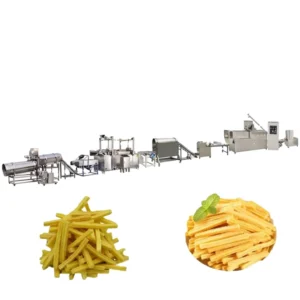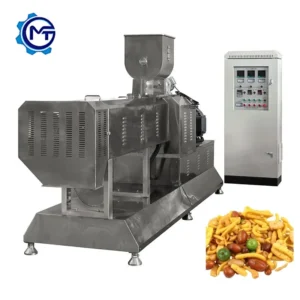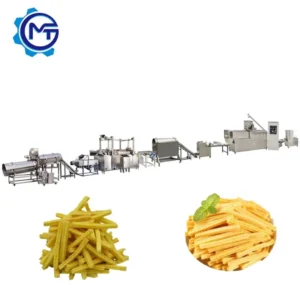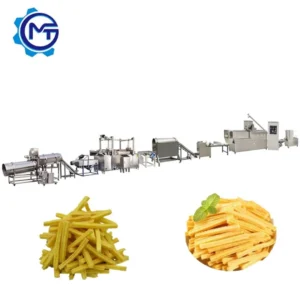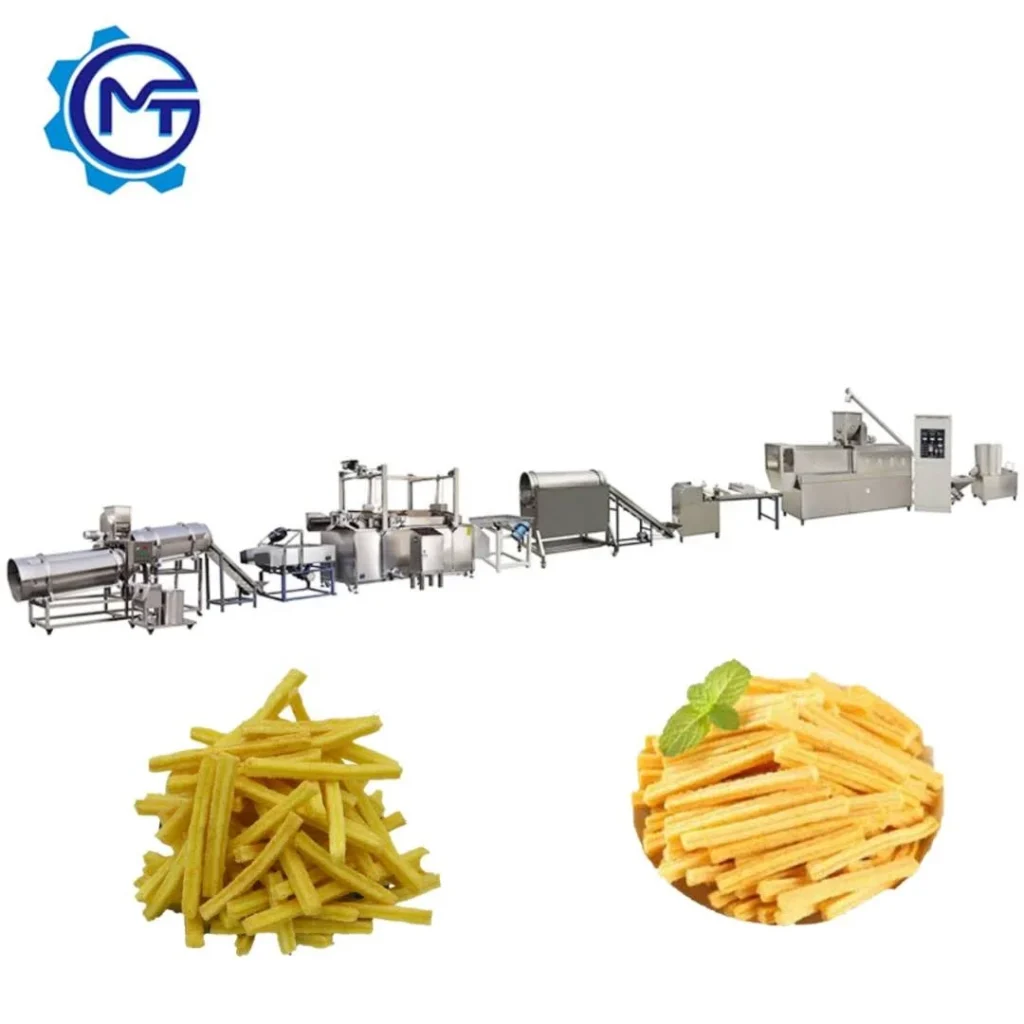
Throughput matching across every station — every mixer, extruder, fryer and flavoring drum in this fried rice cracker extrusion production line full equipment range is specified to hold the same output, preventing mid-line bottlenecks.
Technical Specifications
| Parameter | Value |
|---|---|
| Product Type | Fried Rice Cracker Extrusion Production Line |
| Extruder Type | Single screw extruder with high/low pressure screw configuration |
| Raw Materials | Wheat flour, corn starch, potato starch |
| Output Capacity | 120 kg/h (basis not stated in source) |
| Power (Electric Heating) | 50–70 kW |
| Power (Gas/Diesel Heating) | 50–60 kW |
| Voltage & Frequency | Three-phase 380V/50Hz; single-phase 220V/50Hz; customizable |
| Energy Options | Electricity, gas, diesel, steam |
| Main Product Shapes | Screw shell, round tube, square tube, ring, cartoon shapes |
| Material of Construction | Food-grade stainless steel 201/304 |
| Motor & Drive | Siemens (made in China) or China top brand; Delixi or Delta inverter |
| Overall Dimensions (L×W×H) | 12,000–26,000 × 1,200 × 2,200 mm (source value — verify against layout) |
| Line Stations | Mixer → Screw conveyor → Single screw extruder → Pulling and cutting machine → Automatic fryer → Automatic flavoring line → Cooling |
| Standards | CE, ISO 9001 |
Application Suitability
| Application | Material or Output |
|---|---|
| Secondary puffed fried rice crackers | Wheat flour and rice flour blends |
| Millet rice crust (salad bar style) | Millet and rice mixed starch formulations |
| Pani puri / golgappa shells | Wheat flour and semolina formulations |
| Extruded pellet snack bases | Corn starch and potato starch blends |
| Custom cartoon-shaped fried snacks | Starch and flour blends with adjusted moisture |
Why Raw Material Variability Kills Nominal Output
An extrusion line rated at a given capacity on one flour blend often fails to hold that number when the buyer switches to a locally sourced starch. The actual throughput depends entirely on matching screw configuration and die geometry to the raw material’s gelatinisation behaviour.
I once watched a fried rice cracker extrusion production line full equipment range stall in a Middle East snack plant. The trial ran smoothly on polished rice flour, but the buyer’s production flour was a millet-rice mix with a different amylose ratio. The single screw extruder could not gelatinise the blend at the same feed rate, the pellets came out under-expanded, and the fryer produced hard-centre crackers. Daily output dropped noticeably. [NEED_CITE: effect of amylose-amylopectin ratio on starch extrusion expansion]
From that project onward, I insist on receiving the buyer’s actual production flour for a workshop trial before the line configuration is locked. A screw profile that works on corn starch may starve or surge on potato starch, and no catalogue number can predict that without a physical test.
Matching Every Station From Mixer to Cooling Belt
A fried rice cracker line only runs as fast as its slowest station. If the extruder produces dough pellets faster than the pulling-and-cutting machine can slice them, material backs up and moisture evaporates unevenly before frying. The equipment range here covers mixing, conveying, extrusion, cutting, drying, frying, flavoring, cooling and packing — each station sized so that the rated flow of one feeds directly into the next without buffer silos or manual transfer. This station-level balance is what makes the full equipment range function as an integrated system rather than a collection of standalone machines.
Energy Source Selection and Its Effect on Fryer Performance
The fryer section offers electricity, gas, diesel and steam heating, and the choice affects both product quality and facility utility planning. Gas and diesel heating typically deliver faster thermal recovery when cold product enters the oil bath, maintaining oil temperature stability across continuous batches. Steam heating integrates well where the buyer already operates a boiler plant for other production lines. [NEED_CITE: thermal recovery rates in continuous industrial fryers by energy source] Selecting the energy option before the fryer is built avoids costly heater replacement and ensures the oil temperature profile stays consistent, which directly controls expansion and crunch texture in the final cracker.
Reading the Specs: What the Numbers Actually Mean for Production
The single screw extruder’s high and low pressure screw configuration determines how much shear energy transfers into the starch matrix during extrusion. A low-pressure profile suits wheat flour blends that gelatinise easily, while high-pressure segments are necessary for corn starch and potato starch that need more mechanical work to reach full expansion. The die plate is matched to this screw profile: a die with larger orifice diameters produces round tube and ring shapes with thinner walls that fry evenly, while smaller orifices create dense screw shells that require longer fryer residence time. Motor and inverter selection — Siemens or Delta drives — controls screw speed precisely, which is essential because even a small RPM change alters shear rate and, consequently, pellet density entering the fryer. Stainless steel 201 versus 304 construction matters most in the fryer and flavoring zones where hot oil and seasoning acids contact surfaces continuously; 304 grade holds up longer under those conditions and is the recommended choice for humid or high-salt production environments.
The Hidden Cost of Mismatched Fryer Capacity
Buyers often focus on extruder output and treat the fryer as a commodity add-on. When the fryer basket or belt length is too short for the extruder’s pellet flow, oil temperature dips every time a new batch enters, producing crackers with uneven color and oil absorption. [NEED_CITE: oil temperature fluctuation and product quality in continuous frying operations] This mismatch does not show up during a short factory test but accumulates across a full production shift, generating off-spec product that the flavoring drum then coats unevenly. The downstream cooling conveyor compounds the problem if it cannot handle the actual fryer discharge rate, leaving crackers stacked and trapping residual steam that softens the crunch.
Why Source the Full Range From One Equipment Builder
The line layout and throughput calculation are produced as one document, so every station’s capacity is cross-checked before fabrication begins. Screw and die configuration is recorded against the buyer’s specific raw material formulation, not copied from a generic build. The in-house testing workshop runs the buyer’s actual flour blend before shipment, generating a trial report that confirms pellet expansion and fryer behaviour. Electrical schematics and voltage confirmation are finalized before production starts, preventing commissioning delays caused by frequency or phase mismatches at the installation site. Post-installation, operator training covers the entire line sequence from batching parameters to flavoring drum timing, so the buyer’s team understands how an adjustment at one station affects every station downstream.
Documentation & Verification
- Line layout showing station-to-station throughput matching for the fried rice cracker configuration
- Screw and die configuration record tied to the buyer’s submitted raw material sample
- Electrical schematic and voltage confirmation document matching the target installation country
- Trial run report on customer flour blend from the in-house testing workshop before dispatch
- CE declaration of conformity and ISO 9001 certificate for the full equipment range
Installation, Commissioning & Support
- Foundation must accommodate line length up to 26,000 mm with level tolerance for extruder and fryer alignment
- Dedicated electrical circuit required to handle the combined 50–100 kW load depending on heating selection
- Single screw extruder arrives with screw and die pre-assembled; cutting and fryer stations connected on site
- First-run commissioning includes barrel temperature profile calibration matched to the buyer’s starch formulation
- Operator training covers screw speed adjustment via Delta or Delixi inverter and fryer temperature set-point tuning
- Wear parts list includes replacement screws, die plates and fryer mesh belts with recommended reorder intervals
What to Include With Your Inquiry
To size the fried rice cracker extrusion production line full equipment range correctly, send a representative sample of the flour or starch blend you will actually produce with — the brand and source you use in your plant, not a lab-grade reference. Include your target daily output in kilograms and the shift structure you plan to run. State the voltage, frequency and phase available at your facility, along with which energy sources — gas, diesel, steam or electric — you prefer for the fryer section. If you already operate upstream mixers or downstream packing machines, list their models so the line can be configured to interface with your existing equipment.
Frequently Asked Questions
Q: How is the extruder matched to the fryer and flavoring drum to prevent bottlenecks?
A: Every station’s throughput is calculated from the extruder’s actual pellet output on the buyer’s raw material. The fryer belt length, oil volume and flavoring drum diameter are then sized to absorb that flow without buffer gaps. This matching is documented in the line layout before any machine is built.
Q: Which raw material formulations does the single screw extruder handle?
A: The extruder handles wheat flour, corn starch and potato starch blends. The screw configuration switches between high-pressure and low-pressure profiles depending on the starch’s gelatinisation temperature. A workshop trial on the buyer’s specific blend confirms which profile delivers correct expansion before the die plate is machined.
Q: Which energy source is recommended for different production environments?
A: Gas or diesel heating suits standalone snack plants where fast thermal recovery in the fryer is critical. Steam heating fits facilities that already run a central boiler. Electric heating is specified where local utility rates are low and gas infrastructure is unavailable. The choice is confirmed during the line configuration stage.
Q: What is the full equipment range from mixing to packing?
A: The range covers mixer, screw conveyor, single screw extruder, pulling and cutting machine, dryer, automatic fryer, flavoring drum, cooling conveyor and packing station. Each piece is sourced from the same manufacturer so that mechanical interfaces, control signals and throughput rates align without cross-vendor integration issues.
Q: How are die shapes selected and changed for different products?
A: Each die plate is machined for a specific shape group — screw shell, round tube, square tube, ring or custom cartoon profile. Changing shape requires swapping the die plate and adjusting the cutter timing. The extruder barrel and screw remain unchanged, so product changeover takes one shift rather than a full line reconfiguration.