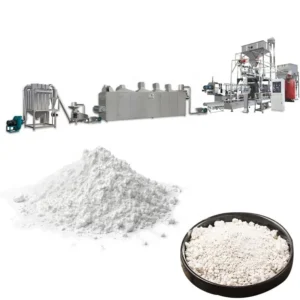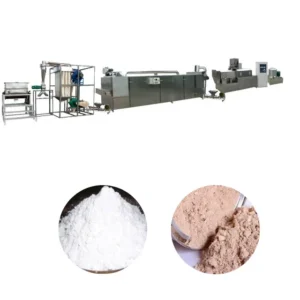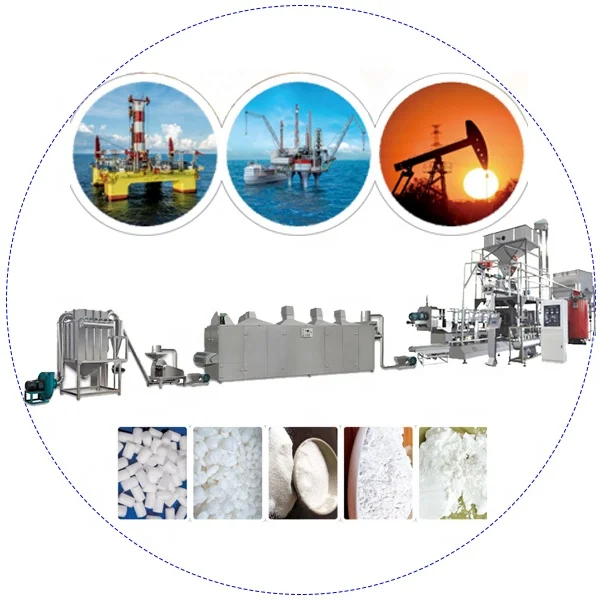
Throughput Alignment — Every station from batching to packing is specified together so output rates stay matched across the entire modified starch production line full equipment range.
Technical Specifications
| Parameter | Value |
|---|---|
| Product Type | Modified Starch Extrusion Production Line |
| Model Options | MT70 / MT85 / MT100 |
| Screw Type | Twin-screw (Double-screw) |
| Screw Diameter (MT70) | 70 mm |
| Screw Length (MT70) | 1520 mm |
| Screw Material | 38CrMoAl |
| Main Motor Power (MT70) | 30 kW |
| Installed Power (MT70 / MT85 / MT100) | 160 kW / 190 kW / 210 kW |
| Power Consumption (MT70 / MT85 / MT100) | 120 kW / 140 kW / 150 kW |
| Output Capacity (MT70 / MT85 / MT100) | 150–200 kg/h / 300–400 kg/h / 300–500 kg/h (basis not stated in source — confirm raw material / moisture content) |
| Overall Dimensions L×W×H (MT70) | 41000 × 1500 × 2200 mm |
| Overall Dimensions L×W×H (MT85) | 43000 × 1500 × 3200 mm |
| Overall Dimensions L×W×H (MT100) | 45000 × 1500 × 3500 mm |
| Voltage & Frequency | 380V 50Hz Three Phase (customizable to 415V/60Hz, 220V/60Hz, etc.) |
| Control System | PLC and MCC control |
| Barrel Cooling System | Yes (temperature control) |
| Heating Ring (MT70) | 7 × 2 kW = 14 kW |
| Dryer Fuel Options | Gas / Diesel / Electricity / Steam |
| Contact Material | Food-grade stainless steel (PVC on select conveyors) |
| Assembly State | Complete line (batching → extrusion → drying → packing) |
| Standards | CE, ISO |
Application Suitability
| Application | Material or Output |
|---|---|
| Food-grade modified starch production | Corn, wheat, and waxy maize starch sources for sauces, soups, bakery, and confectionery |
| Pregelatinized starch for instant foods | Native and chemically modified starch for instant noodles, infant formula, and cold-water-thickening applications |
| Industrial starch modification | Starch substrates tailored for textile sizing, paper coating, and corrugated adhesive use |
| Texturized and functional starch | Starch modified for specific viscosity, gel strength, and thermal stability profiles |
What "Rated Capacity" Means When Your Raw Material Changes
A quoted output figure is only valid for the exact starch source and moisture level used during testing.
I watched a European buyer receive a modified starch line that performed well on standard corn starch during the factory trial. Back at their plant, they switched to waxy maize and the gelatinisation temperature shifted entirely — screw configuration and barrel heating zones had to be reworked from scratch, delaying two scheduled shipments. Capacity numbers on any modified starch production line full equipment range only hold when the raw material, moisture content, and target modification degree stay constant. Buyers should treat any output claim without a stated material basis as a starting point for negotiation, not a guarantee [NEED_CITE: starch gelatinisation temperature variance across corn, wheat, and waxy maize varieties].
Matching Extruder Displacement to Starch Gelatinisation Behaviour
Different starch sources demand different residence times and shear profiles inside the barrel. Waxy maize, high-amylose corn, and wheat starch each reach peak gelatinisation at distinct temperature thresholds, which means the screw element arrangement and barrel zone count must reflect the specific feedstock. The modified starch production line full equipment range includes twin-screw extruders with 38CrMoAl screw elements and seven independently controlled heating zones on the MT70, giving operators enough thermal resolution to dial in the right curve. Barrel cooling loops work alongside the heaters to prevent overshoot, a common cause of unwanted dextrinisation when processing temperature-sensitive starches.
Throughput Balance Across Every Station
An extruder that pushes material faster than the downstream dryer can handle creates a bottleneck that shows up as inconsistent moisture in the finished starch. Every station in this modified starch production line full equipment range — mixer, feeder, extruder, dryer, cooler, and packing — is specified as a single catalogue so capacities align before the line ships. Buyers reviewing equipment options can cross-reference each station’s throughput rating rather than discovering a mismatch after installation [NEED_CITE: common bottleneck points in starch extrusion and drying sequences].
Reading the Spec Sheet for Starch-Specific Parameters
Screw diameter and length define the L/D ratio, which governs how long the starch stays under shear and heat. The MT70 features a 70 mm screw diameter with 1520 mm effective length, giving enough residence time for thorough gelatinisation without excessive degradation. Main motor power at 30 kW provides the torque needed for high-viscosity starch melts, while the 14 kW distributed across seven heating rings allows zone-by-zone temperature profiling. PLC and MCC control keeps barrel temperatures, screw speed, and feed rate synchronised, which matters because even small deviations in starch processing can shift the final viscosity profile outside specification.
The Cost of Skipping Raw Material Trials
When a line is built around a generic screw configuration rather than the buyer’s actual starch source, the consequences surface during the first production week. Product may fall outside the required viscosity range, forcing reprocessing or outright scrap. Dryer settings calibrated for one moisture level cannot compensate for extruder output that arrives too wet or too dry, adding unplanned downtime while operators chase stable parameters. These issues compound when the buyer’s market demands tight specification adherence for food-grade or pharmaceutical-grade starch [NEED_CITE: financial impact of off-spec starch batches in food ingredient supply chains].
Why Source the Full Range From One Equipment Catalogue
Every station from batching to packing comes from a single supplier, eliminating the throughput gaps that appear when machines are sourced from separate vendors. Screw configuration and die design are specified to the buyer’s starch variety and target modification degree rather than copied from a generic template. An in-house testing workshop runs trials on the buyer’s actual raw material before shipment, catching gelatinisation issues early. The equipment catalogue covers twin-screw extrusion across food, industrial, and functional starch applications with pre-sales engineering through commissioning support. Voltage, frequency, and control language are confirmed during the specification phase, preventing delays when the line arrives on site.
Documentation & Verification
- Machine specification sheet listing screw diameter, motor power, and heating zone count for each extruder model
- Line layout and capacity calculation showing throughput alignment at every station from mixer to packer
- Electrical schematic with confirmed voltage, frequency, and PLC language matching the buyer’s facility
- Factory trial run report conducted on the buyer’s specific starch source and moisture content before dispatch
- CE declaration of conformity and ISO certificate covering the complete production line
- Wear parts list detailing screw elements, die plates, and heating rings with replacement intervals
Installation, Commissioning & Support
- MT70 line footprint of 41 m × 1.5 m requires level concrete flooring with anchor points at each station
- 380V three-phase supply with dedicated circuit breaker rated for 160 kW installed power on the MT70
- Machines ship in modular sections for container loading and are reassembled on site by installation engineers
- First-run commissioning includes barrel temperature calibration and screw speed tuning for the buyer’s starch source
- Operator training covers PLC interface navigation, alarm response, and daily barrel cleaning procedures
- Spare screw elements and die plates included in initial shipment to cover the first replacement cycle
Preparing Your Equipment Enquiry
To size the right extruder model and supporting stations, share your starch source — corn, wheat, waxy maize, or another variety — along with the target modification type and desired hourly output. Include your facility’s available voltage and frequency so the motor and control panel can be built to match. If you have an existing dryer or packing system that the new line must integrate with, provide its throughput rating and connection dimensions. Buyers who need a raw material trial before committing should send a representative sample of their starch along with moisture content data.
Frequently Asked Questions
Q: What supporting equipment is included in the full modified starch processing line?
A: The line covers every station from raw material handling to final packing: batching and mixing systems, twin-screw extruder, dryer with selectable fuel source, cooling conveyor, and packing station. Each component is listed in the equipment catalogue with individual capacity data so buyers can verify throughput alignment before placing an order.
Q: How do I choose between MT70, MT85, and MT100 based on my target output?
A: The MT70 suits small-batch or pilot-scale production, the MT85 handles mid-volume runs, and the MT100 targets higher-volume continuous output. Choice depends on your starch source, required modification degree, and daily production target. Requesting a capacity calculation with your specific raw material gives a more accurate recommendation than comparing nominal figures alone.
Q: Can the dryer fuel type be matched to my factory’s available energy source?
A: Yes. Dryer fuel options include gas, diesel, electricity, and steam. During the specification phase, confirm which energy source is available at your site so the dryer is built with the correct burner or heating element configuration, avoiding costly retrofitting after installation.
Q: How is throughput matched between the extruder, dryer, and packing station?
A: Each station’s capacity is calculated based on the extruder’s output at the buyer’s confirmed raw material and moisture level. The dryer length, airflow, and belt speed are then sized to handle that volume, and the packing station is selected to keep pace. This prevents bottlenecks that arise when machines are sourced from separate vendors without coordinated throughput data.
Q: What voltage and frequency options are available for my market?
A: The standard configuration is 380V 50Hz three-phase, but the line can be built for 415V/60Hz, 220V/60Hz, or other regional standards. Voltage and frequency must be confirmed before production begins so motors, transformers, and the PLC panel are wired correctly for the destination facility.