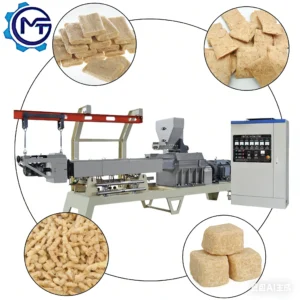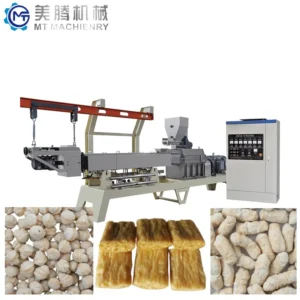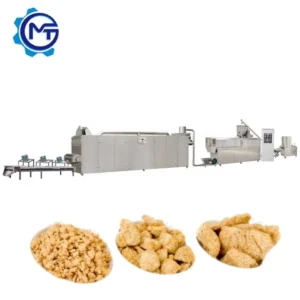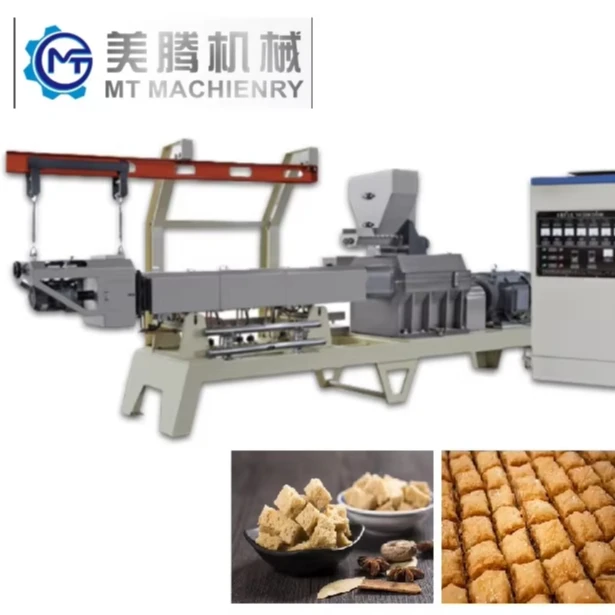
Precision-matched extrusion — every station from mixer to cooling is specified as one system so throughput stays balanced across the entire TVP line instead of bottling up at the dryer.
Technical Specifications
| Parameter | Value |
|---|---|
| Product Type | Twin Screw Extruder Line for Texturized Vegetable Protein (TVP) |
| Model Options | MT65 / MT70 / MT75 / MT85 |
| Installed Power | 84 kW (MT65) / 160 kW (MT70) / 190 kW (MT75) / 210 kW (MT85) |
| Power Consumption | 59 kW (MT65) / 120 kW (MT70) / 140 kW (MT75) / 140 kW (MT85) |
| Output Capacity | 100–150 kg/h (MT65) / 150–200 kg/h (MT70) / 150–200 kg/h (MT75) / 250–300 kg/h (MT85) (basis to be confirmed) |
| Overall Dimensions (L×W×H) | 40000×1200×2200 mm (MT65) / 41000×1500×2200 mm (MT70) / 43000×1500×3200 mm (MT75) / 45000×1500×3500 mm (MT85) |
| Screw Type | Twin Screw |
| Feeding Motor Power | 0.75 kW |
| Rotary Cutting Motor Power | 0.75 kW |
| Pump Motor Power | 0.37 kW |
| Heating Power | 10 kW / 14 kW (model-dependent) |
| Control System | PLC and MCC |
| Line Stations | Mixer → Screw Conveyor → Twin Screw Extruder → Air Conveyor → Multi-layer Dryer → Cooling Machine |
| Dryer Heating Options | Fuel / Gas / Electricity |
| Dryer Drive | Double pitch roller chain, round-trip |
| Mixing Machine Type | Vertical, stainless steel 304 mixing ruler |
| Mixing Machine Power | 4 kW / 7.5 kW / 15 kW (option) |
| Mixing Machine Capacity | 20–30 kg / 70–80 kg / 170–180 kg (option) |
| Standards | CE (since 2014), ISO |
Application Suitability
| Application | Material or Output |
|---|---|
| Texturized Vegetable Protein (TVP/TSP) | Defatted soya flour, low-temperature soya flakes |
| Soya nuggets and soya chunks | High-protein soya-based formulations for meat analogues |
| Vegetarian meat analogues | Plant protein blends targeting fibrous, meat-like texture |
| Plant-based protein ingredients | TVP for fast food, frozen food, and ready meal applications |
| Cereal and snack variants | Achievable by adjusting screw and die configuration |
Why Nominal Capacity Figures Mislead Plant-Based Meat Buyers
Real output depends on your exact soya flour particle size, moisture content, and protein ratio — not a catalog number.
When sourcing plant based meat processing line equipment, buyers often receive a capacity figure that looks solid on paper but collapses once actual raw material hits the hopper. I have watched a TVP line lose more than half its rated throughput simply because the buyer’s defatted soya flour had a different particle size distribution and moisture level than the standard test material. The extruder screw could not feed consistently, and no amount of motor speed adjustment fixed it. [NEED_CITE: raw material variability and extrusion throughput correlation] The fix was not a bigger motor — it was a redesigned screw combination and feeding section matched to that specific flour.
How Screw Configuration Shapes TVP Texture
Twin screw extrusion works by combining shear, heat, and pressure to restructure plant protein into layered, fibrous networks. The screw elements — kneading blocks, reverse flights, and conveying sections — must be arranged in a sequence that matches the behavior of defatted soya flour or low-temperature soya flakes under your target moisture level. A configuration designed for one protein content may over-shear a different blend, collapsing the fiber structure before it reaches the die. Every plant based meat processing line equipment package from Meiteng ships with a screw and die configuration record specified to the buyer’s raw material and target TVP format.
Matching Dryer Capacity to Extruder Output
The multi-layer dryer in this line uses a double pitch roller chain drive with a round-trip material path, giving product enough residence time to reach stable moisture without surface case-hardening. Heating source is selectable between fuel, gas, and electricity depending on local utility costs and workshop conditions. If the dryer is undersized relative to the extruder output, TVP accumulates on the belt and dries unevenly — the outside hardens while the core stays wet. [NEED_CITE: multi-layer dryer residence time and moisture uniformity in protein extrusion] The dryer here is specified together with the extruder as a single system, so belt width, layer count, and thermal input are calculated against the upstream throughput.
Reading the Power and Dimension Data
The installed power ranges from 84 kW on the MT65 to 210 kW on the MT85, but actual consumption sits lower — 59 kW to 140 kW respectively — reflecting how extrusion lines cycle between high-load extrusion and lower-load conveying stages. The overall line length stretches from 40 meters to 45 meters, which means buyers need to confirm workshop length and turning space before committing to a layout. Heating power of 10 kW to 14 kW covers barrel zones where starch gelatinisation and protein denaturation happen; insufficient zone control leads to inconsistent expansion at the die. The PLC and MCC control system manages barrel temperature profiles, screw speed, and feeder rate from one interface, reducing batch-to-batch variation in fiber density and chunk size.
The Hidden Cost of Mismatched Line Stations
A plant based meat processing line equipment package assembled from separate vendors often hides its weakest link until commissioning day. The extruder runs fine, but the mixer batch size does not match the extruder feed rate, forcing constant start-stop cycles that destabilize barrel temperature. Or the cooling machine cannot handle the dryer discharge rate, and TVP piles up and re-absorbs moisture from the air. These mismatches do not show up in individual machine specifications — they appear only when the full sequence runs under load. [NEED_CITE: throughput mismatch consequences in multi-station food extrusion lines]
Why Source the Full Line from One Supplier
Every station in this TVP line — vertical mixer with 304 stainless steel ruler, screw conveyor, twin screw extruder, air conveyor, multi-layer dryer, and cooling machine — is specified and built under one roof. Throughput is calculated across the entire sequence rather than per machine, so no station chokes another. Screw and die sets are configured against your actual defatted soya flour or soya flake sample, not copied from a generic build. An in-house testing workshop runs your raw material before shipment, catching feed instability or texture problems early. The PLC and MCC control architecture is wired and programmed at the factory, arriving as a single coordinated system rather than a collection of independent panels. Pre-sales engineering covers line layout and utility planning, and on-site commissioning includes operator training specific to your product format.
Documentation & Verification
- Line layout and capacity calculation showing throughput match between mixer, extruder, and dryer
- Screw and die configuration record tied to your soya flour particle size and protein content
- Trial run report from in-house testing workshop using your actual raw material batch
- Electrical schematic with confirmed voltage, frequency, and PLC language for your market
- CE declaration of conformity and ISO certificate included with shipment
- Wear parts list covering screws, dies, and dryer chain components
Installation, Commissioning & Support
- Foundation must support line length up to 45 m; confirm floor levelness for dryer chain alignment
- Dedicated circuit required matching installed power up to 210 kW on the MT85 model
- Line arrives in modular sections for assembly; overhead clearance up to 3500 mm needed for MT85
- First-run parameter setting covers barrel temperature zones, screw speed, and feeder calibration
- Operator training addresses screw configuration changes for different TVP chunk sizes
- Spare screws and die plates stocked for first replacement cycle based on your production volume
Preparing Your Inquiry
To size the right model and configuration, we need your raw material specification — including soya flour type, protein percentage, particle size, and moisture level — along with target output in kg per shift and the TVP format you are producing (nuggets, chunks, mince). Please also confirm your workshop dimensions, local voltage and frequency, and whether you need a trial run on your material before the line ships.
Frequently Asked Questions
Q: How is output capacity verified against my specific soya flour and moisture level?
A: We run your actual raw material through our in-house testing workshop before finalizing the line configuration. The trial documents real throughput, texture, and fiber structure under your exact moisture and protein conditions, so the quoted capacity reflects your material rather than a generic benchmark.
Q: How are screw and die configurations selected for different TVP textures?
A: Kneading block arrangement, reverse flight placement, and die aperture geometry are chosen based on your target product — dense chunks, open-structure nuggets, or fine mince. Each configuration is recorded and can be adjusted later if you add new TVP formats to your range.
Q: What voltage, frequency, and control language options are confirmed before production?
A: The electrical schematic is prepared after we confirm your local supply standards and operator language preference. PLC interface labels, MCC wiring, and motor ratings are all matched to your market before the line enters production.
Q: Is a trial run on my raw material available before the line ships?
A: Yes. The in-house testing workshop runs your defatted soya flour or soya flakes through a production-scale extruder, generating a trial report that covers throughput, product texture, and any screw adjustments made. This happens before the line is packed for dispatch.
Q: How is dryer capacity and heating source matched to the extruder output?
A: Belt width, layer count, and residence time are calculated against the extruder’s verified throughput on your material. The heating source — fuel, gas, or electricity — is selected based on your local utility availability and workshop layout to maintain even drying across all layers.