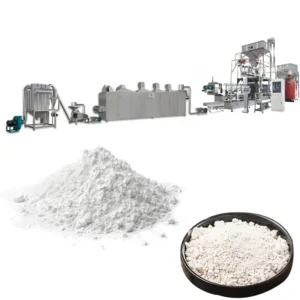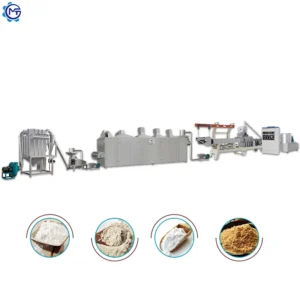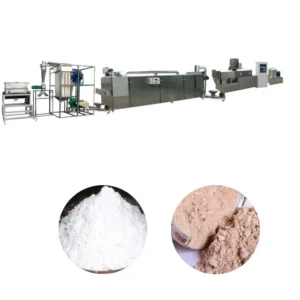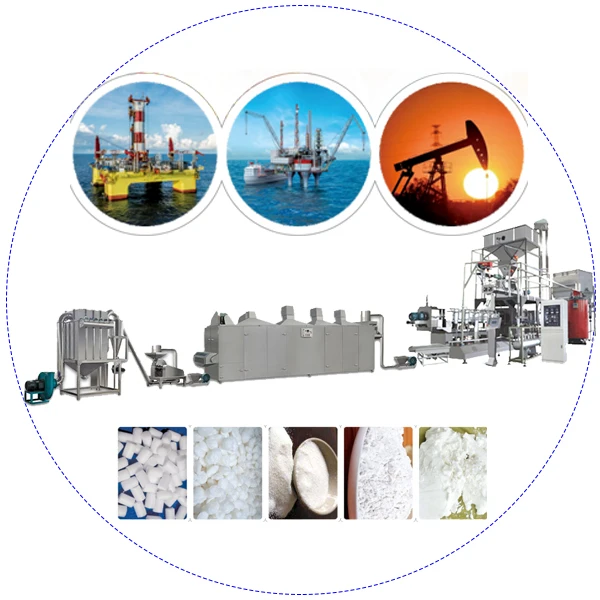
Screw-Die Match to Raw Material — every barrel zone and die opening on this line is verified against the starch type and modification degree you intend to run, not left as a generic template build.
Technical Specifications
| Parameter | Value |
|---|---|
| Product Type | Twin-Screw Modified Starch Extrusion Line |
| Raw Materials | Wheat flour, corn starch, potato starch |
| Screw Configuration | Twin-screw, geometry matched to starch source |
| Extruder Brand | MT |
| Frame Construction | Stainless steel 201 |
| Contact Material | Food-grade stainless steel 304 |
| Energy Source Options | Electricity, gas, diesel, or steam |
| Voltage & Frequency | Three-phase 380 V / 50 Hz; single-phase 220 V / 50 Hz (configurable to local grid) |
| Mixer Motor | 4.0 kW |
| Mixer Batch Output | 3.0–4.0 kg per batch (basis not stated in source) |
| Screw Conveyor Motor | 1.1 kW |
| Screw Conveyor Throughput | 0–150 kg/h (basis not stated in source) |
| Electrical Components | Siemens (China) or equivalent motors; Delixi or Delta inverters |
| Die Design | Interchangeable dies on extruder head |
| Process Flow | Mixer → Screw Conveyor → Twin-Screw Extruder → Shifter → Air Conveyor → Dryer → Air Conveyor → Conditioning → Conveyor → Grinder |
| Certification | CE |
Application Suitability
| Application | Material or Output |
|---|---|
| Pregelatinized cassava starch for paper sizing | Cassava flour at controlled moisture |
| Modified corn starch as food-grade thickener | Corn starch with target viscosity shift |
| Instant soup and sauce base ingredients | Potato or wheat starch blends |
| Pre-gelatinized starch for textile warp sizing | Corn or cassava starch at industrial modification levels |
| Nutritional carrier starch for infant formula | Purified corn or potato starch |
Why the Capacity Figure on Your Quote Means Nothing Without the Raw Material
The only valid throughput number is the one tied to the exact starch source, moisture level, and modification target you will actually run.
Capacity ratings quoted without a raw material basis are the single largest source of dispute in starch extrusion procurement. A line that processes refined corn starch at a given rate may lose significant throughput when switched to raw cassava flour with higher fiber and different gelatinization behavior. [NEED_CITE: starch gelatinization temperature and shear requirements vary by botanical source] Buyers who lock in a purchase based on a headline figure, only to discover the screw profile was copied from a generic build, face weeks of re-commissioning before the output matches the contract.
Where Every Station in the Line Earns Its Place
Buyers surveying equipment before specifying a line need to see the full catalogue and understand where each machine fits. This modified starch extrusion equipment for sale covers every station from the batching mixer through twin-screw extrusion, drying, conditioning, and final grinding. Each unit is sized so that conveyor throughput and dryer residence time align with the extruder output, preventing the kind of bottleneck that forces operators to run the extruder below its actual capability while downstream stations catch up.
Energy Source Selection and What It Means for Your Facility
The line supports electric, gas, diesel, or steam heating across the dryer and extruder barrel zones. Choosing between these is not just a cost question — it determines the ramp-up time to steady-state barrel temperature, the responsiveness of zone control during grade changes, and the utility infrastructure your plant must provide before the machines arrive. [NEED_CITE: industrial thermal energy source selection for food processing lines] The interchangeable die configuration on the extruder head lets you shift between starch grades without swapping the entire die plate, reducing changeover downtime on the production floor.
Reading the Specs That Actually Govern Starch Quality
The twin-screw configuration matters here because modified starch processing depends on precise shear history and residence time inside the barrel. Single-screw designs struggle with the moisture and viscosity ranges that cassava and potato starch demand. The food-grade stainless steel 304 contact parts prevent metallic contamination that can trigger product rejection in food-grade applications. Voltage and frequency configurability ensures the motors and inverter drives operate within their rated envelope on your local grid — running a 50 Hz motor on a 60 Hz supply without a confirmed derating curve shortens winding life and voids the CE declaration scope. The Delixi or Delta inverter drives on the screw conveyor allow operators to meter feed rate in real time, matching whatever the extruder barrel can actually process at that moisture and temperature.
The Hidden Cost of a Mismatched Dryer
When the dryer capacity lags behind the extruder, starch exits the line with residual moisture above specification. Downstream grinding then produces a powder that cakes during storage or fails the customer’s viscosity test. This is not a problem you can fix by turning up the dryer temperature — over-drying pregelatinized starch degrades the cold-water swelling property that makes it valuable in the first place. [NEED_CITE: moisture content specifications for pregelatinized starch products] The dryer on this line is specified alongside the extruder so that residence time and airflow match the throughput, not just the nominal rating on the extruder nameplate.
What Sourcing the Full Line from One Supplier Changes
When every station from the 4.0 kW mixer to the final grinder comes from a single manufacturer, throughput matching becomes the supplier’s problem, not yours. The screw configuration and die geometry are documented against your raw material before the line ships, so the barrel profile is not a guess. An in-house testing workshop runs your actual starch on the extruder before dispatch, catching gelatinization issues while changes still cost days instead of weeks. The CE declaration of conformity covers the assembled line rather than individual machines bolted together after arrival. Food-grade stainless steel 304 contact parts are consistent across every station, eliminating the weak link that a third-party conveyor might introduce.
Documentation & Verification
- Line layout drawing with capacity calculation matched to your starch type
- Screw and die configuration record tied to your raw material batch
- Trial run report on your supplied starch before shipment
- Electrical schematic with voltage and frequency confirmation
- CE declaration of conformity for the complete assembled line
- Operation and maintenance manual with wear parts list
Installation, Commissioning & Support
- Foundation plan accounts for the 1.2 × 0.9 × 1.4 m mixer footprint and vibration isolation
- Three-phase 380 V dedicated circuit sized for the approximately 100 kW electric heating load
- Staggered station assembly sequence to fit standard container shipping dimensions
- Barrel temperature profile and die pressure verified during on-site first run
- Operator training covers inverter adjustment on the screw conveyor for feed-rate tuning
- Wear parts list includes screw elements and die plates with interchange intervals
What to Prepare Before Requesting a Quotation
To get a meaningful line configuration, share your starch botanical source, target modification type, and the viscosity or swelling specification your market requires. Provide your local voltage and frequency so the electrical package is confirmed before production starts, and indicate whether your utility cost structure favors electric, gas, diesel, or steam heating. If you have existing upstream or downstream equipment that this line must integrate with, send the connection dimensions and throughput data so the interfaces are designed in rather than improvised at installation.
Frequently Asked Questions
Q: How is throughput determined for my specific starch raw material?
A: Throughput depends on the botanical source, moisture content, and modification degree. We run your supplied raw material in our testing workshop and document the actual output before finalizing the quotation. This trial run report becomes part of your delivery documentation so the contracted capacity carries a verified basis.
Q: Which energy source should I choose for the dryer and extruder?
A: The choice depends on local utility costs and plant infrastructure. Electric heating offers precise zone control but demands a high-capacity grid connection. Gas or steam may suit facilities already running a boiler. We confirm the thermal source during the proposal stage so the barrel and dryer are built for that medium from the start.
Q: How do you adapt the screw and die for cassava versus corn starch?
A: Cassava starch gelatinizes at a different temperature and responds to shear differently than corn starch. We adjust the screw element sequencing, barrel zone temperatures, and die opening geometry to match the specific botanical source. Each configuration is recorded and stays on file for your future replacement orders.
Q: Can the electrical system be configured for my country’s grid standard?
A: Yes. Voltage and frequency are confirmed with you before production begins. The Delixi or Delta inverter drives and motor specifications are set to your local standard, and the electrical schematic reflects the confirmed configuration so commissioning proceeds without rewiring delays.