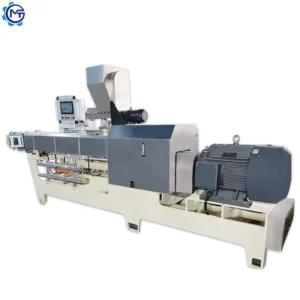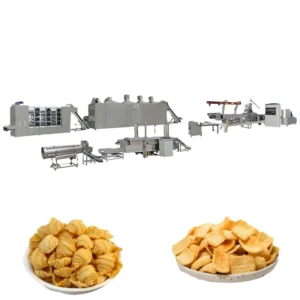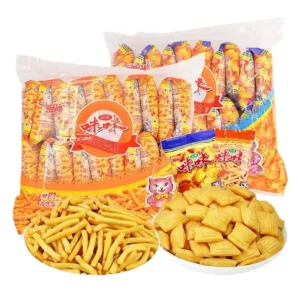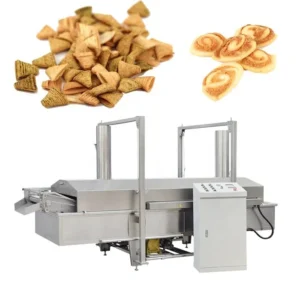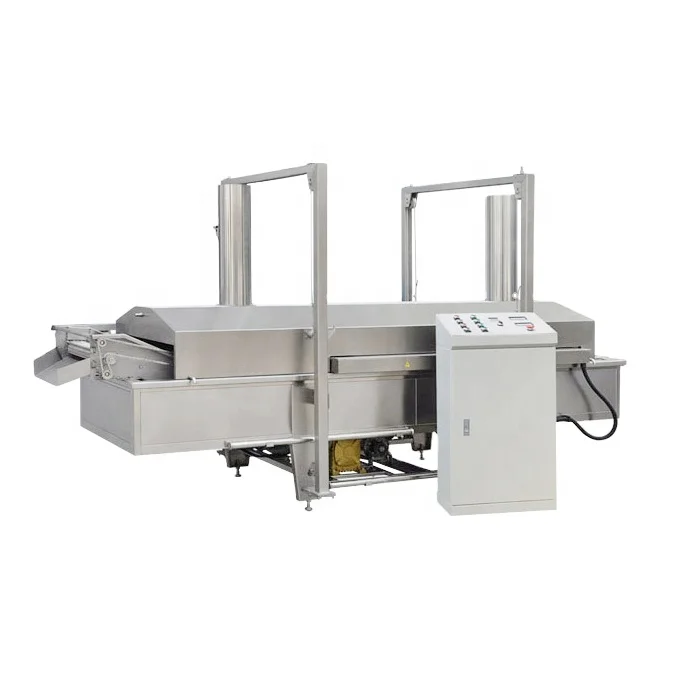
Full Line Throughput Visibility — every station on this fried snack line is listed with its own output and footprint so you can match mixing, extrusion, frying and flavouring capacity before placing an order.
Technical Specifications
| Parameter | Value |
|---|---|
| Product Type | Fried Snack Production Line |
| Overall Dimensions | 22000 × 1200 × 2200 mm |
| Installed Power | 142 kW |
| Real Power | 100 kW |
| Output Capacity | 120–150 kg/h (basis not stated in source — confirm raw material / moisture content) |
| Extruder Type | Twin Screw |
| Extruder Output | 200–250 kg/h (basis not stated in source — confirm raw material / moisture content) |
| Extruder Main Motor | 30 kW |
| Extruder Actual Power | 30–35 kW |
| Extruder Dimensions | 2800 × 830 × 1875 mm |
| Mixer Output | 300–600 kg/h (basis not stated in source — confirm material bulk density) |
| Mixer Tank Volume | 150 kg per batch |
| Mixer Mixing Time | 10 min per batch |
| Mixer Rotary Speed | 385 rpm |
| Mixer Power | 4 kW |
| Fryer Temperature Range | 0–260 °C |
| Fryer Capacity | 200–300 kg/h (basis not stated in source — confirm product type / moisture) |
| Fryer Dimensions | 4500 × 1350 × 2350 mm |
| Flavor Line Output | 400 kg/h |
| Flavor Line Power | 1.5 kW |
| Construction Material | Stainless Steel 304 |
| Line Stations | Mixing → Extrusion → Frying → Flavoring → Drying |
| Standards | CE |
Application Suitability
| Application | Material or Output |
|---|---|
| Bugles and corn chip production | Corn grits, corn flour blends |
| Tortilla chip and rice crust extrusion | Rice flour, wheat flour, starch mixes |
| Shaped puffed snacks (triangles, fish, ducks, gourds) | Cereal-based dough with moisture conditioning |
| Sala crisps and crisp corners | Wheat and corn composite formulations |
| Fried snack lines for contract manufacturers | Multi-product changeover with die swaps |
What a Capacity Figure Hides Before It Costs You
A rated output is only real when it matches your raw material and moisture content.
When I helped a Mexican snack producer commission a fried chip line, the extruder was rated on paper for steady throughput. Their local corn variety, however, carried different starch behaviour and moisture. The fryer could not keep up, the colour was uneven, and the actual yield sat well below the plate. We adjusted frying temperature and belt speed, but the lesson stayed with me: a fried snack production line full equipment range only performs when every station is specified against the buyer’s actual input, not a catalogue average [NEED_CITE: raw material variability in extrusion-based snack production].
This fried snack production line full equipment range lists each station individually — mixer at 300–600 kg/h, extruder at 200–250 kg/h, fryer at 200–300 kg/h — so you can spot where a mismatch would create a bottleneck before the line is built, not after it arrives.
Station-by-Station Visibility for Layout Planning
The fried snack production line full equipment range approach means you see each machine’s footprint and utility draw before finalising your floor plan. The MT65 configuration spans 22 metres end to end, with the fryer alone occupying 4500 × 1350 mm. Knowing this lets you plan drainage, oil filtration placement and ventilation ductwork at the project stage rather than improvising during installation.
Throughput Matching Across Every Station
A mixer that outpaces the extruder means wet dough sitting in the hopper, losing moisture and changing extrusion behaviour. A fryer that cannot absorb extruder output forces the operator to slow the entire line. By listing the mixer, extruder, fryer and flavouring drum capacities side by side, this catalogue lets you verify that no single station becomes the constraint. That matching is the reason the full equipment range is structured as a visible chain rather than a single headline number [NEED_CITE: throughput bottleneck analysis in food processing lines].
Reading the Specs That Matter for Fried Snack Quality
The twin-screw extruder draws 30 kW on its main motor but runs at 30–35 kW actual, meaning the thermal and shear energy available for gelatinisation is well-defined. For corn and rice-based doughs, consistent starch gelatinisation inside the barrel determines whether the pellet entering the fryer expands evenly or splits. The fryer’s 0–260 °C range covers both low-temperature moisture removal and high-temperature crisping, giving operators room to tune colour and oil uptake. Stainless Steel 304 construction across contact surfaces meets food-grade hygiene expectations, and the 142 kW total installed power tells you the transformer and cable sizing you need before the line arrives.
The Hidden Cost of an Underspecified Line
I have seen buyers focus on extruder price and treat supporting stations as commodity add-ons. The result is a line where the flavouring drum cannot coat evenly at production speed, leaving patches of unseasoned product that get rejected downstream. Or the dryer lacks capacity, so fried snacks enter packaging while still warm, trapping condensation and shortening shelf life. These problems do not appear in a factory acceptance test running clean corn grits — they surface weeks later on the buyer’s own formulation [NEED_CITE: post-commissioning output gaps in snack extrusion lines]. Specifying every station against your actual product and raw material avoids the cost of retrofitting or living with reduced throughput.
Why Source the Complete Range from One Supplier
The MT65 line comes from a single manufacturer covering batching through packing, so throughput is matched across stations rather than assembled from separate vendors who optimise their own machine in isolation. Screw configuration and die design are specified to the buyer’s raw material and target product shape — bugles, tortilla chips, rice crust or custom forms. An in-house testing workshop allows trial runs on your actual formulation before shipment, catching the kind of starch-moisture mismatch I described in the Mexico example. Twin-screw expertise extends across pet food, aquatic feed, snacks and cereals, so the engineering team understands how formulation changes propagate through the line. Pre-sales consultation covers engineer design, on-site installation, commissioning and ongoing maintenance, keeping accountability in one place.
Documentation & Verification
- Factory test record demonstrating matched throughput on your formulation before dispatch
- Line layout drawing with station positions, utility connections and floor space allocation
- Machine specification sheet for each station with confirmed voltage and frequency
- Screw and die configuration record matching your target product shape and raw material
- Wear parts list covering screws, dies and fryer belt components with replacement schedule
- CE declaration of conformity and ISO certificate for customs and compliance clearance
Installation, Commissioning & Support
- 22-metre line length requires level concrete floor with drainage under the 4500 mm fryer section
- 142 kW installed power demands dedicated circuit with confirmed voltage and frequency before shipment
- Modular station design allows sequential installation from mixer through to dryer and packing
- On-site commissioning includes fryer temperature profiling and extruder screw speed tuning on your raw material
- Operator training covers die changeover for switching between shaped snack formats
- First-replacement wear parts set — screws, dies, fryer belt links — included with initial shipment
What to Share When You Enquire
To configure a line that matches your production target, we need your raw material type and typical moisture content, the product shapes you plan to run, and your target daily output. Share your workshop dimensions, ceiling height, and local voltage and frequency so the layout and electrical design align with your site. If you have upstream milling or downstream packaging equipment already in place, let us know so the interface stations are specified accordingly.
Frequently Asked Questions
Q: How do I confirm that each station’s capacity is matched so no machine bottlenecks the line?
A: The specification sheet lists individual output for the mixer, extruder, fryer and flavouring drum. We cross-reference these against your raw material and target product to confirm no station constrains the chain. A factory trial run on your formulation validates the match before shipment.
Q: Which voltage, frequency and control language options are available for each station?
A: Voltage and frequency are configurable to your local grid standard. Control panel language is set before production based on your operator preference. Both are confirmed in writing during the specification stage, not assumed from a default build.
Q: Can I see the complete line layout and footprint before placing an order?
A: Yes. A detailed line layout drawing is provided during the proposal stage, showing each station’s position, utility connection points and the 22-metre overall footprint so you can verify floor space and plan drainage, ventilation and oil filtration placement.
Q: Is a trial run on my specific raw material conducted before the line ships?
A: Our in-house testing workshop runs your actual raw material through the extruder and fryer at production settings. The trial run report documents throughput, product colour, expansion and texture, so you see real output before committing to shipment.
Q: What spare wear parts are included with the initial shipment?
A: The shipment includes a wear parts list identifying screws, dies and fryer belt components with recommended first-replacement intervals. A starter set of high-wear items is packed with the line so you are not waiting for parts when the first change falls due.