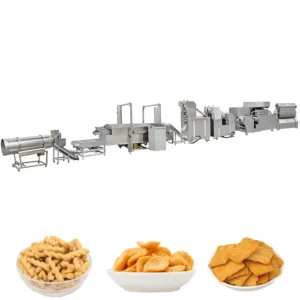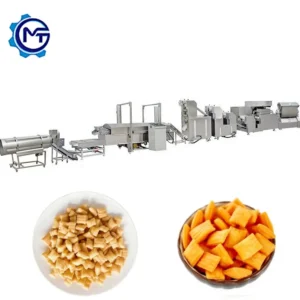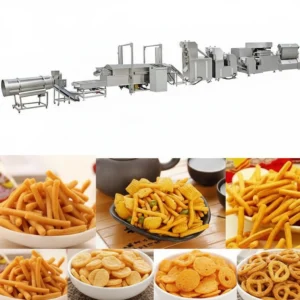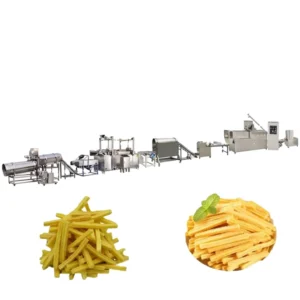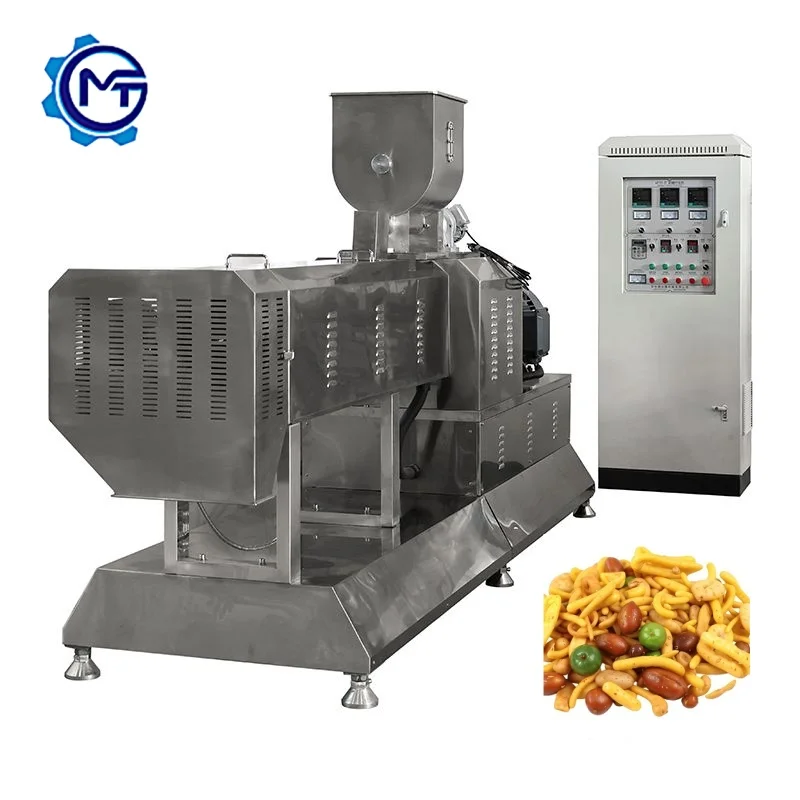
Thermal balance across every station — our continuous deep fryer is specified to match upstream extruder throughput, ensuring uniform frying exposure at rated line capacity.
Technical Specifications
| Parameter | Value |
|---|---|
| Product Type | Continuous Deep Fryer for Fried Snacks Processing Line |
| Capacity Range | 100–1000 kg/h (basis not stated in source — confirm raw material type, moisture content, and product format) |
| Rated Drive Power | 2.6 kW |
| Heating Tube Power | 60 kW |
| Oil Tank Capacity | 320 L |
| Voltage & Frequency | 380V / 50Hz (configurable for export markets) |
| Control System | PLC |
| Heating Method | Electricity or Gas (selectable) |
| Construction Material | Food-grade 304 Stainless Steel |
| Belt System | Upper and lower double-layer mesh belt |
| Speed Regulation | Frequency conversion stepless control |
| Oil Filtration | Continuous circulation filtration system |
| Slag Discharge | Bottom-mounted automatic system |
| Lifting System | Automatic hood and mesh belt lifting |
| Overall Dimensions (L×W×H) | 6700 × 2200 × 1200 mm |
| Net Weight | 2000 kg |
| Standards & Certification | CE; Machinery Test Report; Video Outgoing Inspection |
Application Suitability
| Application | Material or Output |
|---|---|
| Nimko production lines | Extruded chickpea or lentil-based pellets fried to crisp texture |
| Fried snack chips | Potato, corn, or multigrain dough sheets cut and fried continuously |
| Extruded fried snacks | Corn, rice, or wheat-based extruded pellets after drying stage |
| Puffed fried crackers | Tapioca or starch-based sheets requiring controlled oil immersion |
| Fried noodle snacks | Wheat or rice noodle strands fried for instant snack formats |
What "Matched Capacity" Actually Means for Your Frying Station
A continuous deep fryer for sale only delivers value when its throughput is calculated against your extruder’s real output, not a catalog number.
I worked on a fried snack line for a Middle East client last year. Their extruder was rated at a nominal figure on standard corn grits, but the actual recipe used a chickpea blend with different moisture absorption. The mismatch showed up at the fryer: product piled up because the upstream drying stage delivered more volume than expected at the new moisture level, and oil temperature dropped every time a heavier belt load entered [NEED_CITE: importance of throughput matching between extrusion and frying stages]. That is exactly why raw material trial runs before shipment matter. When you evaluate a continuous deep fryer, the question is not its standalone capacity but whether it holds oil temperature and residence time stable at the actual throughput your extruder will feed into it.
How Double-Layer Mesh Belt Design Controls Frying Uniformity
The upper and lower mesh belts sandwich the product during immersion, which prevents lightweight extruded pieces from floating to the oil surface. Without this constraint, items like nimko or thin chips rise and receive uneven heat on the exposed side, creating color variation across the batch. The continuous deep fryer for sale in this configuration keeps every piece fully submerged at a consistent depth throughout the residence time, so the crust forms uniformly. This matters especially for snack formats where visual consistency on the packing line determines whether the batch passes quality inspection.
Oil Circulation Filtration and Edible Oil Service Life
Continuous oil circulation filtration draws oil from the fry tank, passes it through a filter medium to capture fine particulate and sediment, and returns clean oil to the heating zone. This loop reduces the acid value buildup that otherwise accelerates oil degradation and darkens product color over successive shifts [NEED_CITE: relationship between free fatty acid levels and frying oil replacement intervals]. For a fried snack line running multiple shifts, the filtration system extends the interval between full oil changes. The bottom-mounted automatic slag discharge works in tandem, settling heavier debris below the heating element where it is removed without interrupting production.
Reading the Specs That Determine Frying Performance
The 60 kW heating tube power defines how quickly the fryer recovers temperature after a belt load of ambient-temperature product enters the oil. Higher recovery rate means the setpoint stays stable even at the upper end of the throughput range. Frequency conversion stepless speed control lets operators adjust belt travel speed, which directly sets frying residence time — a shorter dwell for thin chips, longer for dense pellets. The 320 L oil capacity provides thermal mass; a larger volume resists temperature swings better when product loading fluctuates. PLC control allows the operator to store recipes with preset oil temperature and belt speed for each product format, reducing changeover variability between runs [NEED_CITE: PLC recipe management in food processing equipment]. Construction in food-grade 304 stainless steel meets the corrosion resistance requirements for continuous contact with heated edible oil and the caustic cleaning agents used during washdowns.
The Hidden Cost of Specifying a Fryer in Isolation
When a fryer is sourced separately from the extruder and dryer, nobody calculates whether its belt width and oil tank volume can absorb the peak output of the upstream stations. The result is a bottleneck where the extruder runs below capacity because the fryer cannot keep pace, or product queues on the conveyor between stages and cools before entering the oil [NEED_CITE: line bottleneck effects on overall equipment effectiveness in snack processing]. Voltage and frequency confirmed too late in the process delay commissioning. A 380V/50Hz machine shipped to a 60Hz market will run the belt drive and oil pump at the wrong speed, altering residence time and filtration flow rate in ways that only appear once the line is running.
Why Source This Station from a Full-Line Equipment Supplier
The fryer is specified against the same capacity calculation used for the upstream extruder and dryer, so throughput is matched across every station rather than guessed independently. Screw configuration and die design for the extruder are documented alongside fryer belt speed settings, creating a complete process record from batching through frying. In-house testing on the buyer’s actual raw material — the same chickpea blend or multigrain mix the line will run commercially — verifies that frying time and oil temperature produce the target color and moisture before the equipment ships. Pre-sales layout engineering accounts for the 6700 mm footprint and utility connections, positioning the fryer between the dryer discharge and the de-oiling or seasoning stations. Ongoing maintenance support includes the wear parts list covering mesh belt sections and heating element replacement schedules.
Documentation & Verification
- Line layout drawing showing fryer position between dryer and seasoning drum
- Machine specification sheet with confirmed voltage and heating method for your facility
- Trial run report on your raw material with recorded oil temperature and belt speed
- Factory test record with video inspection of automatic lifting and slag discharge
- CE declaration of conformity for the complete frying station assembly
- Wear parts list with mesh belt and heating element replacement intervals
Installation, Commissioning & Support
- Floor space of 6700 × 2200 mm with level concrete pad and drainage for oil spill containment
- Dedicated 380V circuit sized for the 60 kW heating load plus drive motors
- Unit ships fully assembled with belt conveying, lifting, and filtration systems pre-fitted
- First-run commissioning includes oil temperature profiling and belt speed calibration per product
- Operator training covers PLC recipe setup, oil level monitoring, and daily filtration procedures
- Spare mesh belt sections and heating elements listed with lead times for reorder
What We Need to Size This Station for Your Line
To match the fryer to your production target, share the raw material type and recipe moisture content, the upstream extruder output you need to absorb, and the fried product format with target color and final moisture. Confirm your facility voltage, frequency, and whether electric or gas heating fits your utility setup. If you have existing drying or seasoning equipment, provide the conveyor height and transfer point dimensions so the fryer integrates without modification.
Frequently Asked Questions
Q: How is fryer capacity matched to upstream extruder output to avoid line bottlenecks?
A: We calculate the fryer belt load based on the extruder’s actual output on your raw material, not a generic rating. The line layout specifies oil tank volume, belt width, and heating power so that peak throughput from the dryer enters the fryer without queuing or temperature drop.
Q: What voltage and frequency configurations are available for different export markets?
A: The standard 380V/50Hz configuration can be adjusted for markets running 220V/60Hz, 415V/50Hz, or other industrial supply standards. Voltage and frequency are confirmed during the specification stage before production begins, ensuring motors and heating elements match your facility’s power supply.
Q: How does the oil circulation filtration system work, and what is the expected oil service life?
A: Oil is continuously drawn from the tank, filtered to remove particulate, and returned clean to the heating zone. This reduces acid value buildup and extends the interval between full oil changes. Actual service life depends on product type, throughput, and the fat content of the material being fried.
Q: Where does this fryer sit in the complete snack line, and what stations come before and after?
A: The fryer is positioned after the extruder and dryer. Product enters the oil bath at controlled moisture from the dryer, exits onto a de-oiling conveyor, and moves to seasoning or coating drums before cooling and packing. Each station’s throughput is calculated together during layout design.
Q: What installation footprint and utility connections are required for integration into an existing line?
A: The unit requires a 6700 × 2200 mm level floor area with drainage access. A dedicated electrical circuit rated for the heating tube power plus drive motors is needed. Gas-heated versions require a supply line sized to the burner rating. Conveyor transfer heights are matched to adjacent equipment.