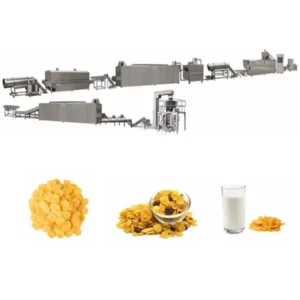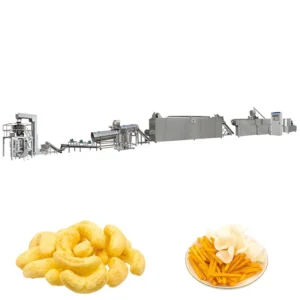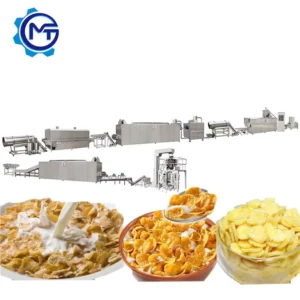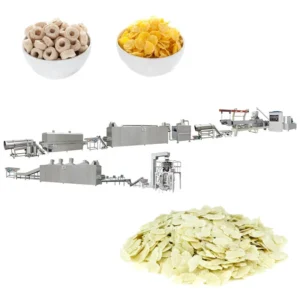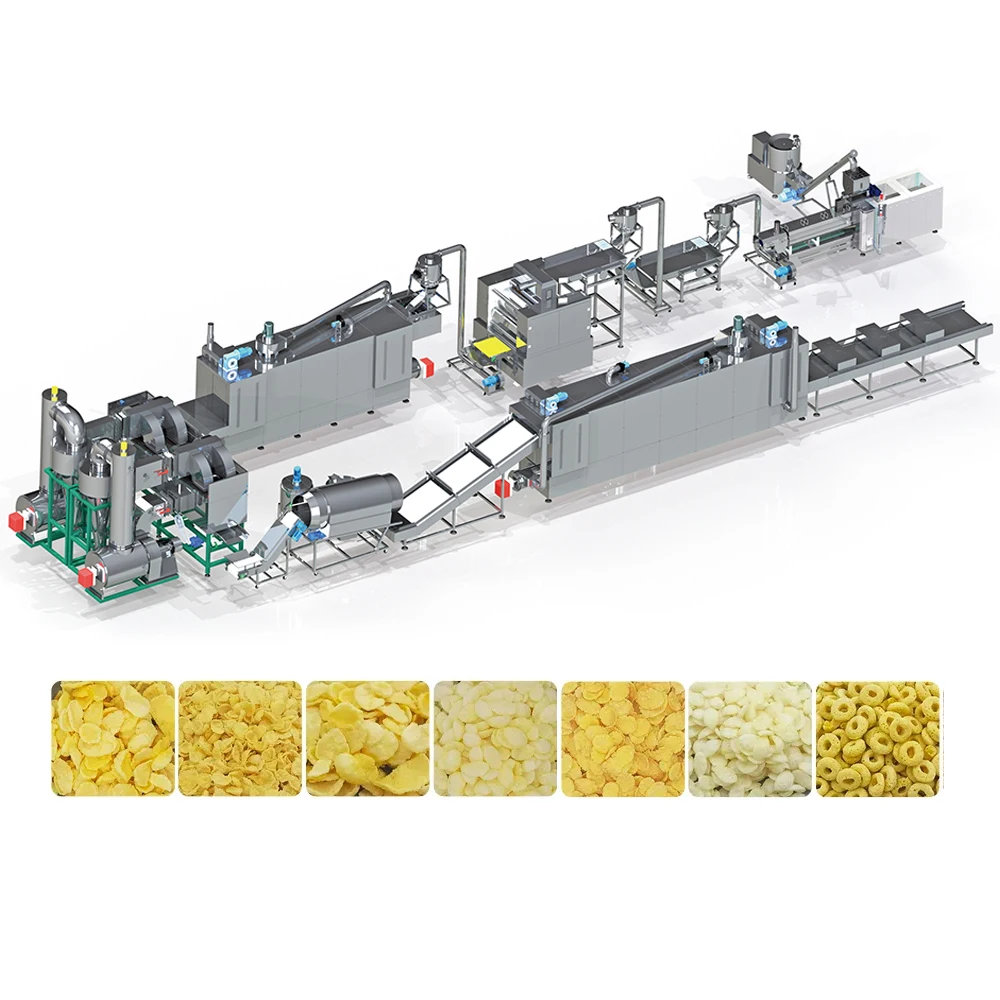
Integrated line configuration — every station from flour mixing to cooling conveyor is throughput-matched so no single unit bottlenecks the corn flakes breakfast cereal production line full equipment range.
Technical Specifications
| Parameter | Value |
|---|---|
| Product Type | Corn Flakes Breakfast Cereal Production Line |
| Line Configuration | Flour Mixer → Screw Elevator → Twin-screw Extruder → Elevator → Dryer → Elevator → Coating Line → Vibrating Spreader → Elevator → Dryer → Cooling Conveyor |
| Extruder Screw Type | Twin-screw, co-rotating, sectional modules |
| Extruder Functions | Forward/backward transport, mixing, de-gassing, cooking, forming |
| Mixer Output | 10–30 kg per load |
| Mixer Power | 4 kW |
| Mixer Tank Size | φ600×500 mm |
| Mixer Dimensions | 1000×800×1200 mm |
| Mixer Construction | Stainless steel contact parts |
| Screw Conveyor Driving Power | 0.75 kW |
| Screw Conveyor Dimensions | 2700×500×2400 mm |
| Screw Conveyor Features | Sealed stainless steel roller, vibrating sifter for stable feeding |
| Corn Flakes Press Machine Power | 16.12 kW |
| Corn Flakes Press Machine Dimensions | 1550×1300×2000 mm |
| Corn Flakes Press Machine Roller Size | 510×310×1050 mm |
| Corn Flakes Press Machine Features | Large roller, integrated cooling system, adjustable roller distance for flake thickness |
| High-temperature Oven Dimensions | 4.5×1.4×1.8 m |
| High-temperature Oven Power | 3.75 kW |
| High-temperature Oven Heating | Gas-fired, dual-side baking system |
| Sugar Spraying System Total Power | 28.75 kW |
| Sugar Spraying System Dimensions | 4000×1900×1880 mm |
| Sugar Spraying System Roller Size | Ø600×2700 mm |
| Sugar Spraying System Components | Conveyor, melting tank, temperature-keeping roller |
| Output Capacity | (basis to be confirmed — depends on raw material, moisture, and target flake specification) |
| Voltage & Frequency | Configurable to 3ph 380V 50Hz, 3ph 380V 60Hz, 3ph 415V 60Hz, 3ph 220V 60Hz, and others |
| Control System | Separate controller box for press machine (full line PLC/MCC to be confirmed) |
| Raw Materials | Corn, rice, oat, other grain powders, nutritional ingredients such as vitamins |
| Product Shapes | Ring, ball, star, stick — changeable via different moulds |
| Post-Processing | Sugar syrup or honey coating |
| Certification | CE |
Application Suitability
| Application | Material or Output |
|---|---|
| Breakfast cereal manufacturing | Corn flakes and grain-based cereals from corn, rice, or oat flour |
| Sugar-coated cereal production | Corn or multi-grain pellets coated with sugar syrup or honey |
| Puffed snack production | Grain-based expanded snacks in ring, ball, star, and stick shapes |
| Fortified instant cereal | Grain powders blended with vitamins and nutritional ingredients |
Why a Corn Flakes Breakfast Cereal Production Line Full Equipment Range Must Be Surveyed Station by Station
An extruder without matching dryer or coating capacity will stall the entire line before the first shift ends.
I have watched buyers in the Pearl River Delta focus exclusively on extruder throughput and treat every downstream station as an afterthought. One Middle East client sent standard corn grits for a trial run, then switched to a high-fat formulation on site — the expansion collapsed, the flaking press produced nothing but broken fragments, and the line sat idle for four days while we reconfigured the screw combination and die clearance. Every station in a corn flakes breakfast cereal production line full equipment range must be verified against the buyer’s actual raw material and target flake density before an order is placed [NEED_CITE: material-dependent extrusion behaviour in grain processing].
How Each Station Contributes to the Final Flake
The corn flakes breakfast cereal production line full equipment range begins with a stainless-steel flour mixer that handles 10–30 kg per load, blending corn flour or multi-grain powder with water and any nutritional additives before a sealed screw conveyor with a vibrating sifter feeds the blend steadily into the twin-screw extruder. The MT-65 extruder uses co-rotating sectional screw modules to gelatinise starch, de-gas the dough, and form a continuous rope of cooked material ready for pressing.
From Cooked Dough to Finished Coated Flake
The flaking press compresses that rope between large rollers with an adjustable gap, while its integrated cooling system keeps the dough temperature low enough to prevent sticking and maintain uniform thickness. The gas-fired oven then bakes both sides of each flake simultaneously at high temperature, driving off residual moisture for consistent crispness. A sugar spraying system — built around a melting tank, a temperature-keeping roller, and a dedicated conveyor — applies syrup or honey evenly before the final drying and cooling stages prepare the product for packing.
Reading the Specs That Actually Matter
Twin-screw co-rotating design is the critical choice here because it handles the variable moisture content of grain slurries far better than a single-screw alternative, maintaining stable pressure through the barrel sections and preventing surging that would produce uneven flake weight. The sectional screw modules allow the screw combination to be rebuilt for different grain types — corn, rice, oat — each of which gelatinises at a different temperature and shear threshold. The press machine’s adjustable roller distance directly controls flake thickness, and the integrated cooling system prevents the dough from welding to the roller surface during continuous operation. Gas-fired dual-side baking in the oven is specified because electrical heating at this scale tends to produce uneven surface colour and inconsistent moisture removal across the belt width. The separate controller box for the press machine isolates its motor circuit from the extruder drive, reducing the risk of a single electrical fault stopping both units simultaneously.
The Cost of Ignoring Downstream Capacity
When the dryer is undersized relative to extruder output, flakes exit the oven still holding too much moisture, and the sugar coating dissolves into a sticky film instead of crystallising on the surface. An undersized sugar spraying roller leaves patches of uncoated flake that fail the visual inspection on the packing line, generating waste that accumulates across every shift [NEED_CITE: coating uniformity requirements in breakfast cereal quality standards]. These are not defects that appear during a short factory trial — they emerge only after sustained production exposes the throughput mismatch between stations.
Why Buyers Source This Line Here
The corn flakes breakfast cereal production line full equipment range is assembled from a single supplier, so throughput is matched across every station rather than pieced together from separate vendors with incompatible belt speeds. Screw configuration and die design are specified to the buyer’s grain formulation and target flake shape, not copied from a generic build. The in-house testing workshop runs the buyer’s actual raw material before shipment, producing a trial report that confirms expansion, density, and press behaviour. Supporting stations — mixer, conveyor, oven, coating system, cooling belt — are selected so that no single unit becomes the constraint on line output. Pre-sales consultation covers line layout and capacity calculation, and the same engineering team handles on-site installation and commissioning.
Documentation & Verification
- Line layout drawing with capacity calculation for each station matched to your grain formulation
- Machine specification sheet recording screw configuration and die design for the extruder
- Electrical schematic with voltage and frequency confirmation for your local power grid
- Factory test record from trial run on your raw material before dispatch
- CE declaration of conformity and ISO certificate for customs and compliance filing
- Wear parts list identifying screws, dies, and roller sleeves with replacement intervals
Installation, Commissioning & Support
- Floor plan must accommodate the full line footprint including the 4.5 m oven and 4 m coating section
- Separate power circuits required for the 16.12 kW press machine and 28.75 kW sugar spraying system
- Voltage and frequency configurable to local grid standard before production begins
- Screw combination and roller gap set during on-site commissioning to match your raw material
- Operator training covers extruder barrel temperature profile, press roller adjustment, and oven gas flow balancing
- First set of spare screws, dies, and roller sleeves supplied for the initial replacement cycle
- Maintenance schedule provided for conveyor bearings, mixer seals, and oven burner inspection
What to Share When Requesting a Quotation
Provide your grain raw material type and any nutritional additives, along with the target flake thickness and coating style — sugar syrup or honey. Confirm your local voltage and frequency, workshop floor dimensions, and ceiling height so the line layout accounts for the oven and dryer footprint. If you have existing upstream batching or downstream packing equipment, share the interface specifications so the conveyor elevators and cooling belt can be matched accordingly.
Frequently Asked Questions
Q: How is output capacity verified across every station to avoid bottlenecks?
A: Each station — mixer, extruder, press, oven, coating system — is calculated against the buyer’s raw material and target flake specification. A trial run in the testing workshop confirms actual throughput before the line is shipped, so the extruder output never exceeds what the dryer and coating roller can handle.
Q: What voltage and frequency options are available for different target markets?
A: The line is configurable to 3-phase 380V 50Hz, 380V 60Hz, 415V 60Hz, 220V 60Hz, and other standards. Voltage and frequency are confirmed during the quotation stage so that motor ratings, heating elements, and control panels match the buyer’s local grid before production begins.
Q: Which stations are included in the standard line, and which can be adjusted?
A: The standard configuration covers mixing, extrusion, pressing, drying, sugar coating, and cooling. Stations can be added or removed depending on the product — for example, a second dryer may be inserted for higher-moisture formulations, or the coating system omitted for uncoated plain corn flakes.
Q: How are screw and die configurations matched to the buyer’s grain material?
A: The twin-screw extruder uses sectional modules that are assembled in a specific combination based on the grain type, moisture content, and target expansion. The die is selected to produce the correct rope diameter for the press machine, and both are recorded in the configuration document supplied with the line.
Q: What spare wear parts are supplied, and when is the first replacement due?
A: An initial set of screws, dies, and press roller sleeves is included with the line. The wear parts list specifies expected service intervals based on production hours and raw material abrasiveness, so replacements can be ordered before the first set reaches end of life.