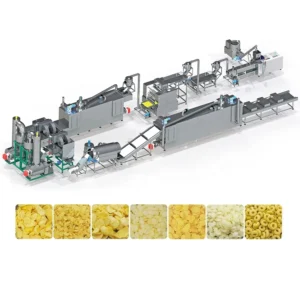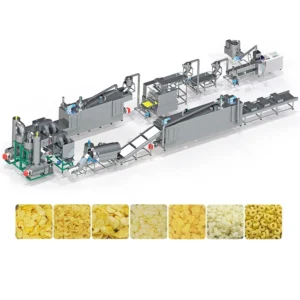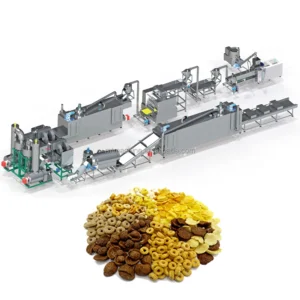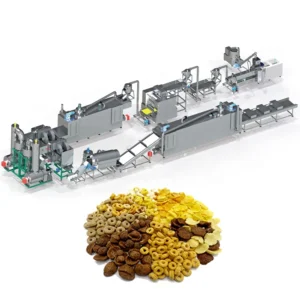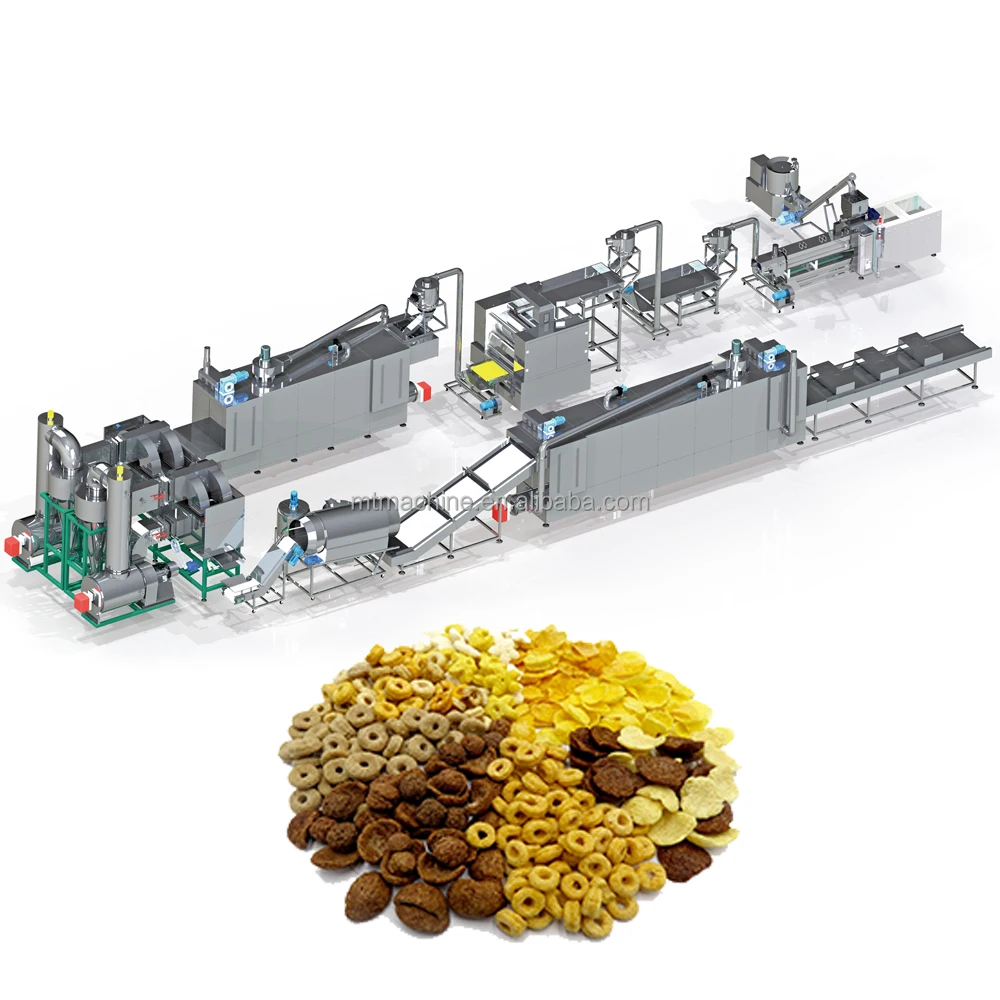
Integrated Throughput Matching — Every station from mixing to packing is balanced to the same output target, preventing the extruder from outpacing downstream dryers or coating drums.
Technical Specifications
| Parameter | Value |
|---|---|
| Model | MT70 / MT75 / MT85 |
| Product Type | Corn Flakes Production Line / Breakfast Cereal Making Machine |
| Screw Type | Twin Screw |
| Installed Power | MT70: 160 kW / MT75: 210 kW / MT85: 190 kW |
| Power Consumption | MT70: 120 kW / MT75: 150 kW / MT85: 140 kW |
| Output Capacity | MT70: 150–200 kg/h (basis to be confirmed); MT75: 300–500 kg/h (basis to be confirmed); MT85: 300–400 kg/h (basis to be confirmed) |
| Overall Dimensions | MT70: 41 × 1.5 × 2.2 m; MT75: 45 × 1.5 × 3.5 m; MT85: 43 × 1.5 × 3.2 m |
| Control System | PLC control (flaking station); MCC and PLC available across line |
| Flaking Machine Drive | Double motors with separate roller driving; hydraulic system for double rollers |
| Flaking Temperature Control | Infrared sensor for even temperature pipe control |
| Dryer Heating Source | Gas or Electric |
| Roasting Oven | Hot air roasting with conciliation burner, dual circulating fans, cyclone dust removal, vibrating pan with high-temperature spraying tubes |
| Coating System | Double tumble for sugar melting, elevator, coating drum, spraying nozzle |
| Raw Materials | Corn, rice, wheat, oat, barley powder |
| Final Products | Natural corn flakes, sugar-coated corn flakes, shaped cereals (ball, tube, ring, fruit loop, star, wheel, flower, heart) |
| Extruder Features | Automatic lubricating and cooling function; wear-resistant screw technology |
| Assembly State | Complete production line |
| Standards | CE; ISO |
Application Suitability
| Application | Material or Output |
|---|---|
| Natural corn flakes for breakfast cereal market | Corn grits and corn flour |
| Sugar-coated corn flakes with glossy finish | Corn base with sugar syrup coating |
| Multi-grain cereal flakes | Rice, wheat, oat, and barley powder blends |
| Shaped breakfast cereals | Same extrusion platform with die changes for balls, rings, loops, stars, and wheels |
| Puffed snack formats | Mould adjustment on extruder for tube, stick, flower, and heart shapes |
Why Capacity Numbers Without Raw Material Context Mislead Buyers
The stated kg/h figure only holds when the extruder processes the same grain type, particle size, and moisture content used during factory testing.
I spent four days on a workshop floor in Southeast Asia last year watching a corn flakes line run at nearly half its signed capacity. The contract said one thing; the buyer’s local corn flour — higher in fat, coarser in grind — said another. The extruder screw combination and die configuration that worked perfectly on standard corn grits back in our testing workshop could not generate enough expansion on that material. We reconfigured the screw elements and opened up the die orifices, and the line finally met expectations, but the delay cost everyone. That is why every corn flakes making machine full equipment range inquiry now starts with a raw material sample, not a capacity number [NEED_CITE: raw material variability in grain extrusion processes].
How Each Station Connects in the Corn Flakes Line
The corn flakes making machine full equipment range begins at the mixing station, where grain powders are blended with water and minor ingredients before entering the twin-screw extruder. Inside the barrel, the material undergoes high-temperature, high-pressure cooking through mechanical shear and external heating. The extrudate exits through a die and is cut into pellets. These pellets then pass through the flaking machine, where hydraulic double rollers press them into thin flakes under controlled temperature monitored by infrared sensors.
Downstream, the flakes move through a dryer that reduces moisture using gas or electric heating, then enter the hot air roasting oven. The roasting stage uses a conciliation burner and two separate circulating fans to blister the flake surface evenly, producing the characteristic crispness and toasted color. A cyclone dust removal device keeps the oven environment clean. For sugar-coated variants, the line adds a sugar melting tumble, coating drum with spraying nozzles, and a second drying pass before cooling and packing.
Matching Throughput Across Every Machine
The reason engineering every station under one supplier matters becomes obvious when you see what happens otherwise. An extruder pushing 300 kg/h of pellets into a dryer rated for 200 kg/h means wet flakes pile up, stick together, and spoil. A roasting oven that cannot keep pace creates a backlog of under-toasted product. When the flaking machine rollers cannot flatten pellets as fast as they arrive, the entire upstream process stalls [NEED_CITE: production line bottleneck analysis in food processing].
On this line, the MT75 twin-screw extruder, flaking machine with PLC-controlled parameters, dryer, hot air roasting oven, and coating drum are all specified to the same throughput target based on the buyer’s confirmed raw material. The vibrating pan in the roasting oven and the double tumble in the coating system are sized to handle the flake volume without accumulation or starvation at any transfer point.
Reading the Specifications for Real Production Impact
The twin-screw design on the MT70, MT75, and MT85 extruders gives operators independent control over shear intensity and residence time through screw element arrangement. For corn flakes, where starch gelatinisation must be thorough but expansion limited — you want dense pellets, not puffed balls — the screw configuration is set to moderate shear with a compression zone that cooks the dough without excessive moisture flash-off at the die.
The flaking station uses separate dual-motor driving for each roller, meaning the gap and pressure can be adjusted independently to achieve consistent flake thickness across the full roller width. Hydraulic pressure maintains that gap even as roller surfaces wear over production runs. The infrared temperature sensor feeding back to the heating pipes prevents uneven flake texture caused by cold spots on the roller surface, a common source of breakage during roasting.
The hot air roasting oven’s dual circulating fans create a cross-flow pattern that toasts both sides of each flake. The conciliation burner modulates flame intensity based on oven temperature feedback, preventing scorching during high-volume runs while maintaining the blistering effect that gives corn flakes their bowl-ready crispness.
The Hidden Cost of Mismatched Line Configuration
When the coating drum is undersized relative to the extruder output, sugar syrup coverage becomes uneven — some flakes are overloaded and clump together, while others pass through bare. Buyers discover this only after the line is installed and running, because the problem does not show up during isolated machine tests. By that point, repositioning or replacing the drum means halting production and reconfiguring downstream conveyors [NEED_CITE: post-installation line modification costs in food manufacturing].
Similarly, if the dryer heating source and airflow capacity do not match the moisture load coming from the flaking station, flakes enter the roasting oven too wet. The roaster then overworks to drive off residual moisture instead of focusing on surface toasting, resulting in either burnt edges or insufficiently crisp centers. These quality defects trace back to capacity imbalances that a spec-sheet-only review would not catch.
What Sets This Equipment Range Apart
Complete line engineering under one supplier means the corn flakes making machine full equipment range is configured as a system, not assembled from unrelated vendors. Throughput calculations at each station account for moisture gain and loss across drying and roasting, not just dry weight at the extruder die.
Screw configuration and die design are matched to the buyer’s actual raw material after testing in the in-house workshop, not copied from a generic template. The flaking machine parameters — roller gap, hydraulic pressure, temperature setpoint — are recorded during the trial run and documented for the buyer’s reference.
Pre-sales consultation covers line layout, utility requirements, and phased installation planning. On-site commissioning includes operator training on PLC controls and screw element replacement procedures. Ongoing maintenance support covers wear parts scheduling for screws, dies, and flaking rollers based on the buyer’s production hours.
Documentation & Verification
- Line layout and capacity calculation with throughput matching across every station
- Machine specification sheet with screw and die configuration matched to your raw material
- Electrical schematic and voltage confirmation for your facility before production begins
- Trial run report on your actual grain powder in the testing workshop before shipment
- Wear parts list with replacement intervals for screws, dies, and flaking rollers
- Operation and maintenance manual covering PLC parameter settings and hydraulic system care
Installation, Commissioning & Support
- Foundation and floor space planning based on overall dimensions up to 45 × 1.5 × 3.5 m for the full line footprint
- Power supply confirmation for installed loads up to 210 kW, with dedicated circuits for extruder main motor and roasting oven burner
- Assembly sequencing from extruder through flaking, drying, roasting, and coating stations with utility connection points mapped
- First-run parameter setting on the PLC-controlled flaking station and twin-screw extruder screw speed and temperature zones
- Operator training covering die changes for shaped cereal formats and hydraulic roller gap adjustment on the flaking machine
- Scheduled replacement guidance for twin-screw elements, extruder dies, and flaking roller surfaces based on production hours
What to Include With Your Inquiry
To size the corn flakes making machine full equipment range correctly, provide the specific grain type and supplier, including moisture content and particle size distribution. Share your target daily output in finished product weight, workshop floor dimensions with ceiling height, and local voltage and frequency standards. If you plan to produce both natural and sugar-coated flakes, or intend to run shaped cereal formats on the same extrusion platform, note this so the die inventory and coating station are included from the start.
Frequently Asked Questions
Q: How is line capacity verified before the equipment is shipped?
A: Capacity figures are confirmed through a trial run using the buyer’s actual raw material in the in-house testing workshop. The extruder screw configuration, die selection, and downstream station settings are adjusted until target output and flake quality are achieved. A trial run report documenting these parameters accompanies the shipment.
Q: How are dryer, roaster, and coating capacities matched to the extruder?
A: Each station is calculated based on the extruder’s confirmed output on the buyer’s raw material, accounting for moisture content changes at each stage. The dryer handles the moisture load from flaking, the roaster is sized for the dried flake volume, and the coating drum accommodates the full roasted output per cycle.
Q: What electrical and control options are confirmed before production?
A: Voltage, frequency, and control panel language are confirmed during the specification phase based on the buyer’s facility requirements. The flaking station operates under PLC control, and MCC integration is available for the full line. Electrical schematics reflecting these choices are provided before manufacturing begins.
Q: Which spare wear parts are included, and what is the replacement schedule?
A: The initial shipment includes spare twin-screw elements, extruder dies, and flaking roller surfaces. Replacement intervals depend on raw material abrasiveness and production hours, documented in the wear parts list. The automatic lubricating system on the extruder extends screw service life under normal operating conditions.
Q: Can the same extrusion line produce both flakes and shaped cereals?
A: Yes. The twin-screw extruder accepts different die configurations to produce pellets for flaking or direct-cut shapes such as balls, rings, loops, and stars. Die changes and corresponding screw adjustments are covered during operator training and documented in the configuration record.