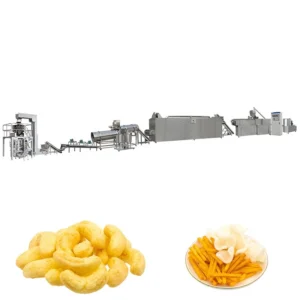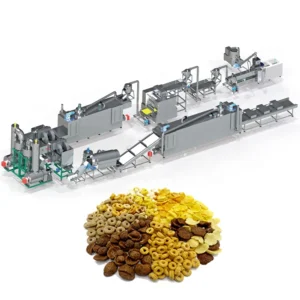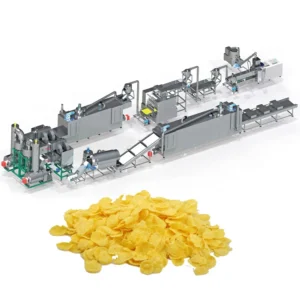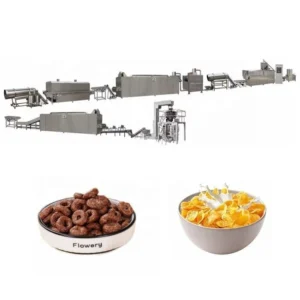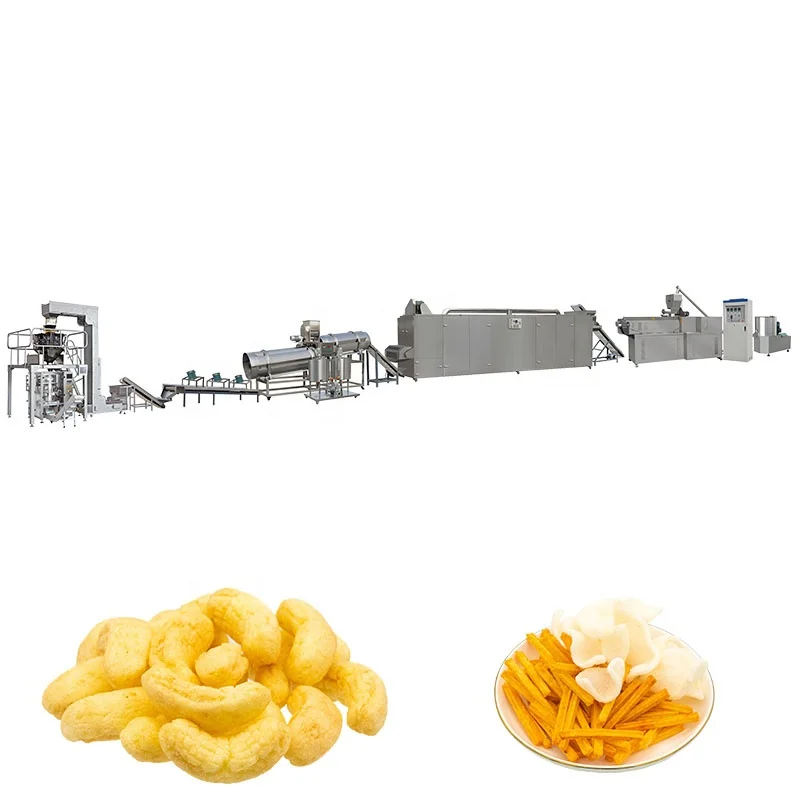
Line-Balanced Throughput — Every station from mixing to packing is sized against the MT-75 output, so the flaker, dryer and roaster never starve or choke the extruder during continuous corn flakes production.
Technical Specifications
| Parameter | Value |
|---|---|
| Product Type | Corn Flakes Production Line |
| Extruder Model | MT-75 Twin Screw Extruder |
| Screw Type | Twin-screw |
| Line Capacity | 200-300 kg/hr (basis not stated in source — confirm raw material, moisture and product format) |
| Voltage | 220V / 380V (frequency to be confirmed per destination market) |
| Control System | PLC control system on flaking machinery; extruder control type to be confirmed |
| Flaking Machinery Dimensions | 1330 × 440 × 960 mm (source value — verify against full-line layout) |
| Flaking Machinery Net Weight | 50 kg (source value — verify against full-line weight) |
| Flaking Machinery Rated Power | 3 kW (source value — verify against whole-line power schedule) |
| Flaking Drive | Dual independent motors, one per roller; hydraulic pressure system |
| Flaking Temperature Control | Infrared sensor for even roller surface temperature |
| Dryer Heating Source | Gas or Electric |
| Roasting Oven | Hot air with conciliation burner, dual circulating fans, cyclone dust removal, vibrating pan with high-temperature spraying tubes |
| Sugar Coating System | Double tumble melter, elevator, coating drum, spraying nozzle |
| Natural Line Flow | Mixing → Extruding → Flaking → Drying → Hot Air Roasting → Cooling → Packing |
| Sugar-Coated Line Flow | Mixing → Extruding → Flaking → Drying → Hot Air Roasting → Sugar Spraying → Sugar Coating → Drying → Cooling → Packing |
| Warranty | 1 year (including core gearbox) |
| Standards | CE, ISO |
Application Suitability
| Application | Material or Output |
|---|---|
| Classic corn flakes | Degerminated corn grits, natural or sugar-coated |
| Multi-grain breakfast flakes | Rice, wheat, oat, barley or blended cereal bases |
| Fortified breakfast cereal | Vitamin- and mineral-enriched grain blends |
| Snack cereal variants | Shaped extrudates roasted for crunchy snack formats |
Why "Rated Capacity" Means Nothing Without the Full Station Chain
An extruder that runs at a given output only matters if every downstream station — flaker, dryer, roaster, coater — can absorb that same flow without creating a bottleneck that caps your real throughput.
I spent weeks troubleshooting a corn flakes line in Lagos where the extruder was rated well above the actual bagged output. The problem was never the screw speed; it was a roaster with a single fan that could not keep up, so half the flakes sat in a cooling conveyor losing moisture unevenly. When buyers evaluate a corn flakes making machine full equipment range, the question is not what the extruder can push, but whether the flaker rollers, the dryer bed length, and the roaster air volume all match that push hour after hour [NEED_CITE: line throughput balancing principles in cereal processing].
Station Matching Across the Corn Flakes Process
The MT-75 feeds cooked, pelleted dough into a hydraulic double-roller flaker. Each roller is driven by its own motor, which keeps the nip pressure uniform even when pellet moisture fluctuates slightly between batches. An infrared sensor monitors roller surface temperature continuously, preventing cold spots that cause uneven sheet thickness.
Drying and Roasting Determine Final Crispness
After flaking, the sheets enter a dryer where residual moisture is brought down before roasting. The hot air roasting oven uses a conciliation burner paired with two separate circulating fans and a cyclone dust removal device. A vibrating pan with high-temperature spraying tubes ensures the flakes tumble through the hot air stream, producing the surface bubbling and golden color buyers expect [NEED_CITE: Maillard reaction temperature ranges in breakfast cereal roasting]. This is where many lines fail — undersized roasters produce pale, tough flakes instead of the crisp blistered texture the market demands.
How Screw Configuration Affects Flake Integrity
In twin-screw extrusion for corn flakes, the screw elements must achieve sufficient starch gelatinisation without over-shearing the dough. Over-sheared dough produces pellets that shatter rather than flatten in the flaker, generating excess fines that waste raw material and foul the roaster cyclone. The L/D ratio, element spacing and barrel temperature profile must all be matched to the specific corn variety and particle size distribution the buyer sources locally. A configuration optimized for American dent corn will not produce the same pellet quality with African white corn unless the screw combination is adjusted — which is exactly the kind of mismatch I have seen shut down lines during commissioning.
Specification Decisions That Shape Daily Output
The PLC control on the flaking machinery allows operators to set roller gap and pressure from a single interface, reducing the manual adjustments that cause thickness variation across shifts. The dual-motor flaker drive means each roller can be serviced independently without a full line stop. Dryer heating source is configurable between gas and electric — gas is the standard choice where fuel cost is lower, while electric heating simplifies installation where gas supply infrastructure is limited. The voltage range of 220V/380V must be confirmed against the buyer’s local supply before production begins, because a motor wound for 380V/50Hz will overheat and trip breakers on a 440V/60Hz grid, and rewinding after delivery delays commissioning by weeks [NEED_CITE: voltage and frequency standards by export market].
The Hidden Cost of an Unbalanced Line
When the flaker cannot match extruder output, pellets pile up in a buffer hopper, cooling and retrograding before they reach the rollers. Retrograded pellets do not flatten into intact sheets — they crumble, and those fines carry through to the roaster where they burn and contaminate the cyclone filter. The operator then has to stop the line every few hours to clean the dust collection system. I have watched this exact pattern repeat on lines in Dhaka and Nairobi, always traced back to a station capacity mismatch that could have been caught during the layout planning stage [NEED_CITE: starch retrogradation effects on cereal flaking].
Why Source the Full Range From One Supplier
Every station in this corn flakes line is specified and supplied as a matched set, so the extruder throughput, flaker nip width, dryer bed area and roaster air volume are calculated together rather than assembled from separate vendor quotes. The screw configuration and die design are set to the buyer’s actual raw material, not copied from a generic template. An in-house testing workshop allows trial runs on the buyer’s corn supply before the line ships, so parameters are documented rather than guessed during commissioning. Documentation includes the line layout with capacity calculations, the screw and die record, and the factory test report — all specific to the buyer’s product.
Documentation & Verification
- Line layout and capacity calculation matching every station from mixer to packer
- Screw and die configuration record tied to your corn variety and moisture
- Electrical schematic with voltage and frequency locked to your facility grid
- Factory trial run report on your raw material before the line ships
- Machinery test report and video outgoing inspection provided
Installation, Commissioning & Support
- Foundation and floor space plan tied to the full station chain footprint
- Dedicated electrical circuits sized for the combined dryer, roaster and extruder load
- PLC interface language configured for your operators before dispatch
- First-run commissioning with screw speed, roller gap and roaster temperature documented
- Wear parts list covering screws, dies and flaker rollers with reorder lead times
- Scheduled maintenance intervals for gearbox, hydraulic system and circulating fans
What We Need to Configure Your Line
To build a realistic proposal, share the corn variety or grain blend you plan to run, the target moisture range, and whether you need natural, sugar-coated or both variants. Confirm your facility voltage and frequency, available floor space and ceiling height, and the daily output you need to meet your packaging schedule. If you already have upstream milling or downstream packing equipment, let us know the interface points so the line layout accounts for them.
Frequently Asked Questions
Q: How is the 200-300 kg/hr capacity verified, and what conditions does it assume?
A: That figure requires confirmation of the raw material type, incoming moisture content and the target flake thickness. During the pre-shipment trial run in our testing workshop, we run your actual corn supply through the MT-75 and downstream stations, then document the sustained throughput under those specific conditions so you know what to expect at your facility.
Q: What voltage and frequency options are available for the target market?
A: The line is configurable for 220V or 380V supply, and frequency must be confirmed for 50Hz or 60Hz depending on your local grid. We lock in these values during the electrical schematic stage and configure the PLC panel language to match your operators before the equipment leaves the factory.
Q: How are station capacities matched to prevent bottlenecks?
A: Each station — extruder, flaker, dryer, roaster and coater — is sized against the same throughput target during the line layout stage. We calculate the flaker nip capacity, dryer residence time and roaster air volume so no single station limits the output of the others under continuous operation.
Q: Can this line produce both natural and sugar-coated corn flakes?
A: Yes. The sugar-coated variant adds a sugar spraying station, a double tumble melter and a coating drum after the hot air roaster, followed by a second drying pass. The natural line omits these stations and goes directly from roasting to cooling and packing.
Q: What spare wear parts are included, and how long does reordering take?
A: The initial shipment includes a set of spare screws, dies and flaker roller components. We provide a full wear parts list with specifications, and typical reorder lead times depend on the part and destination — confirm timing with us before your first planned changeover so spares arrive before you need them.