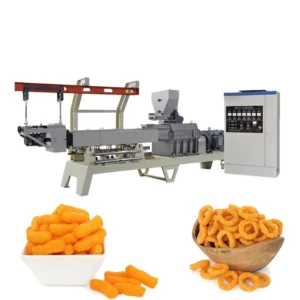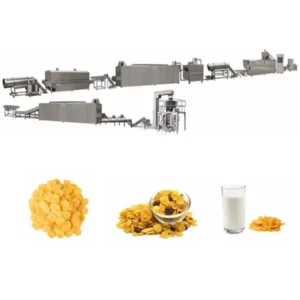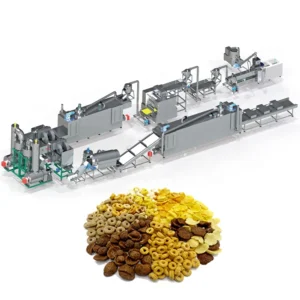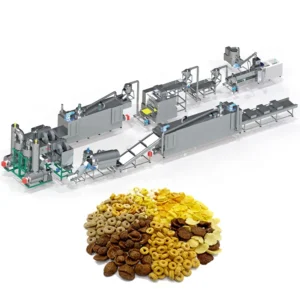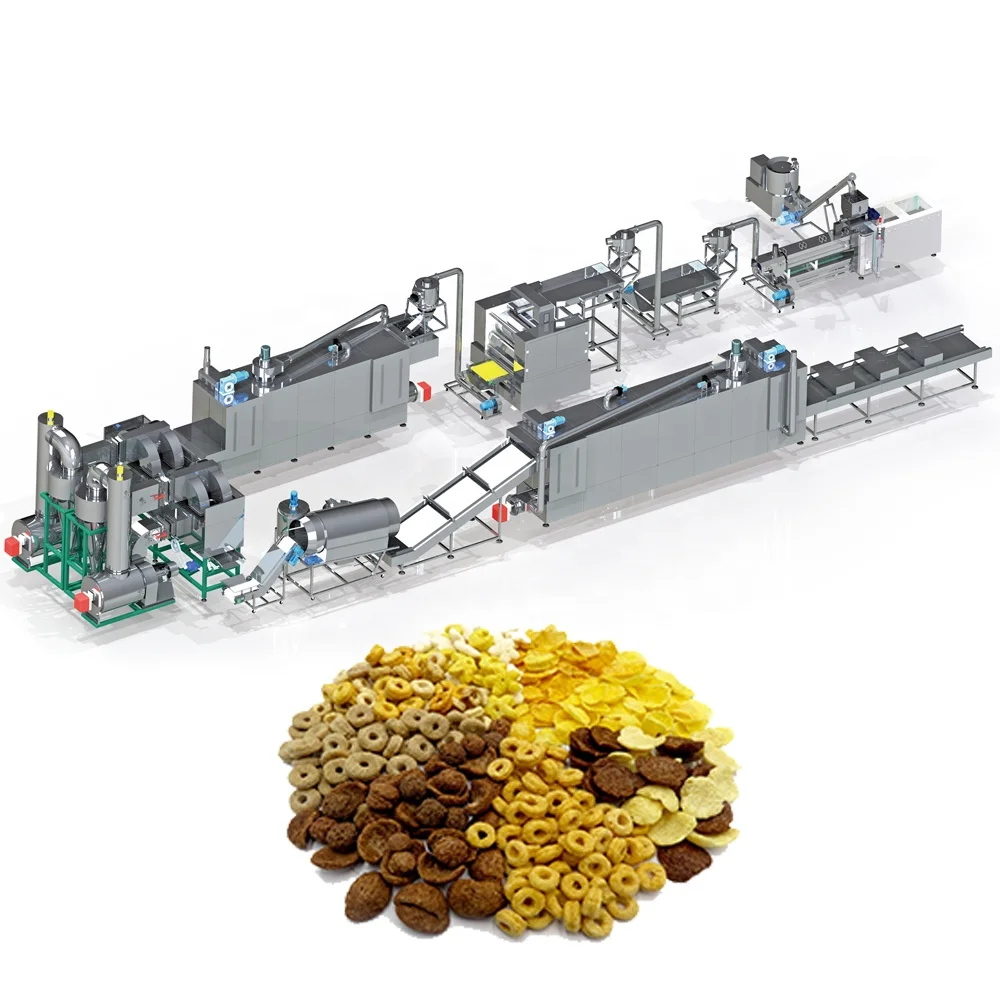
Specified screw and die configuration — every extruder barrel section and roller gap is set to the buyer’s actual corn grit particle size and moisture content, verified on the testing floor before the machine leaves Jinan.
Technical Specifications
| Parameter | Value |
|---|---|
| Product Type | Corn Flakes Production Line |
| Models Available | MT-65 / MT-70 / MT-75 / MT-85 |
| Screw Type | Twin screw, co-rotating sectional modules |
| Output Capacity (MT-65) | 120–150 kg/h (basis not stated in source) |
| Output Capacity (MT-70) | 200–250 kg/h (basis not stated in source) |
| Output Capacity (MT-75) | 300–400 kg/h (basis not stated in source) |
| Output Capacity (MT-85) | 400–500 kg/h (basis not stated in source) |
| Installed Power | 84 kW (MT-65) / 132 kW (MT-70) / 186 kW (MT-75) / 239 kW (MT-85) |
| Real Power Consumption | 59 kW (MT-65) / 92 kW (MT-70) / 140 kW (MT-75) / 167 kW (MT-85) |
| Overall Dimensions (L×W×H) | 12×1.2×2.2 m (MT-65) up to 28×1.5×2.8 m (MT-85) |
| Control System | PLC and MCC |
| Extruder Features | Self-cleaning, forced oil lubrication, non-stop cutting |
| Flaking Roller | Integrated cooling system, adjustable gap for thickness |
| Oven Heating | Gas-fired, both-side baking |
| Raw Materials | Corn grits, corn flour, rice flour, wheat flour, soya bean, peanut, walnut, sugar |
| Contact Materials | Food-grade throughout |
| Certification | CE, ISO |
| Warranty | 1 year complete, lifetime maintenance |
| Lead Time | 5–30 days after advance payment |
Application Suitability
| Application | Material or Output |
|---|---|
| Traditional corn flakes breakfast cereal | Corn grits and corn flour formulations |
| Multi-grain breakfast flakes | Blended rice flour, wheat flour and corn base |
| Sugar-coated and frosted cereal products | Extruded flakes with sugar spraying and drum coating |
| Fortified breakfast cereals | Grain blends with added nutritional components |
| Puffed extruded breakfast snacks | Corn, soya bean, peanut and walnut-based recipes |
Why Nominal Line Capacity Rarely Matches Your Output
A corn flakes production line equipment manufacturer must size every station to your specific corn flour particle distribution, not to a catalog average.
I once watched a breakfast cereal producer receive a line rated for a certain hourly throughput, only to find their corn flour was noticeably coarser than the material used during the supplier’s demonstration. The extruder could not gelatinise the starch fully at the rated feed rate, and the resulting flakes came out hard and undersized. Output dropped to roughly half what the nameplate promised [NEED_CITE: impact of raw material particle size on twin-screw extrusion throughput]. That is the gap between a brochure figure and a working corn flakes production line equipment manufacturer who tests your actual material first.
How Each Station Connects to the Next
Surveying equipment for a corn flakes line means checking that the flour mixer discharge rate, the screw conveyor volume, the extruder throughput, the flaking roller width, and the oven belt area all align. If the flaking roller is narrower than what the extruder delivers, cooked dough piles up upstream and cools before it can be pressed. Every station in this catalogue — from the Φ600 mm mixer tank through the gas-fired oven to the sugar spraying drum — is specified with its own power draw and physical footprint so that buyers can map the material flow and spot bottlenecks before the line ships.
Station-by-Station Equipment Range
The MT-65 through MT-85 extruder models cover capacity bands for small pilot operations up to continuous shift production. Each model pairs with a matching flaking machine, where the 510 mm roller width and adjustable gap control the final flake thickness. Downstream, the gas-fired oven provides both-side baking across a 4.5-meter drying zone, and the sugar spraying system uses a Φ600×2700 mm roller to coat flakes evenly. Having the complete equipment range from one corn flakes production line equipment manufacturer means throughput matching is calculated once, not negotiated across four separate vendors [NEED_CITE: throughput balancing across multi-station food processing lines].
Reading the Specs That Actually Matter
The co-rotating twin-screw design with sectional modules lets the screw profile be rearranged for different grain formulations — a high-fiber wheat blend needs a different compression ratio than pure corn grits. Installed power versus real power consumption tells a practical story: the MT-75 draws 186 kW on paper but runs at roughly 140 kW in steady state, which is the figure to use when sizing your electrical panel. The forced oil lubrication system on the gearbox protects against the shock loads that occur when cold dough first enters the barrel. And the PLC control with MCC means motor starters, temperature zones, and screw speed are all managed from a single interface, reducing the operator errors that cause batch-to-batch density variation in the finished flake.
The Hidden Cost of Skipping the Material Test
When a line is configured from generic screw and die settings rather than a trial on the buyer’s corn flour, the problems surface after installation. Flakes may crack during drying because the extrusion moisture was wrong, or they may stick to the flaking roller because the cooling circuit was undersized for the actual thermal load. Correcting these issues on-site means new screw elements, replacement dies, and days of lost production [NEED_CITE: cost of post-installation process re-engineering in food extrusion]. A testing workshop trial before shipment eliminates most of that risk.
What This Equipment Range Delivers
Screw configuration and die design are specified against the buyer’s raw material sample, not copied from a previous project. The in-house testing workshop runs the buyer’s own corn grits or flour blend before the extruder is crated, producing a trial report that documents actual output and flake quality. Every station from mixing to packing comes from a single supplier, so the conveyor height, the oven belt speed, and the flavouring drum RPM are coordinated at the factory. Electrical schematics and voltage confirmation are completed before production starts, avoiding the commissioning delays that occur when a 50 Hz machine arrives at a 60 Hz facility. CE and ISO certification documentation supports import clearance in regulated markets.
Documentation & Verification
- Line layout drawing with station-by-station capacity matched to your corn formulation
- Screw and die configuration record specifying module arrangement for your grain blend
- Trial run report from the testing workshop using your actual raw material sample
- Electrical schematic with voltage, frequency, and control language confirmed pre-production
- CE declaration of conformity and ISO certificate for customs and regulatory filing
- Wear parts list identifying screw elements, dies, and roller bearings for reorder planning
Installation, Commissioning & Support
- Foundation plan accounts for the MT-85 line length of 28 meters and vibrating flaking roller loads
- Dedicated electrical circuit sized to the real power draw, up to 167 kW for the MT-85 configuration
- Gas supply piping specified for the oven’s both-side baking burners and local fuel type
- PLC program loaded with operator interface language confirmed before the control cabinet ships
- First-run commissioning includes screw speed, barrel temperature, and roller gap calibration on-site
- Spare screw elements and flaking roller bearings shipped with the initial order to cover the first replacement cycle
Before You Send an Inquiry
To match the right extruder model and supporting stations to your project, we need your target corn flake format and the grain formulation you plan to run. Share your daily or shift-based production target, the available floor space and ceiling height in your facility, and the local voltage and frequency standard. If you already operate upstream milling or downstream packing equipment, let us know the interface points so the line layout accounts for existing conveyors and silos.
Frequently Asked Questions
Q: How is the output capacity of each extruder model verified before purchase?
A: Each model carries a rated capacity range, but the actual throughput depends on your specific corn grit particle size, moisture content, and recipe. We run your raw material sample in our testing workshop and document the real output, flake density, and surface quality in a trial report before the quotation is finalised.
Q: Which supporting stations are included, and how is throughput matched across them?
A: The line covers flour mixing, screw conveying, twin-screw extrusion, flaking, gas-fired drying, and sugar coating. Each station’s power rating and physical dimensions are specified so the material flow rate stays consistent from the mixer to the packing end without accumulation or starvation at any point.
Q: What are the space and utility requirements for different line configurations?
A: The MT-65 line fits within a 12-meter footprint at 84 kW installed power, while the MT-85 extends to 28 meters and 239 kW. Gas supply for the oven and compressed air for pneumatic controls must also be provisioned. Detailed layout drawings are provided during the proposal stage.
Q: Can individual stations be ordered separately instead of the complete line?
A: Yes. Each station — extruder, flaking roller, oven, sugar spraying system — is available as standalone equipment. Specifications and interface dimensions are documented so the unit can integrate with existing upstream or downstream machinery from other suppliers.
Q: What documentation supports equipment selection and factory planning?
A: Buyers receive a machine specification sheet, line layout drawing, screw and die configuration record, electrical schematic, and trial run report. These documents cover capacity calculations, utility requirements, and control system details needed for facility engineering and import compliance.