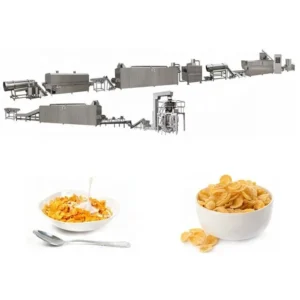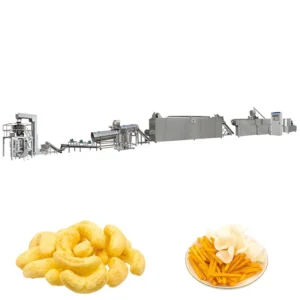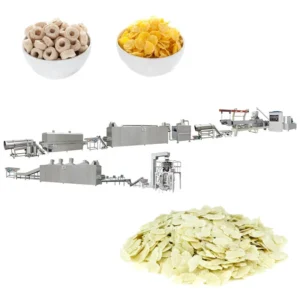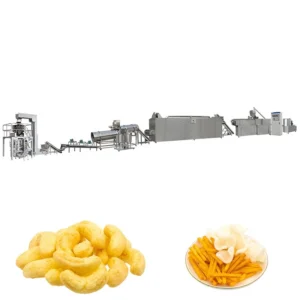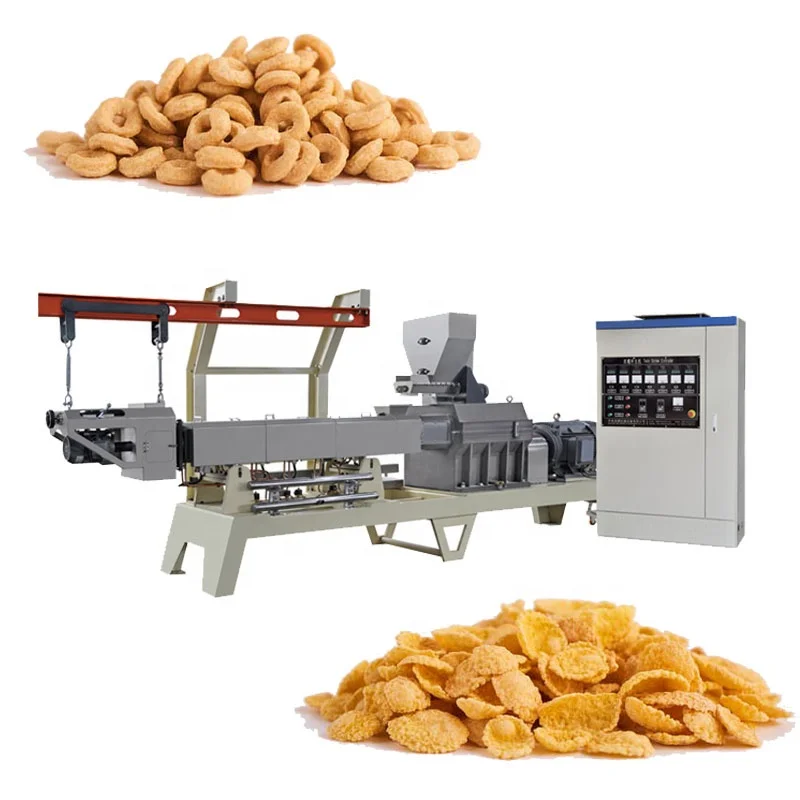
Integrated Line Matching — Every station from mixing to packing is capacity-balanced around the extruder output, preventing the dryer or coater from choking the throughput your twin-screw extruder actually delivers.
Technical Specifications
| Parameter | Value |
|---|---|
| Product Type | Corn Flakes and Breakfast Cereal Production Line |
| Models Available | MT70, MT85, MT75 |
| Extruder Type | Twin Screw |
| Installed Power (MT70 / MT85 / MT75) | 160 kW / 190 kW / 210 kW |
| Power Consumption (MT70 / MT85 / MT75) | 120 kW / 140 kW / 150 kW |
| Output Capacity (MT70) | 150–200 kg/h (basis not stated in source) |
| Output Capacity (MT85) | 300–400 kg/h (basis not stated in source) |
| Output Capacity (MT75) | 300–500 kg/h (basis not stated in source) |
| Overall Dimensions (MT70) | 41 × 1.5 × 2.2 m |
| Overall Dimensions (MT85) | 43 × 1.5 × 3.2 m |
| Overall Dimensions (MT75) | 45 × 1.5 × 3.5 m |
| Control System | PLC |
| Extruder Lubrication | Automatic lubricating and cooling system |
| Flaking Machinery | PLC control, hydraulic double rollers, independent dual-motor drive, infrared sensor temperature control |
| Dryer Heating Source | Gas or Electric (configurable) |
| Roasting Oven | Hot air roasting with vibrating pan, conciliation burner, dual circulating fans, cyclone dust removal |
| Coating System | Double tumble sugar melter, elevator, coating drum, spraying nozzle |
| Raw Materials | Corn, rice, wheat, oat, barley powder |
| Key Features | Wear-resistant screws, automatic lubrication, PLC across all major stations, hydraulic flaking, modular sugar coating |
Application Suitability
| Application | Material or Output |
|---|---|
| Natural corn flakes | Corn grits, corn flour |
| Sugar-coated corn flakes | Corn base with sugar or honey glaze |
| Shaped breakfast cereals | Rice, wheat, oat, barley blends — ball, tube, ring, star, fruit loop, flower, heart, wheel formats |
| Fortified breakfast cereals | Grain blends with added vitamin and mineral premix |
| Oatmeal-based flakes | Oat powder and oat-grain mixtures (moisture confirmation required) |
Why "Rated Capacity" Means Nothing Without Your Raw Material
A corn flakes production line complete equipment set only holds its rated output when screw configuration, dryer throughput, and flaking pressure are all tuned to the specific grain blend you will actually run.
I have seen buyers sign off on a breakfast cereal line based on a nameplate number, only to find their oat-heavy recipe produces excess moisture that turns the flaking roller output into crumbles. The extruder kept running, but the downstream stations could not keep pace with the degraded material, and effective throughput dropped sharply. [NEED_CITE: moisture content impact on cereal flaking yield] When the corn flakes production line complete equipment is specified without accounting for your actual flour blend and ambient humidity, the bottleneck simply moves rather than disappears.
Every Station Mapped Before You Commit
This page lays out the full equipment catalogue for corn flakes and breakfast cereal processing so you can see where each machine sits in the chain. The twin-screw extruder is only one node; the flaking machinery, hot air roaster, and sugar coating drum each carry their own throughput ceiling. A corn flakes production line complete equipment package that names every station lets you verify that no single link constrains the rest.
From Raw Grain to Retail-Ready Cereal
The process starts at the batching and mixing station, where corn, rice, wheat, oat, or barley powder is combined with water and any fortification premix. The twin-screw extruder then gelatinises the starch under controlled barrel temperature and shear, pushing the dough through a die to form the pellet or ribbon that the flaking rollers will compress. After flaking, the material enters the dryer — configurable for gas or electric heating — before moving into the hot air roasting oven where a conciliation burner and dual circulating fans develop the toasted colour and crunch. [NEED_CITE: starch gelatinisation temperature range in cereal extrusion] Sugar-coated variants pass through the double tumble melter and coating drum before final cooling and packing.
Reading the Specs Against Your Production Reality
The three available models — MT70, MT85, and MT75 — differ in installed power and physical footprint, but the numbers that matter most are the ones tied to your recipe. Installed power ranges from 160 kW to 210 kW across the line, while actual power consumption sits lower at 120 kW to 150 kW, reflecting the duty cycle of heating zones and drive motors. The twin-screw extruder features automatic lubricating and cooling, which extends screw service life during continuous runs on abrasive grain blends. The flaking station uses hydraulic pressure on double rollers with independent dual-motor drive, letting you set roller gap and pressure separately for each side — critical when switching between a dense corn grit and a lighter oat mixture. Infrared sensor temperature control on the flaking rollers keeps the sheet temperature within the window needed for clean release without sticking or tearing.
What a Mismatched Dryer or Coater Costs You
If the dryer capacity is sized to a nominal extruder output that your recipe cannot actually sustain, the cereal enters the roasting oven under-dried and emerges unevenly toasted. [NEED_CITE: uneven moisture in cereal drying and its effect on shelf stability] Conversely, an oversized coating drum running half-empty burns sugar on the drum wall and creates clumping. Either mismatch forces you to slow the entire corn flakes production line complete equipment set to the weakest station, meaning you pay for capacity you never use.
Why Source the Full Range from One Supplier
Every station in this catalogue — mixing, extruding, flaking, drying, roasting, coating, cooling, and packing — is specified together so throughput is balanced across the chain rather than assembled from mismatched vendors. The screw configuration and die design are selected against your raw material sample, not copied from a generic template. Our in-house testing workshop runs your actual grain blend before the line ships, so the parameters you receive are proven on your recipe. PLC control spans the extruder, flaking machinery, and coating system, giving operators a consistent interface rather than separate control languages at each station. Factory layout design is available to fit your floor space and local voltage requirements, and basic recipe plus machine setting parameters are included with delivery.
Documentation & Verification
- Line layout and capacity calculation showing throughput at every station for your grain blend
- Machine specification sheet with screw configuration and die design record for your target cereal format
- Electrical schematic and voltage confirmation matched to your facility supply before production begins
- Factory test record and trial run report on your raw material available before dispatch
- CE declaration of conformity and ISO certificate for customs and regulatory submission
- Operation and maintenance manual with wear parts list covering screws, dies, and flaking rollers
Installation, Commissioning & Support
- Foundation planning accounts for the full 41–45 m line length and 1.5 m width footprint of your selected model
- Dedicated power circuits sized to the 120–150 kW operating consumption with local voltage and frequency confirmation
- Line arrives in modular sections with PLC panels pre-wired for faster on-site reconnection
- First-run commissioning includes screw speed, barrel temperature, and flaking roller gap calibration on your grain blend
- Operator training covers PLC navigation across extruder, flaking machinery, and coating system in your preferred language
- Wear parts inventory — screws, dies, roller surfaces — stocked and documented for predictable replacement intervals
What We Need to Specify Your Line Accurately
To size each station correctly, share the grain types and blend ratios you plan to run, along with typical moisture content at the mixing stage. Your target daily output and the number of shifts determine which model fits, while workshop dimensions and ceiling height shape the layout. Confirm your local voltage, frequency, and the control language your operators need so the PLC interface is ready on day one.
Frequently Asked Questions
Q: How is each station’s capacity matched to the extruder output to avoid bottlenecks?
A: We calculate throughput at every station — mixer, extruder, flaker, dryer, roaster, and coater — based on your recipe’s moisture and density. Each piece of equipment is then selected or adjusted so its capacity slightly exceeds the extruder’s actual output on your material, ensuring no single link limits the chain.
Q: What supporting equipment is included and what is optional?
A: The standard corn flakes production line complete equipment set covers mixing, twin-screw extrusion, flaking, drying, hot air roasting, and cooling. Sugar coating with the double tumble melter and coating drum is included for glazed variants. Packing station configuration depends on your bag format and is specified during the layout phase.
Q: Can the line produce both natural and sugar-coated corn flakes on the same extruder platform?
A: Yes. The extruder, flaking machinery, dryer, and roasting oven handle both variants. For sugar-coated output, the cereal simply passes through the coating drum after roasting. Switching between natural and coated runs requires a cleaning cycle on the coating drum and melter, not a hardware change.
Q: How are voltage, frequency, and control language confirmed for different markets?
A: During the specification stage, we collect your facility’s supply voltage and frequency along with your operators’ preferred language. The PLC interface, motor ratings, and heating elements are then configured before production. A voltage confirmation document is signed off prior to build so no rework is needed at commissioning.
Q: What cereal shapes and formats can this line produce?
A: By changing the extruder die and mould, the line can produce ball, tube, stick, ring, fruit loop, star, wheel, flower, and heart shapes. The flaking station is used for traditional flat flakes, while shaped cereals bypass the flaker and go directly from extrusion through drying and roasting.