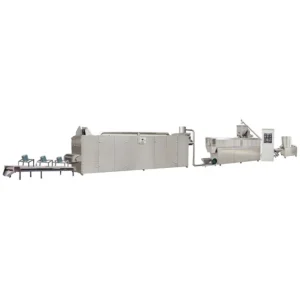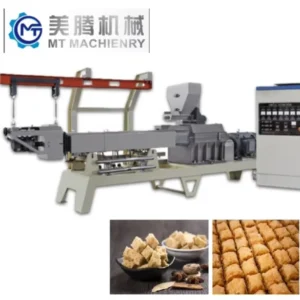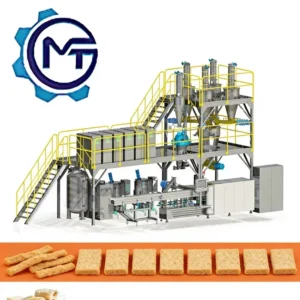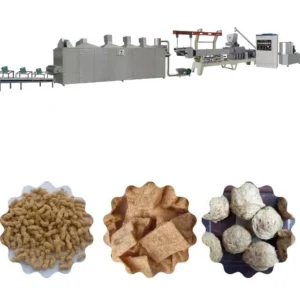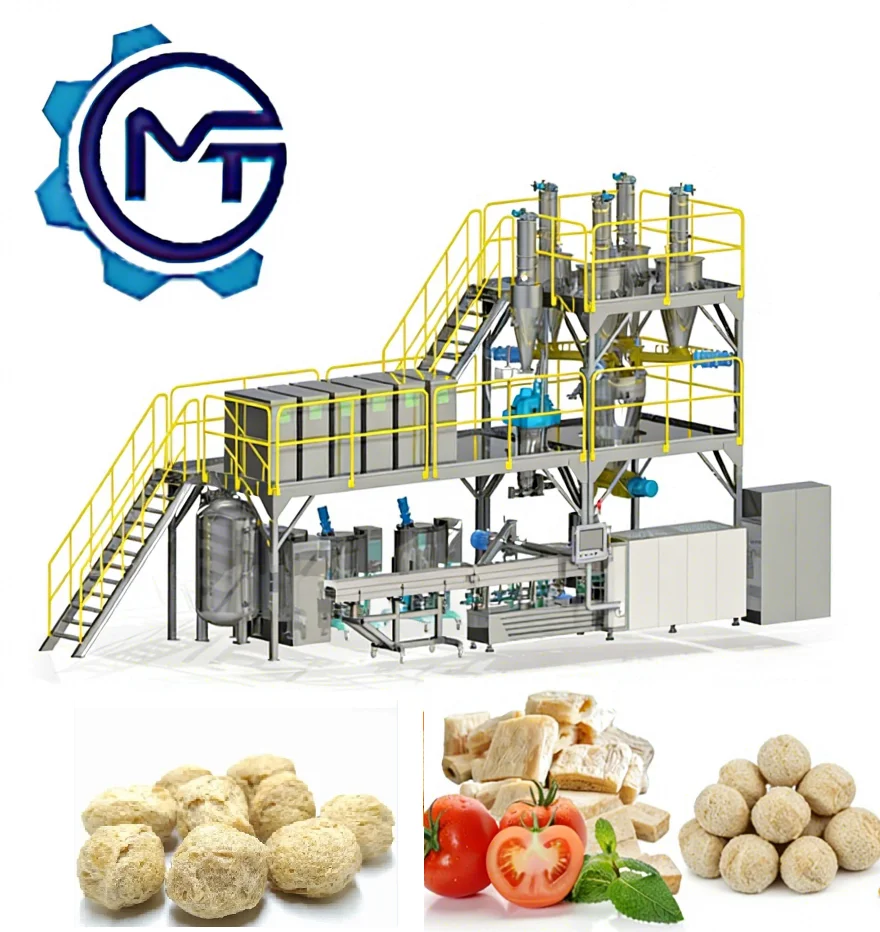
Throughput-Matched Stations — Every station from the vertical mixer through the cooling machine is sized against the extruder’s real output on your defatted soya flour, preventing the bottleneck where半成品 piles up and fiber structure tears apart on the conveyor.
Technical Specifications
| Parameter | Value |
|---|---|
| Product Type | Textured Soy Protein Production Line |
| Models Available | MT65, MT70, MT75, MT85 |
| Extruder Type | Twin Screw |
| Screw Length | 1050 mm / 1520 mm (model dependent) |
| Main Motor Power | 22 kW / 30 kW / 45 kW (model dependent) |
| Installed Power | 84 kW (MT65) / 160 kW (MT70) / 190 kW (MT75) / 210 kW (MT85) |
| Power Consumption | 59 kW (MT65) / 120 kW (MT70) / 140 kW (MT75) / 140 kW (MT85) |
| Output Capacity | 100–150 kg/h (MT65) / 150–200 kg/h (MT70) / 150–200 kg/h (MT75) / 250–300 kg/h (MT85) (basis not stated in source — confirm raw material type, moisture content and die configuration) |
| Overall Dimensions | 40,000×1,200×2,200 mm (MT65) to 45,000×1,500×3,500 mm (MT85) |
| Mixer Type | Vertical mixing machine with stainless steel 304 mixing ruler |
| Mixer Capacity Options | 20–30 kg / 70–80 kg / 170–180 kg |
| Mixer Power Options | 4 kW / 7.5 kW / 15 kW |
| Dryer Type | Multi-layer dryer with double pitch roller chain drive, round-trip drying |
| Dryer Heating Options | Fuel / Gas / Electricity (selectable) |
| Line Stations | Mixer → Screw Conveyor → Twin Screw Extruder → Air Conveyor → Multi-layer Dryer → Cooling Machine |
| Certification | CE, ISO |
| Assembly State | Complete line, factory-tested before shipment |
Application Suitability
| Application | Material or Output |
|---|---|
| Soya chunks and nuggets for meat analogues | Defatted soya flour, low temperature soya flakes |
| Textured vegetable protein (TVP/TSP) blocks | Soybean dregs, peanut dregs |
| Vegetarian and maigre snack production | Defatted soya flour with adjusted screw configuration |
| Deep-frozen food ingredient preparation | Soya flakes requiring specific oil and water absorption |
| Fortified, cholesterol-free protein snacks | Blends of soya flour and cereal additives |
What "150 kg/h Output" Actually Means on Soya Flour
A nominal capacity figure means nothing until it is verified against your specific raw material at your target moisture content.
I once visited a plant where the extruder was rated for a certain throughput on paper, but when they switched to a finer-mesh defatted soya flour, the actual output dropped noticeably and the fiber lamination broke down. The buyer had sized their downstream cooling belt based on the brochure number, and the mismatch caused product to accumulate and tear. Before any plant based meat processing line equipment for sale is shipped, the real test happens in a testing workshop running your exact feedstock, not a generic starch blend. [NEED_CITE: raw material variability in soy protein extrusion]
Matching the Extruder to the Protein Structure
The twin-screw configuration allows precise control over shear and residence time, which directly governs how the soy protein unfolds and realigns into fibrous layers. Screw length — available at 1050 mm or 1520 mm depending on model — determines how long the material stays under heat and pressure, a critical factor when targeting the distinct bite of a soya chunk versus a finer TVP granule. This is where plant based meat processing line equipment for sale either delivers the expected texture or falls short.
Dryer Integration and Moisture Precision
The multi-layer dryer uses a double pitch roller chain drive for round-trip drying, giving operators adjustable temperature and dwell time. Selectable heating sources — fuel, gas, or electricity — mean the dryer can tie into existing plant infrastructure rather than forcing a new utility build-out. Precise moisture removal at this stage locks in the layered fiber structure and prepares the product for consistent oil absorption during downstream frying or preparation. [NEED_CITE: moisture content targets for textured soy protein stability]
Decoding Screw Length, Motor Power, and Die Design
Screw length and main motor power together define the mechanical energy input available for protein texturization. A 1520 mm screw with a 45 kW main motor provides extended shear exposure for denser, larger-format chunks, while a 1050 mm screw at 22 kW suits smaller nugget formats with shorter conditioning requirements. The die design — matched to the target product shape — controls expansion rate at the extruder exit, which in turn determines whether the final piece holds a meat-like cross-section or collapses into a brittle fragment. Heating power ranges from 10 kW to 14 kW across models, maintaining barrel temperature profiles that keep starch gelatinization consistent batch after batch. Vertical mixer capacity tiers (20–30 kg, 70–80 kg, 170–180 kg) are matched to extruder feed rate so the screw never starves or floods.
The Hidden Cost of Mismatched Line Stations
When an extruder is sourced separately from its dryer and cooling conveyor, the throughput numbers rarely align. I watched a production run where a plant based meat processing line ran well at the die face but the dryer could not remove moisture fast enough, causing the protein sheets to mat together into unusable clumps. The buyer lost an entire shift of material before shutting down to re-engineer the airflow. Sizing every station under one manufacturer eliminates this category of failure. [NEED_CITE: throughput mismatch consequences in extrusion lines]
Why Source the Full Line from One Manufacturer
Every station — mixer, screw conveyor, twin-screw extruder, air conveyor, multi-layer dryer, and cooling machine — is sized and tested together, so the throughput at each point is calculated rather than assumed. Screw configuration and die design are specified to your raw material and target product format, not copied from a generic template. The in-house testing workshop runs trial production on your defatted soya flour or soya flakes before the line ships, documenting density, fiber structure, and actual output. Electrical schematics, voltage, and control language are confirmed against your factory’s requirements during the engineering phase. Wear parts lists covering screws, dies, and cutting blades are provided with the initial documentation package.
Documentation & Verification
- Factory test record on your specific soya flour or flakes before dispatch
- Line layout and capacity calculation showing throughput at every station
- Screw and die configuration record matched to your target chunk or granule format
- Electrical schematic with voltage and frequency confirmed for your facility
- Trial run report documenting fiber structure and moisture on your raw material
- CE declaration of conformity and ISO certificate
Installation, Commissioning & Support
- Line footprint spans up to 45,000 mm length; confirm floor space and ceiling height before delivery
- Installed power reaches 210 kW on the MT85; verify dedicated circuit and transformer capacity
- Dryer heating source configurable to fuel, gas, or electricity to match existing plant utilities
- First production run supervised on-site with parameter adjustment to your raw material
- Operator training covers screw configuration changes for different TVP formats
- Wear parts list supplied with recommended replacement intervals for screws and dies
What to Include in Your Inquiry
To configure a plant based meat processing line equipment for sale that matches your production target, share your raw material type (defatted soya flour, low temperature soya flakes, or a blend), target product format (chunks, nuggets, fine TVP), and desired hourly output. Specify your local voltage and frequency, dryer heating preference, and any existing upstream or downstream equipment the line must integrate with. If you have a specific fiber density or water absorption target, include that as well — it shapes screw and die selection.
Frequently Asked Questions
Q: How is output capacity verified on my specific soya raw material before shipment?
A: Your raw material is run through the extruder in the testing workshop under production conditions. Output, fiber structure, density, and moisture content are documented in a trial run report. This report ships with the line, so you know what to expect from day one rather than starting product development after installation.
Q: What voltage, frequency, and control language configurations are available?
A: Electrical specifications are confirmed during the engineering phase before production begins. Voltage, frequency, and control panel language are matched to your facility’s utility supply and operator requirements. The electrical schematic is included in the documentation package for local electrician review.
Q: How do I select the right extruder model for nuggets versus chunks versus fine TVP?
A: Selection depends on your target product dimensions, required fiber density, and raw material characteristics. Screw length, die configuration, and motor power are specified to match. The MT65 through MT85 range covers different throughput bands, and the testing workshop validates the choice on your actual feedstock before commitment.
Q: Can the dryer heating source be specified to match my factory’s existing infrastructure?
A: Yes. The multi-layer dryer is available with fuel, gas, or electric heating. This selection is made during line configuration so the dryer integrates with your plant’s existing utility supply without requiring additional infrastructure modifications or separate energy contracts.
Q: What spare wear parts are included, and how are replacements supplied?
A: A wear parts list covering screws, dies, and cutting blades is provided with the line documentation. Replacement availability is confirmed before commissioning so that scheduled maintenance does not cause unplanned downtime. First-order spare parts can be included in the initial shipment.