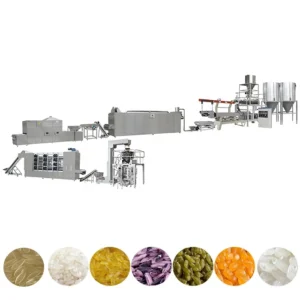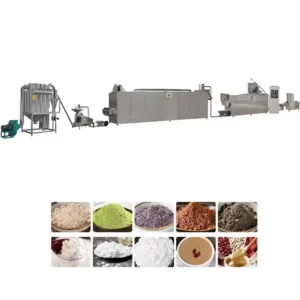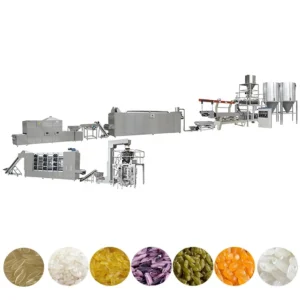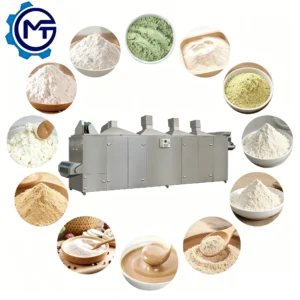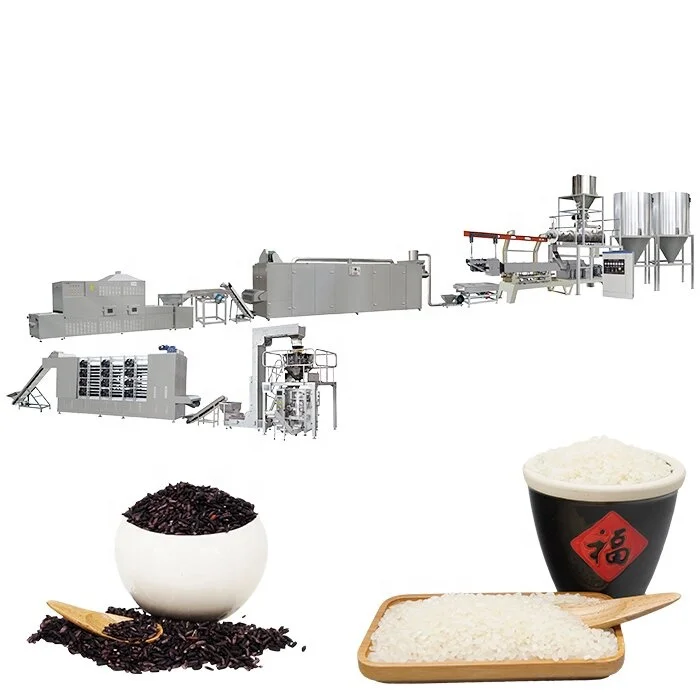
Turnkey equipment matching — Every station from the 15 kW batch mixer through the 5000 mm cooling dryer is sized so that throughput holds across the entire fortified rice line without one section waiting on another.
Technical Specifications
| Parameter | Value |
|---|---|
| Product Type | Fortified and Artificial Rice Production Line |
| Line Stations | Powder mixer, feeder, twin-screw extrusion granulator, vibrating screen, air conveyor, drying box, lifting machine, cooling dryer, drum polisher, storage tank, packaging machine |
| Extruder Type | Twin-screw |
| Extruder Screw Length | 2500 mm |
| Extruder Main Motor Power | 110 kW (frequency control) |
| Extruder Feeder Power | 1.5 kW (frequency control) |
| Extruder Cutting Power | 2.2 kW (frequency control) |
| Extruder Oil Pump Power | 0.75 kW |
| Mixing Machine Power | 15 kW |
| Mixing Machine Batch Capacity | 130 kg–150 kg per batch |
| Mixing Tank Thickness | 1.5 mm stainless steel |
| Mixer Cover Thickness | 1.2 mm |
| Vibrating Screen Power | 0.2 kW |
| Cooling Dryer Power | 2.2 kW |
| Cooling Dryer Dimensions | 5000 × 1500 × 1900 mm |
| Dryer Heating Type | Electric (gas, diesel, or steam available on request) |
| Voltage & Frequency | Customisable (e.g. 3 ph 380 V 50 Hz, 3 ph 415 V 60 Hz, 3 ph 220 V 60 Hz) |
| Control System | Frequency control on feeder, extruder and cutter |
| Output Capacity | (basis to be confirmed — dependent on raw material formulation, moisture content and grain size) |
| Standards | CE declared, ISO declared |
Application Suitability
| Application | Material or Output |
|---|---|
| Fortified / nutritional rice | Rice flour blended with micro-nutrients and starches |
| Instant and self-heating rice meals | Pre-gelatinised starch and grain blends requiring uniform rehydration |
| Artificial rice from broken rice or grain by-products | Milled rice fractions reformed into whole-grain shapes |
| Konjac / shirataki rice | Konjac flour and calcium hydroxide blends requiring specialised screw configuration |
What a Capacity Figure Without Raw Material Context Really Means
A fortified rice line rated at a nominal output tells you nothing until it runs on your actual flour blend and micro-nutrient premix.
I once watched a line get installed in Southeast Asia where the supplier had tested on a standard rice flour recipe, but the buyer’s formulation carried a noticeably higher protein load. The extruder could not gelatinise the starch properly at the parameters they were given, and the team spent weeks on-site adjusting screw speed, barrel temperatures, and moisture levels before the grain held its shape. A Fortified Rice Production Line Equipment package must be validated on the real formulation before it leaves the factory floor. [NEED_CITE: starch gelatinisation behaviour under varying protein and fibre loads in twin-screw extrusion]
How Barrel Profile and Screw Geometry Define Grain Integrity
The 2500 mm screw length on the twin-screw extruder gives rice flour and starch blends enough residence time for complete gelatinisation before the material reaches the die. Frequency control on the main motor, feeder, and cutter means the operator can adjust the shear rate and feed ratio in real time, which is the difference between a dense, intact grain and one that fractures during drying. For Fortified Rice Production Line Equipment, getting this balance right at the extrusion stage prevents downstream waste at the vibrating screen and polishing drum.
Moisture Management Across the Drying and Cooling Sequence
The drying box and the 5000 mm cooling dryer work in sequence to bring extruded rice grains from a high-moisture state down to a shelf-stable level without cracking the surface. Electric heating is standard, but gas, diesel, or steam options exist for sites where electrical cost makes resistive heating impractical. [NEED_CITE: industrial drying energy costs by heating medium in food processing] Multi-pass drying at controlled temperatures prevents case hardening, which would trap moisture inside the grain and cause splitting during storage. The cooling dryer then stabilises the grain temperature before it enters the drum polisher, where surface starch dust is removed for a clean finish.
Reading the Specs That Actually Matter for Rice Grain Quality
The 1.5 mm stainless steel mixing tank and 1.2 mm cover are thicker than what many lightweight batch mixers use, and that matters when you are blending abrasive micro-nutrient premixes into rice flour day after day — thinner walls develop pinholes. The 110 kW main motor on the extruder provides the torque required for high-amylose rice formulations that resist shear, while the 1.5 kW frequency-controlled feeder ensures a steady volumetric feed rate that prevents surging at the die. On the electrical side, the customisable voltage and frequency options (380 V, 415 V, 220 V at 50 or 60 Hz) are not a luxury; running a 380 V 50 Hz motor on a 415 V 60 Hz supply will over-speed the extruder and alter the entire shear profile. [NEED_CITE: voltage and frequency compatibility standards for exported food processing machinery]
The Cost of Skipping a Pre-Shipment Trial Run
When an extruder ships without a trial run on the buyer’s actual raw material, the first production days become an expensive experiment. Screw and die configurations tuned for a generic recipe may produce rice grains that are too porous for self-heating meal packaging or too dense for instant rice rehydration targets. The dryer may be undersized for the moisture load the real formulation delivers, creating a bottleneck that idles the extruder. [NEED_CITE: production loss from post-installation commissioning delays in food extrusion projects] These problems compound: operators re-run batches, waste raw material, and lose buyer confidence in the finished product before the line ever reaches steady state.
What Makes This Line Different at the Procurement Stage
Throughput is matched across every station, from the 130–150 kg batch mixer through the extruder and down to the cooling dryer, so no single section becomes a constraint. The screw configuration and die design are specified to the buyer’s raw material and target rice grain shape rather than copied from a generic build. An in-house testing workshop allows trial runs on the actual formulation before the line ships, producing a documented trial report that travels with the equipment. The Fortified Rice Production Line Equipment package is backed by pre-sales consultation through installation, commissioning, and ongoing maintenance support from the same engineering team that built the line.
Documentation & Verification
- Line layout and capacity calculation based on your rice flour formulation and target grain size
- Screw and die configuration record matched to your specific starch blend
- Electrical schematic with confirmed voltage, frequency, and control language for your site
- Trial run report on your raw material produced in the testing workshop before dispatch
- CE declaration of conformity and ISO certificate included with shipping documentation
Installation, Commissioning & Support
- Foundation planning accounts for the 110 kW extruder and 5000 mm cooling dryer footprint and weight distribution
- Dedicated electrical circuits sized for 15 kW mixer and 110 kW extruder with confirmed voltage and frequency
- Assembly from shipped modules with alignment verification at each station connection point
- First-run parameter setting on your raw material with screw speed, feeder rate, and barrel temperature logging
- Operator training covering frequency drive adjustment on feeder, extruder, and cutter controls
- Wear parts list for screws and dies with recommended replacement intervals for rice flour processing
Before You Send an Inquiry
Share your rice flour or grain blend composition, including starch type and any micro-nutrient premix ratios, so the line can be configured around your actual material rather than a generic recipe. Specify your target daily output, workshop dimensions, and ceiling height to confirm the layout fits. Include your local voltage, frequency, and preferred control language so the electrical schematic and HMI are built correctly from the start.
Frequently Asked Questions
Q: How is line capacity verified on the buyer’s actual raw material rather than a nominal figure?
A: The testing workshop runs your specific rice flour and micro-nutrient blend through the extruder before shipment. Screw speed, barrel temperatures, moisture content, and die configuration are adjusted until the rice grain meets your density and shape specification. A trial run report documents the verified parameters and output rate, which becomes the baseline for on-site commissioning.
Q: What voltage, frequency, and control language configurations are available?
A: The line supports customisable three-phase supply options including 380 V 50 Hz, 415 V 60 Hz, and 220 V 60 Hz. The electrical schematic is confirmed with the buyer before production. Control language on the frequency drives and HMI is set to match the operator team at the installation site.
Q: How are screw and die configurations selected for different rice grain sizes?
A: Screw elements and die inserts are chosen based on the starch composition, target grain shape, and required density. High-amylose rice flour needs a different shear profile than a konjac blend. The configuration record travels with the equipment so operators can reference it during production changeovers.
Q: Is a trial run performed on the buyer’s raw material before shipment?
A: Yes. The in-house testing workshop runs your actual formulation through the line before it ships. This catches formulation-specific issues such as unexpected expansion behaviour or moisture retention that would otherwise surface only after installation, reducing on-site commissioning time.
Q: How is throughput balanced between the extruder, dryer, and cooling stages?
A: Each station is sized during the layout phase based on the verified extruder output on your raw material. The drying box and 5000 mm cooling dryer are selected so their moisture removal capacity matches the extruder’s production rate, preventing material backlog or idle time at either stage.