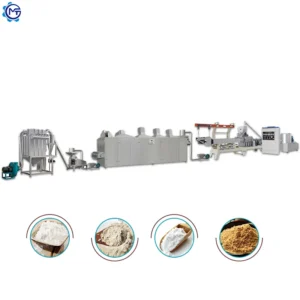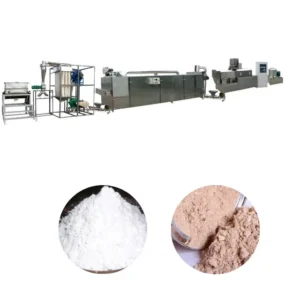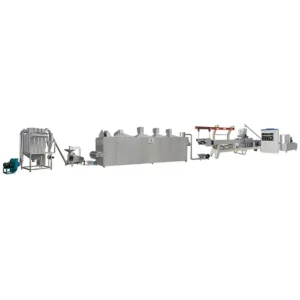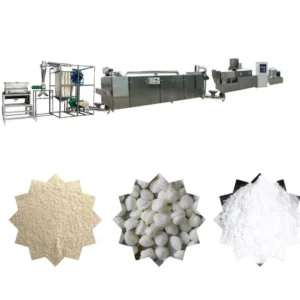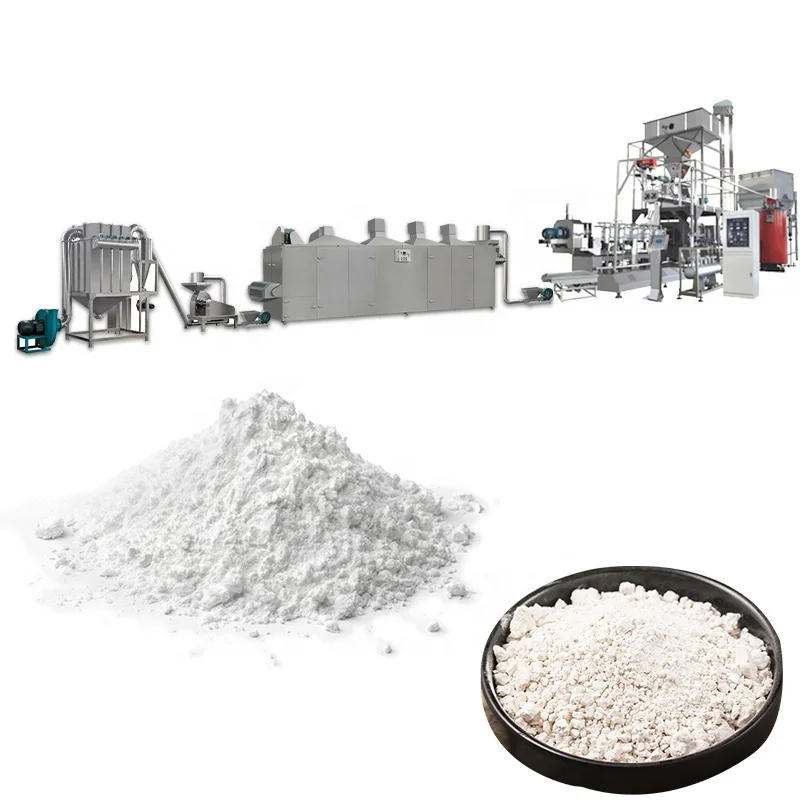
Integrated Line Throughput — every station from batching through packing is matched to the extruder’s actual output on your starch feedstock, eliminating the bottleneck that forms when vendors supply mismatched capacities.
Technical Specifications
| Parameter | Value |
|---|---|
| Product Type | Twin Screw Modified Starch Production Line |
| Models Available | MT75, MT70, MT70C |
| Screw Type | Twin screw |
| Installed Power (MT75) | 180 kW |
| Installed Power (MT70) | 120 kW |
| Installed Power (MT70C) | 150 kW |
| Power Consumption (MT75) | 135 kW |
| Power Consumption (MT70) | 120 kW |
| Power Consumption (MT70C) | 125 kW |
| Output Capacity (MT75) | 200–250 kg/h (basis to be confirmed with raw material type and moisture) |
| Output Capacity (MT70) | 100–150 kg/h (basis to be confirmed with raw material type and moisture) |
| Output Capacity (MT70C) | 250–300 kg/h (basis to be confirmed with raw material type and moisture) |
| Overall Dimensions (MT75) | 32000 × 3500 × 4300 mm |
| Overall Dimensions (MT70) | 30000 × 1500 × 2200 mm |
| Overall Dimensions (MT70C) | 34000 × 3500 × 4300 mm |
| Voltage | 380V 50Hz Three Phase (verify against local standard) |
| Control System | Frequency conversion speed regulation on feeding, driving, and rotary cutting |
| Mixer Capacity Options | 20–30 kg/time, 70–80 kg/time, 170–180 kg/time |
| Mixer Power Options | 4 kW, 7.5 kW, 15 kW |
| Mixer Contact Material | 201 S.S. or 304 S.S. |
| Grinder Drive Motor | 15 kW |
| Grinder Air Circulating Motor | 1.5 kW |
| Grinder Mesh Number | 100–120 mesh |
| Grinder Dust Removal | Integrated pulse dedusting system |
| Dryer Type | Multi-layer oven with double pitch roller chain transmission |
| Certification | CE |
Application Suitability
| Application | Material or Output |
|---|---|
| Pregelatinised starch production | Corn starch, cassava starch, potato starch, tapioca starch |
| Oil drilling grade modified starch | Maize starch and cassava starch with targeted gelatinisation |
| Nutritional and infant formula base powder | Starch-based formulations requiring controlled extrusion cooking |
| Food additive and thickener production | Modified starch for binding, stabilising, and texturising applications |
Why Nominal Capacity Fails on Real Starch Feedstocks
A line rated on corn starch parameters will not hold the same throughput when your actual raw material is cassava or potato starch.
Buyers frequently receive quotations based on a standard starch type, then discover during commissioning that the screw configuration cannot maintain the quoted output on their local feedstock. The extruder either starves or overloads, gelatinisation degree drops, and the downstream dryer and grinder sit idle while the operator fights to stabilise the process. I have watched this exact scenario unfold on cassava starch lines where the trial ran on corn starch — the screw combination had to be stripped and rebuilt twice before the line held a steady rate, costing the project over two weeks of on-site debugging [NEED_CITE: raw material variability impact on extrusion throughput].
How Each Station in the Modified Starch Production Line Full Equipment Range Connects
The modified starch production line full equipment sequence runs from a flour mixer through a screw conveyer into the twin screw extruder, then an air conveyer to the multi-layer oven, a second air conveyer into the pulse grinder, followed by storage silo, secondary mixing, and final hoisting to the packaging machine. Every station is specified together so that the mixer batch time, extruder feed rate, dryer residence time, and grinder throughput all align to a single target capacity rather than each vendor optimising for their own machine in isolation.
Matching Dryer and Grinder Capacity to the Extruder Output
The multi-layer oven uses a double pitch roller chain transmission that provides stable conveying during the round-trip drying path, preventing the material jams that plague single-layer dryers when starch moisture release is uneven. Downstream, the pulse grinder handles 100–120 mesh adjustment with an integrated dust removal system rated at 1.5 kW for air circulation. If the grinder cannot keep pace with the dryer discharge, modified starch accumulates on the floor and the entire line slows to match the weakest station [NEED_CITE: throughput balancing in starch processing lines].
What the Power and Drive Specifications Mean for Starch Processing
The twin screw extruder uses frequency conversion speed regulation across feeding, driving, and rotary cutting systems. This matters because different starch types demand different shear profiles — cassava starch gelatinises at a lower temperature window than corn starch, so independent speed control on the feed screw and main drive lets the operator fine-tune residence time without changing the physical screw elements. The MT75 draws 180 kW installed with 135 kW operating consumption, while the MT70 and MT70C sit at lower power bands, allowing selection based on target output and available utility capacity. The grinder drive motor at 15 kW is sized to reduce dried starch sheet to a consistent powder without the thermal buildup that degrades pregelatinised starch functionality.
What Happens When Extruder and Downstream Equipment Are Sourced Separately
When the dryer is purchased from a different vendor than the extruder, there is no single party responsible for the moisture profile entering the drying stage. I have seen lines where the extruder delivers starch at a moisture level the dryer was never designed to handle, resulting in incomplete drying and a grinder that clogs within hours. The buyer ends up mediating between two suppliers who each insist their machine meets specification, while the line remains offline.
Why Buyers Source the Full Modified Starch Production Line Full Equipment Here
Screw configuration and die design are specified to your actual starch raw material and target modification type — pregelatinised starch demands a different screw profile than oil drilling starch. The in-house testing workshop runs your raw material before shipment, generating a trial report that confirms gelatinisation degree and throughput on your specific feedstock. Line layout documentation shows throughput calculations across every station from mixer to packaging machine. CE certification covers the complete assembly rather than individual machines. Electrical schematics and control language are confirmed against your site requirements before production begins, avoiding the voltage and frequency mismatches that delay commissioning [NEED_CITE: pre-shipment testing standards for food extrusion machinery].
Documentation & Verification
- Line layout and throughput calculation matching each station to your starch type
- Screw and die configuration record matched to your raw material and modification target
- Trial run report on your actual starch feedstock before factory dispatch
- Electrical schematic with voltage and frequency confirmed to your local standard
- Operation and maintenance manual covering extruder through grinder and packaging stations
Installation, Commissioning & Support
- Foundation planning based on the selected model footprint, up to 34000 mm line length
- Dedicated three-phase power circuit sized to the model’s installed power requirement, up to 180 kW
- Factory-assembled test run before disassembly for shipment to your site
- On-site commissioning with screw configuration adjustment for your local starch feedstock
- Operator training on frequency conversion speed regulation and die pressure monitoring
- Wear parts list covering screw elements, die plates, and grinder sieve screens
Before You Request a Quotation
Provide the specific starch type you intend to process, your target modification such as pregelatinised or oil drilling grade, and the moisture content of your incoming raw material. Share your available voltage, frequency, and any control language requirements for your operators. If you have existing upstream batching or downstream packing equipment, specify the interface points so the line can be configured to connect rather than duplicate.
Frequently Asked Questions
Q: How is output capacity verified on my specific starch raw material?
A: The in-house testing workshop runs a trial on your actual starch feedstock — whether cassava, corn, or potato — at the moisture content you will use in production. The trial generates a report documenting gelatinisation degree, extruder throughput, and dryer performance. This data replaces nominal capacity claims with verified numbers tied to your material.
Q: What screw configuration is used for pregelatinised versus oil drilling starch?
A: Pregelatinised starch requires a screw profile that delivers complete gelatinisation at controlled shear to preserve functional viscosity. Oil drilling starch targets a different degree of modification with adjusted residence time and die design. The configuration record documents the exact screw element sequence and die geometry selected for your target product.
Q: How do I confirm voltage and control language before shipment?
A: During the specification confirmation stage, you receive the electrical schematic showing voltage, frequency, and breaker sizing for your site. The control system language for the frequency conversion interface is set to your operator’s preference. Both are documented and signed off before the line enters production.
Q: How is throughput matched between the extruder, dryer, and grinder?
A: Each station is selected based on the extruder’s verified output on your starch. The multi-layer oven residence time is calculated from the moisture reduction required, and the pulse grinder is sized so its 100–120 mesh throughput keeps pace with the dryer discharge. The line layout document shows these calculations station by station.