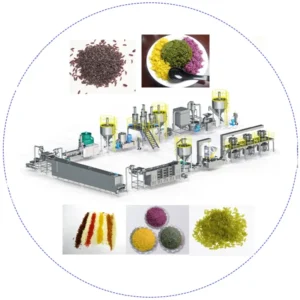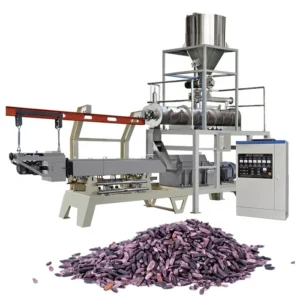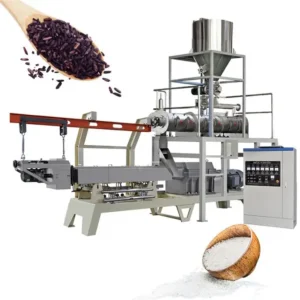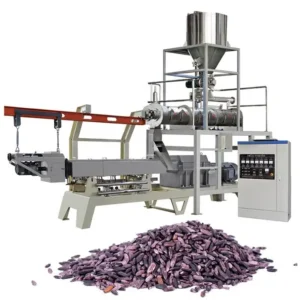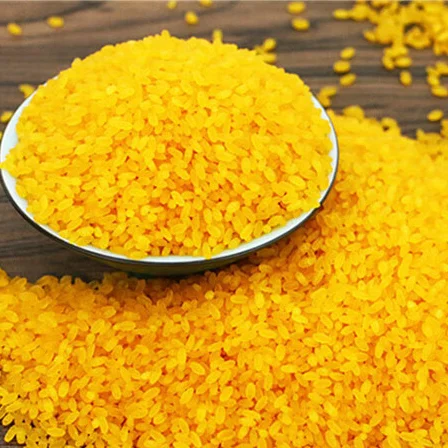
Matched Throughput Across Every Station — Each machine in the fortified rice line, from the twin-screw extruder through the circulation dryer to the roaster, is sized so no single unit bottlenecks the full process.
Technical Specifications
| Parameter | Value |
|---|---|
| Product Type | Nutritionally Fortified Artificial Rice Production Line |
| Models Available | MT65, MT70, MT85, MT75, MT95 |
| Extruder Type | Twin-screw extruder |
| Feeding System | Single or double screw feeding (matched to material) |
| Speed Control | Frequency speed controlling |
| Lubrication | Automatic lubricating and cooling system |
| Drying Oven Heat Source | Electric or gas |
| Drying Oven Feature | Circulation drying process, frequency motor mesh belt speed control |
| Control System | Automated (PLC or MCC basis to be confirmed) |
| Line Stations | Mixing, Extruding, Vibrating, Low Temperature Drying, Cooling, High Temperature Roasting, Cooling, Packing |
| Model MT65 | Installed Power 85 kW | Consumption 60 kW | Capacity 80–100 kg/hr (basis not stated in source) | 28 × 1.2 × 2.2 m |
| Model MT70 | Installed Power 120 kW | Consumption 85 kW | Capacity 100–120 kg/hr (basis not stated in source) | 30 × 1.5 × 2.2 m |
| Model MT85 | Installed Power 235 kW | Consumption 165 kW | Capacity 200–300 kg/hr (basis not stated in source) | 34 × 3.5 × 4.3 m |
| Model MT75 | Installed Power 180 kW | Consumption 135 kW | Capacity 300–500 kg/hr (basis not stated in source) | 32 × 3.5 × 4.3 m |
| Model MT95 | Installed Power 260 kW | Consumption 195 kW | Capacity 800–1000 kg/hr (basis not stated in source) | 36 × 3.5 × 4.3 m |
| Standards | CE certified, ISO certified |
Application Suitability
| Application | Material or Output |
|---|---|
| Fortified rice kernels for nutrition programmes | Broken rice, rice bran, corn blended with vitamins and minerals |
| Artificial rice from mixed grains | Millet, wheat, oats, buckwheat, bean flours with starch binders |
| Value-added reprocessed grain kernels | Cracked or broken rice re-extruded into uniform rice-shaped pellets |
| Micronutrient-enriched staple rice | Corn or wheat base with iron, folic acid, vitamin A premix |
| Specialty grain rice analogues | Gluten-free formulations using rice and starch blends |
What Your Raw Material Formula Does to Nominal Capacity
A capacity number without a material basis is just a motor rating wearing a production costume.
I spent four days in a Colombian plant reconfiguring a nutritional powder line because the customer switched to a 30 percent quinoa blend after we had already set the screw profile for pure rice starch. The gelatinisation window shifted, the extrudate came out hard and undercooked, and we rebuilt the screw stack from scratch. A fortified rice production line full equipment range only performs when every station is calibrated to your actual grain mix, moisture content, and micronutrient loading — not to a generic test flour. When a supplier quotes throughput without asking for your formulation, you are paying for a machine that has not been designed for your product [NEED_CITE: starch gelatinisation temperature ranges across common grains].
Extruder Screw Geometry and Starch Behaviour
The twin-screw extruder at the heart of this fortified rice production line full equipment range handles high-starch formulations that single-screw designs struggle with. Broken rice, corn, and millet each demand different shear profiles inside the barrel, and the screw elements must be arranged to deliver the right combination of mixing, compression, and metering. The automatic lubrication and cooling system keeps barrel temperature within a tight band, which matters because even a few degrees of drift can push rice starch past its gelatinisation peak and produce kernels that fracture during drying rather than holding their shape.
Drying and Roasting Sequences That Preserve Kernel Integrity
After extrusion the line moves through low-temperature drying, cooling, then high-temperature roasting before a second cooling pass. This staged thermal profile prevents the moisture gradient from cracking the kernel surface, which is a common failure point when producers try to dry fortified rice in a single high-heat pass. The circulation drying oven runs on a frequency-controlled mesh belt, so residence time adjusts independently of the belt speed on upstream and downstream conveyors. Choosing between electric and gas heat sources depends on local energy costs and available utility connections, not on the dryer’s internal design [NEED_CITE: industrial drying energy source selection criteria].
Matching Extruder Model to Grain Formulation and Output Target
The five extruder models in this range span different installed power levels and physical footprints, and the selection depends on your raw material’s viscosity under shear and your daily output target. High-fibre formulations with buckwheat or bean flour generate more resistance inside the barrel, meaning a model with greater installed power may be required to sustain the same throughput that a pure rice formula would deliver on a smaller unit. Frequency speed controlling on the main drive lets operators fine-tune screw RPM once the line is running, but the starting configuration — motor size, barrel length, screw element sequence — must already be in the right neighbourhood. The feeding system is configurable as single or double screw, and the choice depends on whether your premix includes fine vitamin-mineral powders that tend to bridge in a standard hopper.
The Cost of Skipping a Pre-Shipment Material Trial
When an extruder ships without a trial run on your actual grain formulation, the first weeks of commissioning become a paid experiment. Operators adjust screw speed, barrel temperature zones, and die clearance one variable at a time while producing off-spec kernels that cannot be sold. In my experience across Latin American installations, the plants that insisted on pre-shipment testing reached stable production noticeably faster than those that accepted a standard configuration and tuned on-site [NEED_CITE: extrusion line commissioning timelines with and without factory trials]. The downtime cost during that tuning period is rarely included in the original equipment budget.
Why Procurement Here Differs From Catalogue Shopping
Every station in the line is specified as a matched set, so the vibrating conveyor, drying oven, and roaster are not undersized relative to the extruder output. The in-house testing workshop runs your actual broken rice or grain blend before the machines leave the factory, producing a trial report that documents the screw configuration and die geometry that worked. Electrical schematics are confirmed against your facility’s voltage and frequency before production begins, avoiding the commissioning delays I have seen when a 60 Hz market receives a 50 Hz drive. Supporting documentation travels with the shipment so your local installation team has the layout, wiring diagrams, and wear parts list on day one.
Documentation & Verification
- Line layout drawing showing throughput balance across mixing, extrusion, drying and packing stations
- Screw and die configuration record matched to your specific grain and micronutrient formulation
- Trial run report produced in the testing workshop using your supplied raw materials
- Electrical schematic with voltage and frequency confirmed for your facility before production
- Operation and maintenance manual with wear parts list and replacement intervals
- CE declaration of conformity and ISO certificate included with shipment documentation
Installation, Commissioning & Support
- Foundation and floor space planning based on the selected model footprint, up to 36 × 3.5 × 4.3 m for the MT95 configuration
- Dedicated electrical circuit sized to installed power, ranging from 85 kW on the MT65 to 260 kW on the MT95
- Machines shipped in modular sections with assembly sequence documented for on-site reconnection
- First-run commissioning includes screw speed, barrel temperature, and dryer belt speed calibration on your raw material
- Operator training covers feeding system changeover between single and double screw modes for different formulations
- Wear parts supply includes replacement screw elements and die plates with lead times confirmed at order
Preparing Your Inquiry
Share your target formulation with grain ratios, starch content, and micronutrient premix details so we can select the correct screw configuration and feeding system. Confirm your daily output requirement along with workshop dimensions and ceiling height to determine which extruder model fits your space. Provide your local voltage, frequency, and preferred control language so the electrical package is built correctly from the start.
Frequently Asked Questions
Q: What supporting equipment is included in the complete fortified rice line from mixing to packing?
A: The line covers mixing, twin-screw extrusion, vibrating conveying, low-temperature drying, cooling, high-temperature roasting, a second cooling stage, and packing. Each station is sized to match the extruder throughput so material flows continuously without bottlenecking at any single unit. Heat source for the dryer is configurable as electric or gas depending on your utility setup.
Q: How do I match extruder model to my raw material formulation and target capacity?
A: Model selection depends on your grain blend’s behaviour under shear and your output target. High-fibre or high-protein formulations create more barrel resistance, often requiring a larger model to sustain the same throughput that a pure rice formula achieves on a smaller unit. We review your formulation before recommending a specific model and screw configuration.
Q: What drying options are available and how does the circulation drying system work?
A: The drying oven is available with electric or gas heating. A frequency-controlled motor adjusts mesh belt speed independently, allowing residence time to be tuned to the moisture content of your extruded kernels. Circulation airflow ensures even drying across the full belt width, reducing surface cracking that occurs with uneven heat distribution.
Q: Can the feeding system be configured for my specific grain or starch blend?
A: Yes. The feeding system is selectable as single or double screw depending on your material characteristics. Fine vitamin-mineral premixes that tend to bridge in standard hoppers typically require the double screw option, while free-flowing grain flours work well with a single screw feeder.
Q: What documentation is provided to verify machine specifications before shipment?
A: You receive a line layout with throughput calculations, a screw and die configuration record for your raw material, a trial run report from our testing workshop, confirmed electrical schematics, a CE declaration, and a wear parts list. These documents let your team verify every specification before the machines arrive at your facility.