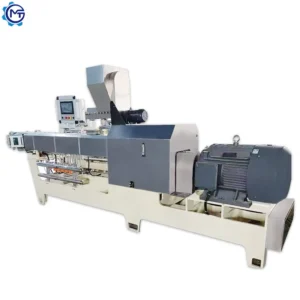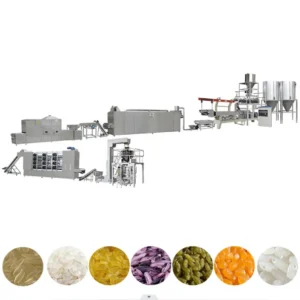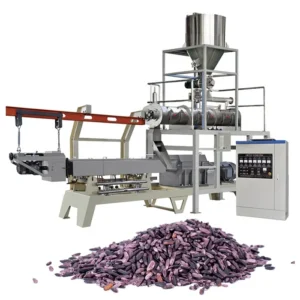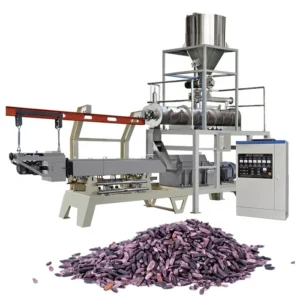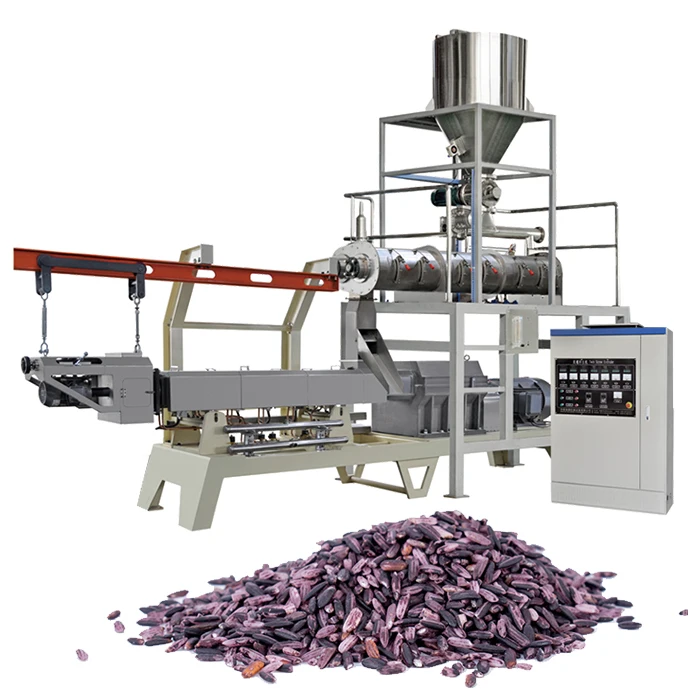
Screw Configuration Matched to Your Grain Blend — we document the exact screw elements, compression ratio, and die geometry after running your raw formulation in our testing workshop, not copied from a generic catalogue.
Technical Specifications
| Parameter | Value |
|---|---|
| Product Type | Fortified Artificial Rice Production Line |
| Screw Type | Twin-screw |
| Model Options | MT65 / MT70 / MT75 / MT85 / MT95 |
| Installed Power Range | 85 kW (MT65) to 260 kW (MT95) |
| Power Consumption Range | 60 kW (MT65) to 195 kW (MT95) |
| Output Capacity Range | 80–100 kg/h (MT65) to 800–1,000 kg/h (MT95) (basis not stated in source — confirm raw material formulation, moisture content and kernel size) |
| Overall Dimensions (L×W×H) | 28 × 1.2 × 2.2 m (MT65) to 36 × 3.5 × 4.3 m (MT95) |
| Control System | Frequency speed controlling with high automation |
| Lubrication System | Automatic lubricating and cooling system |
| Feeding System | Single or double screw feeding system (selected according to material characteristics) |
| Drying Oven Heating Source | Electric or gas |
| Drying Oven Feature | Circulation drying process with frequency motor controlling mesh belt speed |
| Basic Material Compatibility | Broken rice, rice, corn, millet, wheat, oats, buckwheat, bean, starch as main ingredient; vitamin and mineral as part of ingredient |
| Certification | CE |
Application Suitability
| Application | Material or Output |
|---|---|
| Fortified artificial rice kernel production | Broken rice and rice bran blended with vitamins and minerals |
| Nutritional grain enrichment | Rice, corn, millet, wheat or oat base with micro-nutrient premix |
| Instant rice processing | Starch-rich grain formulations with hot water rehydration characteristics |
| Grain by-product valorization | Rice bran, broken rice and milling residues reformed into whole kernel shapes |
Why Capacity Claims Fail on High-Protein Grain Blends
When a nutrition programme supplier orders a complete equipment range fortified artificial rice production line based on a brochure rating, the number rarely reflects what happens with their specific formulation. High protein content, added mineral premixes and fibrous bran all alter dough rheology inside the barrel, changing gelatinisation behaviour and die pressure. The result is output well below the nameplate figure. [NEED_CITE: effects of protein and fibre content on twin-screw extruder throughput]
Throughput must be validated on your actual grain blend before the line is finalised.
I have watched buyers commit to a model based on a published capacity number, only to discover during commissioning that their fortified formulation — loaded with iron sulphate, zinc oxide and vitamin A microcapsules — creates a denser melt that restricts flow through the die. The extruder runs, but the downstream dryer sits half-empty and the cooling conveyor cycles mostly air. That mismatch costs production days and erodes confidence in the entire project.
How Every Station Connects in the Catalogue
The complete equipment range fortified artificial rice production line covers mixing, extruding, vibrating, low-temperature drying, cooling, high-temperature roasting, a second cooling stage and packing. Each station is sized so its throughput envelope overlaps with its neighbours, preventing the common problem where one bottleneck starves the rest of the line. Frequency-controlled motors on the dryer mesh belt and the cooling conveyors allow fine speed matching once the extruder output stabilises on a given formulation.
Feeding System Selection and Raw Material Uniformity
Grain blends for artificial rice vary widely in particle size distribution. Broken rice and coarse corn grits flow differently from finely milled vitamin premix and starch powder. The single or double screw feeding system is selected after testing how your blend behaves in the hopper — whether it bridges, ratholes or floods. [NEED_CITE: bulk density and flowability of grain-vitamin blends in screw feeders] A double screw feeder with counter-rotating screws handles cohesive powders more reliably, while a single screw suits free-flowing granular material. Getting this choice wrong causes surging feed rates that show up as density variation in the finished kernels.
Interpreting the Key Specifications for Your Project
The twin-screw configuration across the MT65 through MT95 range means every model applies shear and mixing action simultaneously, which is essential when dispersing micro-nutrient particles evenly through a starch matrix. The automatic lubricating and cooling system maintains barrel temperature stability during long production runs; without it, friction heat builds up and alters the degree of starch gelatinisation mid-shift. Installed power spans from 85 kW on the MT65 to 260 kW on the MT95, but actual power consumption is lower — 60 kW to 195 kW respectively — because the frequency drives adjust motor load to match real-time dough resistance. The circulation drying oven uses a frequency motor on the mesh belt, allowing the operator to extend or shorten residence time depending on kernel moisture content leaving the extruder.
The Hidden Cost of Mismatched Station Capacity
When the extruder, dryer and cooling conveyor are sourced from different vendors, each party quotes a standalone capacity that ignores the others. I have seen lines where the dryer was rated for a higher output than the extruder could deliver, so the buyer paid for unused thermal capacity and extra floor space. Conversely, an undersized dryer forces the extruder to slow down, and the entire line runs below the buyer’s investment expectation. [NEED_CITE: throughput matching in multi-vendor food processing lines] These mismatches surface only during commissioning, when schedule pressure is highest and change orders are most expensive.
Why Buyers Source the Full Range Here
Every station from batching to packing comes from one supplier, so the line layout and capacity calculation are produced as a single document rather than stitched together from separate quotations. Screw and die configuration records are written after a trial run on the buyer’s own grain formulation in the in-house testing workshop, not pulled from a standard build. Electrical schematics confirm voltage, frequency and control language before production begins, preventing the commissioning delays that arise when a 380 V machine arrives at a 440 V site. Pre-sales consultation covers utility planning — water, compressed air, gas supply for the drying oven — so the buyer’s factory contractor has clear connection points before the equipment ships.
Documentation & Verification
- Line layout drawing showing every station footprint and throughput match for your target kernel size
- Screw and die configuration record specific to your grain-vitamin formulation
- Trial run report using your raw material documenting actual output and kernel density
- Electrical schematic with confirmed voltage, frequency and PLC language
- CE declaration of conformity and ISO certificate for customs and regulatory filing
- Wear parts list with part numbers for screws, dies, feeder augers and dryer belt sections
Installation, Commissioning & Support
- Foundation plan accounts for the full line length up to 36 m and vibrating station dynamic loads
- Electrical room must supply dedicated circuits matching confirmed kW draw from 60 to 195 kW per model
- Equipment ships in sectional modules for container loading and on-site reassembly
- First-run commissioning includes screw speed, barrel temperature and die pressure tuning on your grain blend
- Operator training covers frequency drive adjustment on the dryer mesh belt and cooling conveyors
- Spare screw elements, die plates and feeder augers dispatched with the initial shipment
What to Share When Requesting a Line Proposal
Provide your target grain formulation — including the percentage of broken rice, bran, starch binder and vitamin-mineral premix — along with the desired kernel dimensions and daily output target. Share your facility’s available floor length and ceiling height, the local voltage and frequency standard, and the preferred control language for the operator interface. If you have existing upstream milling or downstream packing equipment, include model details so the line layout can integrate connection points correctly.
Frequently Asked Questions
Q: How are the extruder, dryer and cooling stations sized to prevent bottlenecks across the complete line?
A: Each station’s throughput envelope is calculated from the same raw material formulation and target kernel size. The dryer mesh belt speed and oven length are matched to the extruder’s actual output on your blend, and the cooling conveyor is sized to handle the full dried volume. This prevents one station from starving or flooding its neighbour.
Q: What supporting stations are included from batching through packing, and where does each fit?
A: The complete equipment range fortified artificial rice production line includes mixing and batching, twin-screw extruding, vibrating separation, low-temperature drying, first cooling, high-temperature roasting, second cooling and packing. Each station is sequenced to maintain kernel integrity and moisture control from wet dough to shelf-ready product.
Q: How do I select the correct model from the MT65 to MT95 range based on my target output?
A: Model selection depends on your confirmed raw material formulation and required kernel dimensions, not just a target kg/h figure. A trial run on your grain blend determines the actual throughput for each model, and the line proposal recommends the unit that meets your output without running at maximum load continuously.
Q: Is single or double screw feeding recommended for my specific grain formulation?
A: That depends on your blend’s flow behaviour. Cohesive mixes with fine vitamin powder and high starch content tend to bridge in a single screw hopper, making a double screw feeder more reliable. Free-flowing granular broken rice usually suits a single screw. We test your material before specifying the feeder type.
Q: What electrical, utility and control system specifications should I confirm before ordering?
A: Confirm your site voltage and frequency, available gas supply for the drying oven if gas-heated, compressed air pressure and water connection points. Also specify the preferred language for the frequency speed control interface so operators can adjust parameters without translation delays during commissioning.