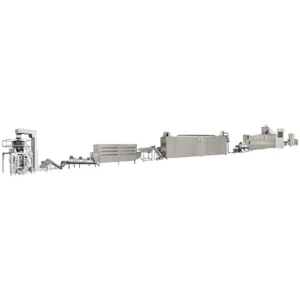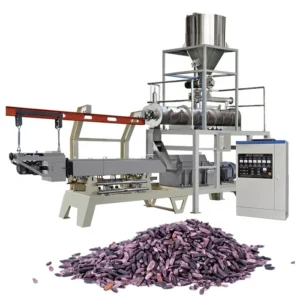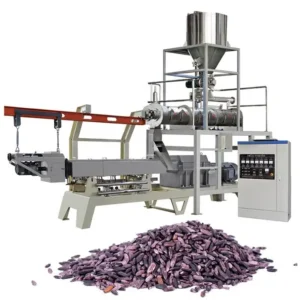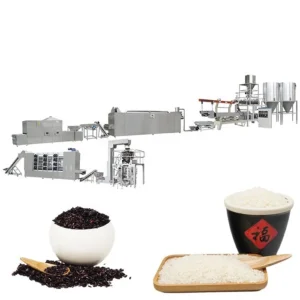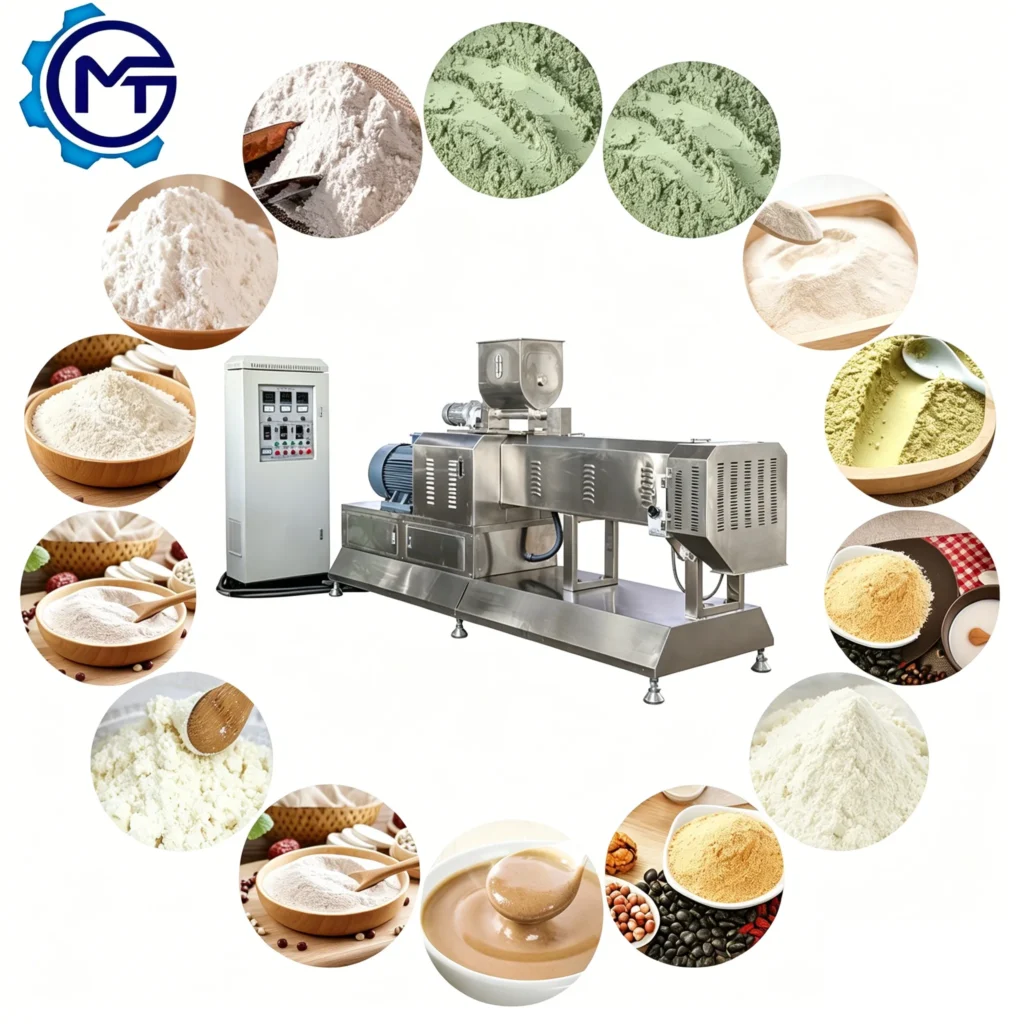
Matched Line Throughput — Every station from batching to grinding is calculated against your actual formulation so no single machine chokes the rest of the line.
Technical Specifications
| Parameter | Value |
|---|---|
| Model | MT65 / MT70 / MT75 / MT85 |
| Product Type | Fortified Nutrition Powder Processing Line |
| Extruder Type | Twin-screw |
| Installed Power | 84 kW (MT65) / 160 kW (MT70) / 190 kW (MT75) / 210 kW (MT85) |
| Power Consumption | 59 kW (MT65) / 120 kW (MT70) / 140 kW (MT75) / 150 kW (MT85) |
| Output Capacity | 120–150 kg/h (MT65) / 150–200 kg/h (MT70) / 200–250 kg/h (MT75) / 300–400 kg/h (MT85) (basis not stated in source — confirm raw material type, moisture content, and nutrient formulation) |
| Overall Dimensions (L×W×H) | 20 000×1500×2200 mm (MT65) to 25 000×1500×3500 mm (MT85) |
| Voltage & Frequency | 380 V 50 Hz Three Phase (other configurations available on request) |
| Control System | PLC and MCC control |
| Contact Material | 304 Stainless Steel (food-grade) |
| Mixer Options | 20–30 kg / 70–80 kg / 170–180 kg batch sizes; 4 kW / 7.5 kW / 15 kW |
| Drying Oven | Multi-layer, adjustable temperature and time; fuel / gas / electric heating |
| Pulse Grinder | 11 kW (capacity subject to formulation verification) |
| Certifications | CE, ISO |
Application Suitability
| Application | Material or Output |
|---|---|
| Infant formula and baby food powder | Rice flour, corn starch, and blended vitamin-mineral premix |
| Instant nutrition porridge | Pre-gelatinised starch with soy protein and trace elements |
| Therapeutic and functional food | High-fiber and protein-enriched cereal blends |
| Artificial fortified rice granules | Rice flour mixed with micronutrients, extruded into rice-shaped pellets |
| Modified starch products | Cassava, maize, and wheat starch modified by thermal and shear treatment |
Why "Nominal Output" Rarely Survives Contact With Your Real Recipe
A line rated on one flour blend can stall the moment soy protein or mineral premix enters the barrel.
When a nutritional powder processing line manufacturer quotes capacity on a single reference material, buyers often discover the real output only after installation. Protein-heavy ingredients like soy meal change dough viscosity and friction behaviour inside the barrel. Trace mineral additions alter gelatinisation temperature. I once spent extra weeks on a site in Vietnam re-tuning screw speed and barrel zones because the trial recipe contained nothing but rice flour, while production introduced a significant share of legume meal and micro-nutrients. Running a nutritional powder processing line on your exact formulation before shipment removes that surprise [NEED_CITE: impact of protein content on extrusion barrel pressure and residence time].
How Screw Profile Meets Ingredient Behaviour
The twin-screw extruder sits at the centre of every nutritional powder processing line because it can be re-profiled for each recipe. Starch-heavy blends need longer gelatinisation zones with moderate shear. Protein-dense formulas demand higher shear sections to break down molecular aggregates. Die aperture then governs the expansion ratio that determines whether the dried output mills into a fine porridge flour or a coarser instant drink base. Selecting the correct screw elements and die geometry against the buyer’s ingredient list is what separates stable running from constant barrel blockage.
Matching Mixer Batch Size to Extruder Feed Rate
A mixer that discharges too slowly starves the extruder; one that dumps too fast floods the screw conveyor. MT65 through MT85 models offer mixer batch options from 20 kg up to 180 kg, allowing the upstream station to match the extruder’s hourly demand. Consistent feed density prevents surging, which otherwise causes fluctuations in gelatinisation degree and final powder solubility. Matching every station to a common throughput target keeps the full nutritional powder processing line balanced across shifts [NEED_CITE: feed consistency requirements for twin-screw food extrusion].
Reading the Spec Sheet for What It Actually Controls
Installed power and power consumption figures tell different stories. The 210 kW installed figure on the MT85 represents peak motor capability, while 150 kW consumption reflects typical running load once barrel heaters reach steady state. Voltage must be confirmed early because 380 V 50 Hz wiring differs from 440 V 60 Hz markets in cable gauge and breaker rating. PLC and MCC control allows recipe storage so operators can switch between infant porridge and adult nutrition powder without manual re-calibration. Stainless steel 304 contact surfaces resist the mildly acidic environment created when vitamin C or iron salts are present in the mix, extending component service life.
The Hidden Cost of Skipping a Pre-Shipment Trial
When a line arrives without prior testing on the buyer’s actual formulation, commissioning becomes product development. Screw elements must be swapped, barrel zones re-mapped, and dryer temperatures re-profiled, often with raw material that already passed its shelf-life window. Downtime during this phase delays first saleable batch and strains operator confidence. A pre-shipment trial run using the customer’s own recipe locks in screw configuration, die selection, and temperature profile before the crate is nailed shut, shifting risk back to the factory floor rather than the buyer’s production hall [NEED_CITE: commissioning delay causes in food extrusion projects].
Why Buyers Specify This Line
Every station from mixer to pulse grinder is sourced under one supplier, so throughput calculations align rather than conflict. Screw configuration and die design are documented against the buyer’s ingredient list, not copied from a generic template. An in-house testing workshop allows trial runs on customer-supplied raw material before dispatch. PLC and MCC control supports recipe recall for facilities running multiple powder SKUs. CE and ISO documentation accompanies each shipment, smoothing customs clearance in regulated markets.
Documentation & Verification
- Line layout showing throughput matching across mixer, extruder, dryer, and grinder
- Screw and die configuration record matched to buyer’s nutrient formulation
- Trial run report on customer raw material before dispatch
- Electrical schematic with confirmed voltage, frequency, and control language
- CE declaration of conformity and ISO certificate for export clearance
Installation, Commissioning & Support
- Foundation must support up to 25 m line length and dynamic vibration from the MT85 extruder
- Dedicated three-phase circuit sized to 210 kW installed capacity for the largest model
- Extruder and dryer shipped in modular sections for container loading and on-site assembly
- First-run parameter setting includes screw speed, barrel zone temperatures, and dryer dwell time
- Operator training covers PLC recipe storage and MCC lockout procedures
- Wear parts list identifies screw elements, die plates, and grinder screens for reorder planning
Before You Send an Inquiry
Share your full ingredient list including protein percentage, fat content, and vitamin-mineral premix ratio. Specify target output per hour and whether the powder will be packed in sachets or bulk bags. Confirm local voltage, frequency, and preferred control language so the electrical package arrives ready to connect.
Frequently Asked Questions
Q: How is output capacity verified for my specific nutrient formulation?
A: The manufacturer runs your actual raw material blend in the in-house testing workshop before shipment. Screw speed, barrel temperature profile, and die aperture are adjusted until the target output and powder solubility are achieved, then documented in a trial run report that ships with the line.
Q: What is the complete equipment list from batching to final grinding?
A: The line includes a ribbon mixer, screw conveyor, twin-screw extruder, air conveyor, multi-layer drying oven, second air conveyor, and pulse grinder. Optional stations such as a packaging weigher and metal detector can be added downstream of the grinder.
Q: Can the line handle multiple product recipes with different vitamin additions?
A: Yes. PLC and MCC control stores separate recipes for each formulation. Operators select the recipe on the touch screen, and the system recalls the correct screw speed, barrel zone temperatures, and dryer settings, reducing changeover time between production runs.
Q: How do I match mixer batch size, extruder capacity, and grinder throughput?
A: Mixer batch options range from 20 kg to 180 kg. The supplier calculates discharge cycle time against the extruder’s hourly demand for the chosen MT model, then verifies that pulse grinder throughput exceeds extruder output to prevent material backlog at the final station.
Q: What voltage and control system options are available for my market?
A: Standard configuration is 380 V 50 Hz three-phase. Other voltages and frequencies are available on request. Control language on the PLC interface can be set to English, Spanish, or other languages before shipment to match local operator requirements.