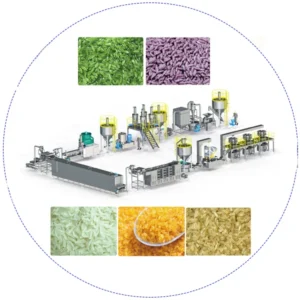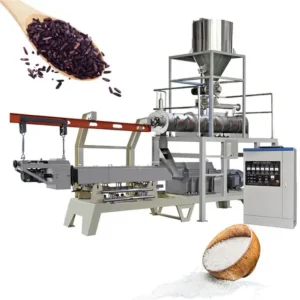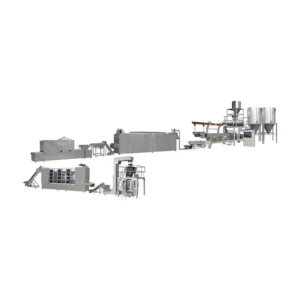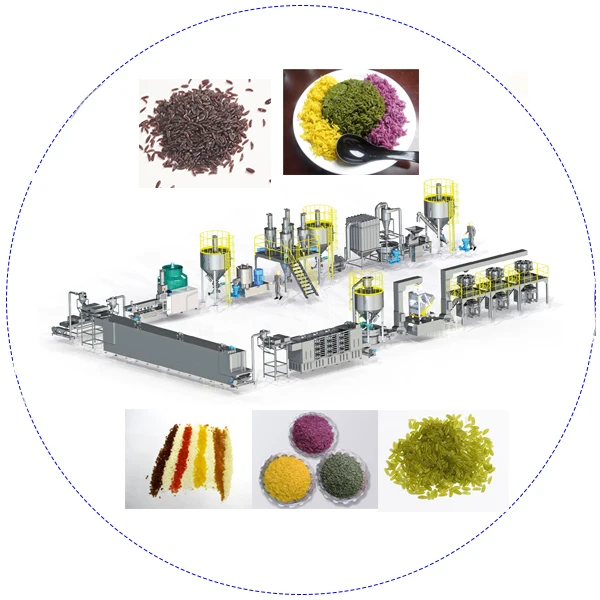
Screw Configurations Matched to Material — Every extruder in this line is set up for the buyer’s specific cereal blend and target kernel density, not shipped with a generic build.
Technical Specifications
| Parameter | Value |
|---|---|
| Product Type | Artificial Rice Extruder / Fortified Rice Kernel Production Line |
| Available Models | MT65, MT70, MT85, MT75, MT95 |
| Installed Power | MT65: 85 kW; MT70: 120 kW; MT85: 235 kW; MT75: 180 kW; MT95: 260 kW |
| Power Consumption | MT65: 60 kW; MT70: 85 kW; MT85: 165 kW; MT75: 135 kW; MT95: 195 kW |
| Output Capacity | MT65: 80–100 kg/h; MT70: 100–120 kg/h; MT85: 200–300 kg/h; MT75: 300–500 kg/h; MT95: 800–1000 kg/h (basis not stated in source — confirm raw material type, moisture content and formulation) |
| Overall Dimensions (L×W×H) | MT65: 28×1.2×2.2 m; MT70: 30×1.5×2.2 m; MT85: 34×3.5×4.3 m; MT75: 32×3.5×4.3 m; MT95: 36×3.5×4.3 m |
| Screw Type | Twin-screw with single or double screw feeding system selectable per material |
| Control System | Frequency speed control, high automation |
| Lubrication and Cooling | Automatic lubricating and cooling system |
| Drying Oven Heating Source | Electric or gas |
| Drying Oven Feature | Circulation drying with frequency motor controlling mesh belt speed |
| Production Procedure | Mixing → Extruding → Vibrating → Low temperature drying → Cooling → High temperature roasting → Cooling → Packing |
| Certifications | CE, ISO |
Application Suitability
| Application | Material or Output |
|---|---|
| Fortified rice kernel production | Broken rice and rice bran blended with vitamin and mineral premixes |
| Artificial rice for nutrition programmes | Rice, corn, millet, wheat and oat blends reconstituted into uniform kernels |
| Reconstituted cereal kernels | Buckwheat, bean and starch formulations shaped into rice-sized granules |
| Institutional food supply | Fortified rice kernels meeting government and NGO nutritional specifications |
Why Capacity Numbers on an Artificial Rice Extruder Production Line Often Mislead Buyers
Quoted output means nothing unless it was measured on your exact blend of broken rice, starch and micronutrient premix.
I spent years on the procurement side before moving into equipment sales, and the most expensive mistake I watched a buyer make was trusting a brochure capacity figure. The line ran fine on pure rice flour during the factory test. When their actual formulation — a mix of broken rice, quinoa flour and chickpea starch with added iron and zinc — went through the barrel, the expansion ratio dropped and kernel density fell outside specification. Four days of reconfiguring screw elements and adjusting barrel temperature zones followed. That is why output capacity on any fortified rice kernel machine must be verified against the buyer’s own raw material before the line leaves the factory. [NEED_CITE: starch gelatinisation behaviour in multi-grain extrusion formulations]
How Each Station Connects Across the Full Equipment Range
The artificial rice extruder production line covers every stage from raw material batching through final packing. The mixing station feeds the twin-screw extruder, where cereal flour and micronutrient blends are conditioned under controlled moisture, shear and temperature. The extruded strands pass through a vibrating conveyor before entering the low-temperature circulation drying oven, which removes surface moisture without cracking the kernel structure. A high-temperature roasting stage follows to set the final texture, and the product is cooled before packing. Each station is sized so that throughput from the extruder is not bottlenecked by undersized downstream equipment.
Barrel Temperature Zones and Their Effect on Kernel Integrity
Barrel temperature profiling across the twin-screw sections controls starch gelatinisation rate and expansion behaviour. Early zones handle hydration and initial gelatinisation, while downstream zones manage melt viscosity and die pressure. When the blend includes high-fibre components like buckwheat or bean flour, the temperature curve needs adjustment compared to pure rice formulations. The automatic lubricating and cooling system on these extruders maintains thermal stability across long production runs, reducing the risk of kernel surface defects caused by localised overheating. Frequency speed control on both the extruder screws and the drying oven mesh belt allows operators to fine-tune residence time without stopping the line. [NEED_CITE: thermal profiling in twin-screw extrusion of starch-based food products]
Reading the Specification Sheet for Your Formulation
The power consumption figures across the model range — from 60 kW on the MT65 to 195 kW on the MT95 — reflect the energy required to process increasingly viscous cereal-starch blends at higher throughputs. Installed power ratings are higher than consumption values, accounting for startup loads and peak torque demands during formulation changeovers. The twin-screw design with selectable single or double screw feeding means the system can handle both free-flowing rice flour and cohesive bean-starch mixtures without material bridging in the hopper. Overall line dimensions scale from 28 metres for the smallest configuration to 36 metres for the MT95, which affects workshop layout planning and utility routing. The drying oven offers electric or gas heating, a decision that depends on local energy costs and available gas infrastructure at the installation site.
What Happens When Downstream Equipment Is Undersized
A common failure point on cereal processing lines is an extruder producing at full capacity while the dryer cannot keep up. Kernels pile up on the mesh belt, drying becomes uneven, and surface cracking increases reject rates. I have seen entire production batches scrapped because the drying oven was specified for a lighter snack product rather than dense, moisture-retentive rice kernels. The circulation drying design with frequency-controlled belt speed on this line addresses that mismatch, but only if the oven capacity was calculated against the extruder’s actual output on the buyer’s specific formulation. [NEED_CITE: moisture migration rates in extruded cereal kernel drying]
Why Buyers Choose This Range for Fortified Rice Projects
Throughput matching across every station means the extruder, dryer, roaster and packer are selected as a coordinated system rather than assembled from separate vendors. Screw configuration and die design are specified to the buyer’s raw material and target kernel shape before production begins. An in-house testing workshop allows trial runs on the customer’s actual cereal blend, so screw combinations and temperature profiles are validated before the line ships. The full equipment range covers mixing through packing under one supplier, eliminating interface disputes between equipment vendors. Pre-sales engineering includes line layout and capacity calculation, and support extends through on-site installation, commissioning and operator training.
Documentation & Verification
- Line layout and capacity calculation showing throughput matching between extruder and dryer stations
- Screw and die configuration record specified to your cereal blend and kernel shape
- Trial run report produced on your actual raw material before shipment
- Electrical schematic with voltage, frequency and control language confirmed for your market
- Factory test record documenting continuous run performance on your formulation
- Wear parts list identifying screws, dies and barrel sections with reorder codes
Installation, Commissioning & Support
- Floor space planning based on line dimensions up to 36 m length for the MT95 configuration
- Power supply sizing for installed loads up to 260 kW with dedicated circuit breakers
- Drying oven heating source selected between electric and gas based on site utilities
- Frequency speed control commissioning across extruder and mesh belt for formulation tuning
- Operator training on screw element changeover and barrel temperature zone adjustment
- Spare screw and die inventory recommended for first replacement cycle planning
What to Include in Your Inquiry
Share your raw material formulation, including the ratio of broken rice to other cereals and the type of micronutrient premix you intend to add. Specify your target daily output and the kernel dimensions your market expects. Confirm the voltage, frequency and control language required at your facility, along with whether electric or gas heating is preferred for the drying oven. If you have existing upstream milling or downstream packing equipment, note the interface requirements so the line can be configured accordingly.
Frequently Asked Questions
Q: How is output capacity verified on the buyer’s actual raw material and formulation?
A: Before shipment, the line runs a trial using the customer’s own cereal blend and micronutrient premix in the in-house testing workshop. Output is measured under those conditions, and the screw configuration, die selection and barrel temperature profile are adjusted until kernel density and shape meet specification. A trial run report is provided documenting the results.
Q: What voltage, frequency and control language options are confirmed before production?
A: The electrical schematic and voltage are confirmed with the buyer before manufacturing begins. Frequency options match the destination market’s grid standard. Control panel language is selected to match the operating team. This confirmation step prevents commissioning delays caused by mismatched electrical supply or unreadable interface text on site.
Q: How are screw and die configurations selected for different cereal and starch blends?
A: Screw element arrangement and die geometry are chosen based on the raw material’s starch content, fibre level and target kernel density. High-fibre blends like buckwheat require different compression ratios than pure rice formulations. The configuration record is documented and shared with the buyer, enabling repeat setups for future production runs.
Q: What spare wear parts are included and what is the reorder process?
A: A wear parts list is provided with the line documentation, identifying screws, dies and barrel sections subject to abrasive wear from cereal and starch materials. Initial spare sets can be included with the shipment. Reorder codes are documented so replacement parts can be sourced directly without remeasuring or respecifying components.
Q: Is a trial run on customer raw material performed before shipment?
A: Yes. The in-house testing workshop runs the buyer’s actual formulation through the extruder and downstream stations before the line is packed for dispatch. This validates throughput, kernel quality and equipment settings under real production conditions, reducing the commissioning time required after installation at the buyer’s facility.