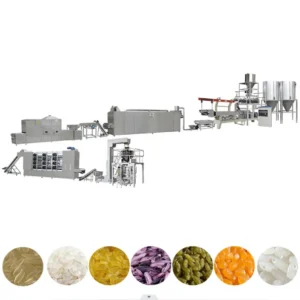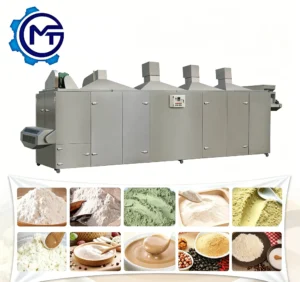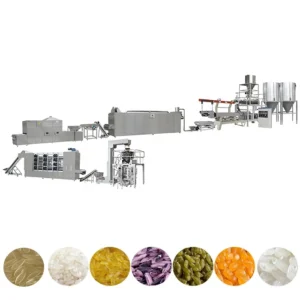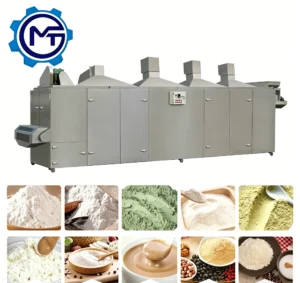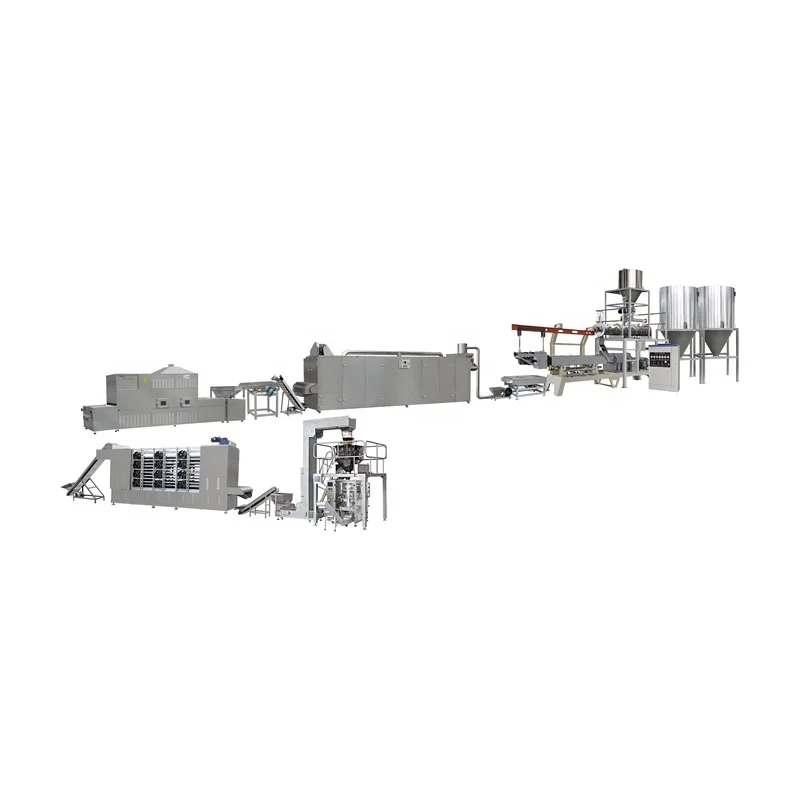
Integrated line throughput — Every station from extruder to packing is sized against your actual rice-starch formulation, so the fortified rice kernel making machine full equipment range runs as a balanced system rather than a collection of mismatched standalone units.
Technical Specifications
| Parameter | Value |
|---|---|
| Product Type | Fortified Rice Kernel Extrusion Line |
| Models Available | MT65 / MT70 / MT85 / MT75 / MT95 |
| Screw Type | Twin-screw |
| Installed Power | 85 kW (MT65) / 120 kW (MT70) / 235 kW (MT85) / 180 kW (MT75) / 260 kW (MT95) |
| Power Consumption | 60 kW (MT65) / 85 kW (MT70) / 165 kW (MT85) / 135 kW (MT75) / 195 kW (MT95) |
| Output Capacity | 80–100 kg/h (MT65, basis to be confirmed) / 100–120 kg/h (MT70, basis to be confirmed) / 200–300 kg/h (MT85, basis to be confirmed) / 300–500 kg/h (MT75, basis to be confirmed) / 800–1000 kg/h (MT95, basis to be confirmed) |
| Overall Dimensions (L×W×H) | 28×1.2×2.2 m (MT65) / 30×1.5×2.2 m (MT70) / 34×3.5×4.3 m (MT85) / 32×3.5×4.3 m (MT75) / 36×3.5×4.3 m (MT95) |
| Feeding System | Single or double screw feeding, selected by material characteristics |
| Screw Material | Wear-resistant alloy with special processing technology |
| Lubrication | Automatic lubricating and cooling system |
| Control System | Frequency speed control, automated |
| Line Stations | Mixing → Extruding → Vibrating → Low-temperature drying → Cooling → High-temperature roasting → Cooling → Packing |
| Dryer Heating Source | Electric or gas |
| Dryer Feature | Circulation drying, mesh belt speed controlled by frequency motor |
| Voltage & Frequency | Customized to local supply |
| Certification | CE |
| Assembly State | Complete turnkey line |
Application Suitability
| Application | Material or Output |
|---|---|
| Fortified rice kernel production | Rice flour blended with vitamins, minerals, and trace elements for nutrition programmes |
| Artificial rice from broken rice | Broken rice and rice bran reprocessed into intact, cookable kernels |
| Multi-grain nutritional rice | Corn, millet, wheat, oats, buckwheat, and bean blends extruded into rice-shaped kernels |
| Instant rice manufacturing | Pre-gelatinised starch-based formulations for rapid-cook rice products |
| Food security fortification | Staple rice kernels enriched with iron, folic acid, and vitamin A for public distribution |
What "Rated Capacity" Leaves Out on a Fortified Rice Kernel Line
A nominal output figure means nothing until it is verified on your exact rice-starch blend at your target moisture.
When I plan a fortified rice kernel making machine full equipment range for a buyer, the first question is never about the extruder model — it is about the raw material recipe. A formulation with higher protein or fibre content changes the melt viscosity inside the barrel, which directly affects how much material the screws can push through the die per hour. I have seen lines quoted at a certain capacity on a standard rice flour basis, only to stall when the buyer introduced a vitamin-mineral premix that altered the dough rheology entirely. The extruder was not the bottleneck; the downstream dryer could not remove moisture fast enough from the denser kernels, and the whole line backed up [NEED_CITE: material rheology effects on extrusion throughput]. That is why the trial run on your actual formulation in the testing workshop is not optional — it is the only way to confirm that every station in the catalogue can hold the rate the extruder promises.
Matching Every Station Across the Fortified Rice Kernel Line
The fortified rice kernel making machine full equipment range is not a single extruder sold with generic accessories. Each station — mixing, extruding, vibrating, low-temperature drying, cooling, high-temperature roasting, and packing — is selected so that its throughput ceiling sits above the extruder’s verified output on your material. The circulation drying oven uses a frequency-controlled mesh belt, which means the residence time inside the chamber can be adjusted to match the moisture removal rate your specific kernel geometry demands, rather than forcing a fixed speed that works only for one recipe.
How Screw and Die Configuration Shape the Final Kernel
The twin-screw design allows operators to adjust screw element sequencing along the barrel, controlling shear intensity and residence time zone by zone. For a dense, cookable artificial rice kernel, the die plate must produce a uniform cross-section that survives drying without cracking. The wear-resistant alloy screws maintain this geometry over extended production runs, and the automatic lubricating and cooling system keeps barrel temperatures stable across shifts [NEED_CITE: twin-screw element configuration and product density control]. When the screw profile is matched to your rice-starch blend rather than copied from a generic build, the extrudate exits the die with consistent expansion — which is exactly what the downstream roasting and cooling stages need to deliver a uniform final product.
Reading the Specification Table for Your Production Target
The five extruder models in this range — MT65 through MT95 — span installed power from 85 kW to 260 kW, with overall line lengths from 28 m to 36 m. Power consumption figures sit notably below installed power, reflecting the actual energy draw during steady-state extrusion rather than peak motor startup loads. The feeding system offers single or double screw options; double screw feeding is typically selected when the premix includes fine vitamin-mineral powders that require more consistent volumetric delivery into the barrel. The dryer’s choice between electric and gas heating sources depends on local utility costs and the thermal load required by your kernel moisture profile. Frequency speed control across the line means every motor — from the feeder through the mesh belt to the packing conveyor — can be tuned during commissioning to balance material flow without manual intervention.
The Hidden Cost of an Undersized Dryer
An extruder that produces kernels faster than the dryer can stabilise them creates a cascade of problems. Wet kernels pile up on the cooling conveyor, sticking together and deforming under their own weight. The roasting stage then receives product with uneven moisture, producing a mix of over-browned and under-cooked kernels in every batch. I have walked into facilities where the operator was manually thinning the mesh belt load to compensate, effectively cutting the line’s real output well below the extruder’s rated capacity [NEED_CITE: downstream bottleneck effects on extrusion line output]. This mismatch rarely appears on a quotation that lists machines individually — it only surfaces during commissioning, when the cost of replacing a dryer or adding a second drying pass has already compounded against the project timeline.
Why Procurement Here Differs from Assembling Standalone Machines
The complete line from batching to packing comes from one manufacturer, meaning throughput is calculated across every station rather than left to chance at each interface. Screw configuration and die design are specified to your raw material and target kernel shape, not pulled from a generic library. Before shipment, the in-house testing workshop runs your actual rice-starch formulation through the extruder and downstream equipment, generating a trial run report that documents real output and product quality. The CE-certified line ships with electrical schematics confirming voltage and frequency for your facility, eliminating the commissioning delays that arise when a control panel arrives configured for the wrong grid. Pre-sales consultation covers line layout against your factory footprint, and on-site installation includes operator training on the specific screw profile and dryer settings your recipe requires.
Documentation & Verification
- Line layout and capacity calculation matched to your rice-starch formulation and target output
- Screw and die configuration record specific to your kernel shape and material blend
- Trial run report on your actual raw material conducted before shipment
- Electrical schematic with voltage and frequency confirmed for your local grid supply
- CE declaration of conformity covering the complete integrated line
- Operation and maintenance manual with wear parts list for screws, dies, and dryer belt
Installation, Commissioning & Support
- Foundation planning based on line dimensions from 28 m to 36 m depending on model selected
- Dedicated power circuit sized to the extruder’s installed power, up to 260 kW for the MT95
- Frequency-controlled drives on feeder, mesh belt, and packing conveyor calibrated during commissioning
- Trial run parameters transferred from testing workshop to your production floor at startup
- Operator training on screw element maintenance and automatic lubricating system checks
- Wear parts inventory list covering screws, die plates, and dryer belt sections for first replacement cycle
What We Need to Specify Your Line
To configure the right extruder model and supporting stations, share your rice or multi-grain formulation including the vitamin-mineral premix ratio, your target daily output in finished kernel weight, and the moisture specification for the packed product. Provide your facility voltage and frequency, the control panel language preference, and the available floor length and ceiling height so the line layout can be drafted to your building constraints. If you have existing upstream milling or downstream packing equipment, include those specifications so the interface conveyors can be sized accordingly.
Frequently Asked Questions
Q: How is output capacity verified on my specific rice or starch formulation?
A: Before shipment, your raw material is run through the extruder and downstream stations in the testing workshop. The trial run documents actual throughput, kernel geometry, and moisture at each stage, so the capacity figure you receive is based on your recipe — not a generic flour benchmark.
Q: What voltage and frequency options are available, and is the control panel language configurable?
A: The line’s electrical system is built to match your local grid supply, whether that is 50 Hz or 60 Hz, with voltage confirmed during the specification phase. Control panel language is set to your operator preference before the machine ships, avoiding commissioning delays caused by untranslated interfaces.
Q: How do I select the right extruder model from the MT65–MT95 range for my production target?
A: Selection depends on your verified throughput requirement after trial runs on your material, available floor space, and power supply capacity. The MT65 suits smaller nutrition programme batches, while the MT95 addresses high-volume staple fortification projects, with three intermediate models filling the range.
Q: Which supporting stations are matched to each extruder model?
A: Each extruder model is paired with a dryer, cooler, roaster, and packing station whose throughput capacity exceeds the extruder’s verified output on your material. The dryer mesh belt length, roasting chamber volume, and cooling conveyor speed are all calculated to prevent downstream bottlenecks at full extruder rate.
Q: Can the line layout be customized to my factory footprint and utility conditions?
A: Yes. The line layout is drafted against your building dimensions, column spacing, and utility connection points. Overall line length ranges from 28 m to 36 m depending on the model, and the layout document shows each station’s position, material flow direction, and required utility drops for your approval before production begins.