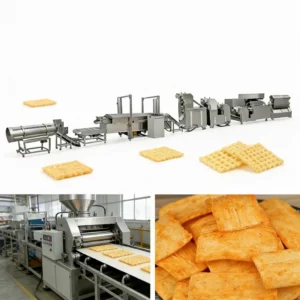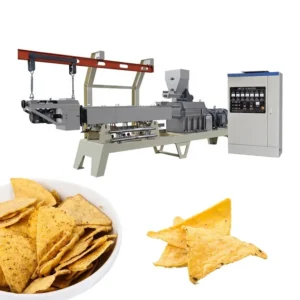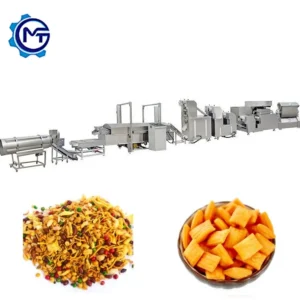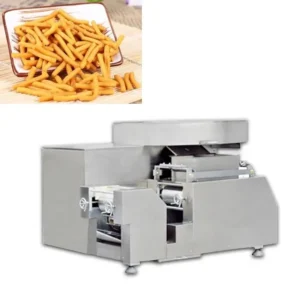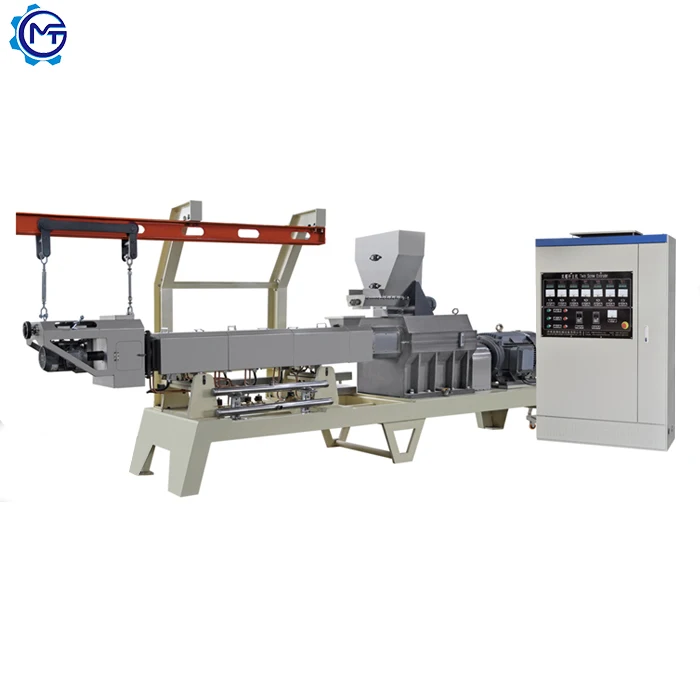
Throughput-Matched Stations — every module on this fried puffed snack line is sized so the extruder, fryer, and flavoring drum never starve or flood each other, confirmed by a factory trial on your flour or starch blend before dispatch.
Technical Specifications
| Parameter | Value |
|---|---|
| Product Type | Fried Puffed Snack Production Line |
| Extruder Type | Single screw extruder |
| Raw Materials | Wheat flour, corn starch, potato starch |
| Output Capacity | 120 kg/h (basis not stated in source — confirm raw material blend / moisture content) |
| Power | 50–70 kW (electricity); 50–60 kW (gas or diesel) |
| Voltage & Frequency | 380V/50Hz (three-phase), 220V/50Hz (single-phase), customizable to local voltage |
| Overall Dimensions (L×W×H) | 12000–26000 × 1200 × 2200 mm |
| Machine Material | Food-grade stainless steel 201/304 |
| Control System | PLC with Siemens or China top-brand motor, Delixi or Delta inverter |
| Energy Options | Electricity / Gas / Diesel / Steam |
| Product Shapes | Screw shell, round tube, square tube, ring, cartoon shapes (adjustable via die) |
| Assembly State | Complete line |
| Standards | CE, ISO 9001 |
| After-sales Service | Engineers available to service machinery overseas |
Application Suitability
| Application | Material or Output |
|---|---|
| Secondary puffing fried snacks | Wheat flour, corn starch, or potato starch base |
| Salad strips and vegetable rolls | Starch-based dough, formed and fried to target crispness |
| Golgappa / pani puri shells | Wheat and starch blends, thin-wall hollow expansion |
| Puffed tubes and rings | Starch-dominant formulations with controlled gelatinisation |
| Cartoon-shaped snack formats | Die-cut shapes for children’s snack lines |
What a "120 kg/h" Label Hides About Your Actual Flour Blend
Nominal capacity only holds when the screw geometry and die match the exact starch-to-protein ratio you are running.
I have watched a snack line stall at barely half its rated output because the supplier copied a generic screw configuration from a wheat-based recipe, and the buyer was running a potato-starch-heavy blend that expanded too early in the barrel. The material backed up, torque spiked, and the operator had to keep backing off the feed rate. A fried puffed snack production line manufacturer who does not ask for your specific raw material formulation before quoting is selling you a guess [NEED_CITE: screw configuration matching to starch gelatinisation behaviour in single screw extruders].
How Single-Screw Geometry Controls the Final Puff
The single screw extruder on this line relies on compression ratio and barrel temperature profiling to gelatinise the starch fraction before the die exit. When the screw pitch and barrel heating zones are tuned to the buyer’s flour or starch blend, the dough exits the die at a moisture level that allows the hot oil to flash the remaining water into steam — that flash is what creates the open cell structure in a salad strip or puffed tube. Run the same machine with a higher-protein flour and no adjustment, and the expansion collapses before the crust sets.
Die Selection and Shape Integrity Across the Fryer
The die plate determines not just the cross-section — ring, tube, shell, or cartoon — but also the wall thickness, which governs how evenly the product puffs during frying. A die with too-thin walls on a high-starch recipe will blister and deform in the oil; too thick, and the center stays dense while the surface over-browns. Every die configuration on this fried puffed snack production line for sale is documented against the buyer’s target product shape and raw material sheet so replacements can be reordered without re-engineering the profile [NEED_CITE: die wall thickness influence on oil absorption and expansion in secondary puffing snacks].
Reading the Specification Sheet Against Your Production Reality
The power range of 50–70 kW for electric heating, or 50–60 kW equivalent for gas and diesel, reflects the thermal load of bringing the fryer oil up to temperature and maintaining it under continuous product loading. The overall line footprint of 12 to 26 metres in length means you need a clear production hall with adequate extraction above the fryer and enough downstream conveyor length for cooling before packing. The PLC control with inverter-driven motors allows the pulling-and-cutting station to track extruder output speed precisely, which matters when you are cutting short pieces like rings where a half-second timing drift means scrap. Food-grade stainless steel 201 or 304 on contact surfaces keeps the line compliant with food safety audits in most export markets, and the choice between the two grades usually depends on whether your local humidity or cleaning chemicals demand the higher corrosion resistance of 304.
The Cost of Undersizing the Dryer and Flavoring Drum
A mismatch between extruder throughput and fryer capacity shows up within the first production shift. Oil temperature drops each time a batch enters, recovery takes longer than expected, and the product emerges under-expanded or oil-logged. Further downstream, a flavoring drum that cannot keep pace forces the operator to batch the seasoning step, introducing moisture unevenly and creating clumping in the final pack. These are not defects in any single machine — they are symptoms of a line assembled from separate vendors who each quoted their own station in isolation [NEED_CITE: throughput balancing in multi-stage snack processing lines].
Why Sourcing the Whole Line from One Supplier Matters Here
The mixer feeds the screw conveyor at a rate calculated for the extruder’s actual barrel volume, not a brochure figure. The pulling-and-cutting machine speed range is matched to the die output so cut length stays consistent across all shapes. The automatic fryer has a belt width and oil volume sized for the extruder’s maximum continuous output, and the flavoring drum diameter and rotation speed are set so every piece contacts the seasoning powder evenly before the cooling conveyor carries it to packing. Screw and die configuration records are kept on file, so when your first replacement is due, the parts arrive without a re-engineering cycle. An in-house testing workshop runs your raw material on the line before it ships, which means product development starts weeks before installation day, not after.
Documentation & Verification
- Line layout drawing with station-by-station throughput calculation for your target output
- Screw and die configuration record matched to your flour or starch blend
- Electrical schematic with voltage and frequency confirmed for your local supply
- Trial run report on your raw material from the in-house testing workshop
- CE declaration of conformity and ISO certificate for customs and audit compliance
- Operation and maintenance manual with wear parts list and replacement intervals
Installation, Commissioning & Support
- Foundation leveling across the 12–26 m line length to maintain conveyor tracking and oil bath level
- Dedicated three-phase circuit sized for the 50–70 kW electrical heating load or gas supply line for alternative energy option
- Partial assembly in modular sections for container loading, with full re-assembly supervised on site
- First-run parameter setting covering barrel temperature zones, screw speed, fryer oil temperature, and cutting timer
- Operator training on die changeover procedure for switching between ring, tube, and shell shapes
- Spare screws, dies, and cutting blades shipped with the line, with reorder drawings on file
Preparing Your Inquiry
To get a line configuration that actually holds its output on your floor, include your primary flour or starch blend with approximate protein and moisture figures, your target daily production volume, and the local voltage and frequency at the installation site. If you already have upstream mixing or downstream packing equipment you intend to keep, note the connection heights and throughput so the new stations can be matched to them.
Frequently Asked Questions
Q: How is the 120 kg/h capacity verified against my specific flour or starch blend?
A: We run your actual raw material through the extruder and fryer in our testing workshop before shipment. The trial confirms that the screw configuration and die produce your target shape and expansion at that output rate, and the results are documented in a trial run report you receive before the line ships.
Q: What voltage, frequency and control language will the line ship with for my market?
A: The PLC, inverters, and motor ratings are confirmed against your local supply before production begins. We verify the control panel language, emergency stop labeling, and electrical schematic with you so commissioning starts without rewiring or reprogramming delays on site.
Q: Can the fryer and flavoring station capacity be scaled independently from the extruder?
A: Each station is sized to the extruder’s verified output on your recipe. If you plan to expand extruder capacity later, we can specify the fryer and flavoring drum with headroom so those stations do not need replacing when you upgrade the front end of the line.
Q: Is a trial run on my raw material performed before shipment?
A: Yes. Every line undergoes a production trial in our in-house workshop using your flour or starch formulation. This confirms shape, expansion, color, and texture meet your market specification, and any screw or die adjustments are completed before the machines are packed for export.