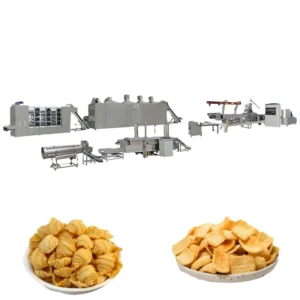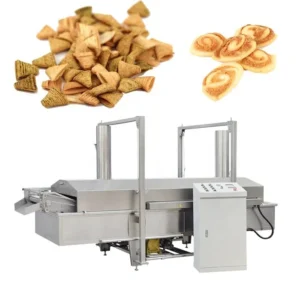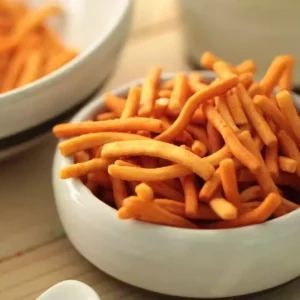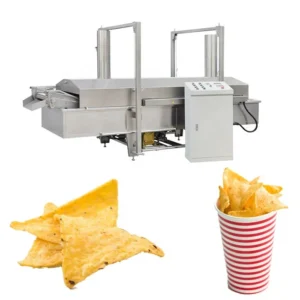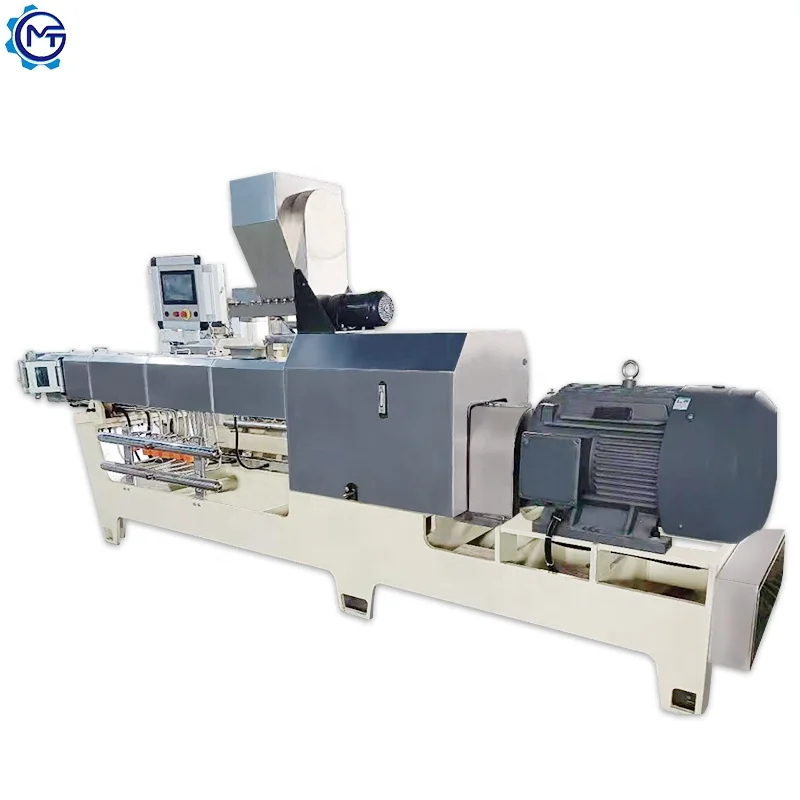
Throughput Matched Across Stations — mixer, extruder, fryer and flavor drum outputs are listed side by side so no single machine holds back the line.
Technical Specifications
| Parameter | Value |
|---|---|
| Product Type | Fried Snack Food Processing Line (Rice Crust / Bugles / Pizza Rolls) |
| Extruder Type | Twin-screw (Double Screw Extruder) |
| Models Available | MT65 / MT70 / MT85 / MT75 / MT95 |
| Installed Power (Line) | MT65 — 142 kW; MT70 — 185 kW; MT85 — 240 kW; MT75 — 245 kW; MT95 — 370 kW |
| Real Power Consumption | MT65 — 100 kW; MT70 — 130 kW; MT85 — 180 kW; MT75 — 185 kW; MT95 — 280 kW |
| Output Capacity | MT65 — 120–150 kg/h (basis to be confirmed); MT70 — 200–250 kg/h (basis to be confirmed); MT85 — 300–500 kg/h (basis to be confirmed); MT75 — 400–500 kg/h (basis to be confirmed); MT95 — 800–1000 kg/h (basis to be confirmed) |
| Powder Mixer Tank Volume | 150 kg |
| Powder Mixer Rotary Speed | 385 rpm |
| Powder Mixer Mixing Time | 10 min per batch |
| Fryer Temperature Range | 0–260 °C |
| Fryer Dimensions | 4500×1350×2350 mm |
| Construction Material | Stainless steel (food-grade contact parts) |
| Overall Line Dimensions | MT65 — 22000×1200×2200 mm; MT70 — 2400×1500×2400 mm; MT85 — 26000×1500×2300 mm; MT75 — 26000×1500×2800 mm; MT95 — 30000×1500×2800 mm |
| Certification | CE |
| Warranty | 1 year complete warranty; life-time maintenance service |
Application Suitability
| Application | Material or Output |
|---|---|
| Rice crust chips | Rice flour, starch-based formulations |
| Bugles (corn horns) | Corn grits, corn flour blends |
| Pizza rolls | Wheat flour, seasoning-inclusive dough |
| Tortilla chips | Corn masa, wheat-corn blends |
| Small fish crisps | Starch and flour mixtures |
| 3D shaped snacks (gourd, duck, Christmas tree, triangles, golden corners) | Grain-based and flour-based formulations via custom dies |
What "300 kg/h" Leaves Out When Specifying a Frying Chips Making Machine Full Equipment Range
A rated line capacity is only as real as the raw material and product shape it was measured on.
I have walked into plants where the extruder was pushing product at spec, but the fryer downstream could only handle half that volume because the previous supplier quoted each station independently. The result was product sitting on conveyors, moisture creeping back in, and operators manually throttling the extruder down to match the bottleneck. When you evaluate a frying chips making machine full equipment range, the question is not just what each station can do alone — it is whether the throughput numbers sit on the same raw material, the same moisture content, and the same finished product density. [NEED_CITE: throughput matching methodology in extruded snack line engineering]
Every Station Visible Before You Commit
This catalogue approach puts mixer output, extruder throughput, fryer capacity, and flavor drum speed on the same page. A buyer comparing options for a frying chips making machine full equipment range can see where stations align and where a different model closes a gap — without waiting for a revised quotation. The five extruder sizes from MT65 to MT95 span small-batch development runs up to high-volume production, and each pairs with a mixer and fryer selected to match rather than constrain.
Die and Screw Configuration Shape the Line
The twin-screw extruder in this range uses screw elements and die plates configured to the buyer’s raw material and target product geometry. A corn horn die produces a different expansion profile than a flat rice crust die, and the barrel temperature zones must follow suit. Getting these settings right before the line ships is what separates a smooth commissioning from weeks of trial and error on the factory floor. [NEED_CITE: twin-screw die design principles for puffed snack geometry]
Reading the Power and Capacity Numbers
The real power consumption figures are consistently lower than installed power across all five models, reflecting the difference between peak motor rating and sustained operating draw. For a plant planning electrical infrastructure, the real power column determines transformer sizing and dedicated circuit requirements. The fryer temperature range reaching 260 °C covers the typical frying window for starch-based snacks, where oil temperature must hold steady to achieve consistent expansion and final moisture content. Line dimensions stretch from 22 meters for the MT65 configuration up to 30 meters for the MT95, so floor space planning should account for the full footprint plus operator walkways and raw material staging.
The Hidden Cost of Mismatched Stations
When a fryer is undersized relative to the extruder, product queues on the belt and absorbs ambient moisture before it hits the oil, leading to uneven frying and off-spec density. Conversely, an oversized flavor drum running half-empty damages product through excessive tumbling. These mismatches do not show up in individual machine specs — they surface only when someone maps throughput station by station against the actual recipe and cut weight. [NEED_CITE: snack line bottleneck analysis in food processing engineering]
Why Source the Complete Range from One Build
The line is engineered as matched stations rather than assembled from separate vendors, so throughput calculations account for every transfer point. Screw and die configurations are specified against the buyer’s raw material before production begins, not copied from a generic template. An in-house testing workshop runs trial batches on customer-supplied ingredients so product development starts before the line ships, not after. Stainless steel construction across all food-contact surfaces meets hygiene requirements for export markets. Documentation covers the full chain from line layout through electrical schematics to trial run reports.
Documentation & Verification
- Line layout and capacity calculation showing throughput at every station for your target product
- Machine specification sheet with screw and die configuration matched to your raw material
- Electrical schematic with voltage and frequency confirmed for your destination market
- Trial run report from the in-house testing workshop on your actual formulation before dispatch
- Operation and maintenance manual covering all stations from mixer to flavor drum
- CE declaration of conformity and factory test record
Installation, Commissioning & Support
- Floor space must accommodate line lengths from 22 to 30 meters depending on selected model, plus utility corridors
- Electrical supply must match the real power draw of the chosen configuration, with dedicated circuits for the extruder main motor
- Equipment ships in modular sections for containerized transport and on-site assembly
- Commissioning includes first-run parameter setting for barrel temperatures, fryer oil temperature, and conveyor speeds
- Operator training covers screw and die changeover procedures for switching between snack shapes
- Wear parts list includes screws, dies, and fryer belt components with recommended replacement intervals
What to Prepare Before Requesting a Quote
Share your raw material formulation with moisture percentages, the target product shapes and cut weights you plan to produce, and your daily output requirement. Confirm the voltage, frequency, and control language standard for your facility, along with available floor space and ceiling height. If you are replacing or adding individual stations to an existing line, provide the throughput and interface dimensions of the equipment already in place so compatibility can be checked against the frying chips making machine full equipment range.
Frequently Asked Questions
Q: How do I match each station’s capacity so no single machine bottlenecks the line?
A: Start with your target finished product output and work backward through moisture loss at frying, cut weight at the die, and mixer batch frequency. Each station in this range is listed with its throughput so you can verify alignment before ordering, rather than discovering a constraint during commissioning.
Q: What raw material formulations work with these extruders for fried snack shapes?
A: Flour-based and grain-based formulations including rice flour, corn grits, wheat flour, and starch blends are compatible. The twin-screw configuration handles varying moisture levels and ingredient ratios, with screw elements adjusted to the specific formulation during the pre-shipment trial run.
Q: Can individual stations be ordered separately to fit an existing line?
A: The mixer, extruder, fryer, and flavor drum are available as individual units. Provide your current line throughput and interface dimensions so the replacement station can be matched for capacity and physical connection points without creating a new bottleneck.
Q: What voltage and frequency options are available for my destination market?
A: Voltage and frequency are configured to match the buyer’s local electrical standard before production begins. Confirm your facility supply specifications during the inquiry stage so the electrical schematic and motor selections reflect the correct values from the start.
Q: How are screw and die configurations selected for different snack shapes?
A: Die geometry determines the cross-section and expansion profile of the extruded piece, while screw element arrangement controls residence time and shear. Each combination is specified based on your target product — bugles require a different setup than flat rice crust — and validated during the in-house trial run.