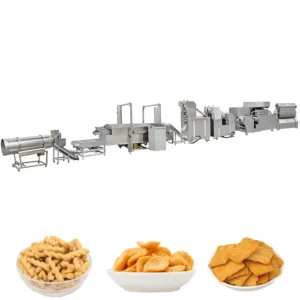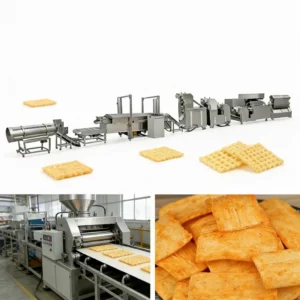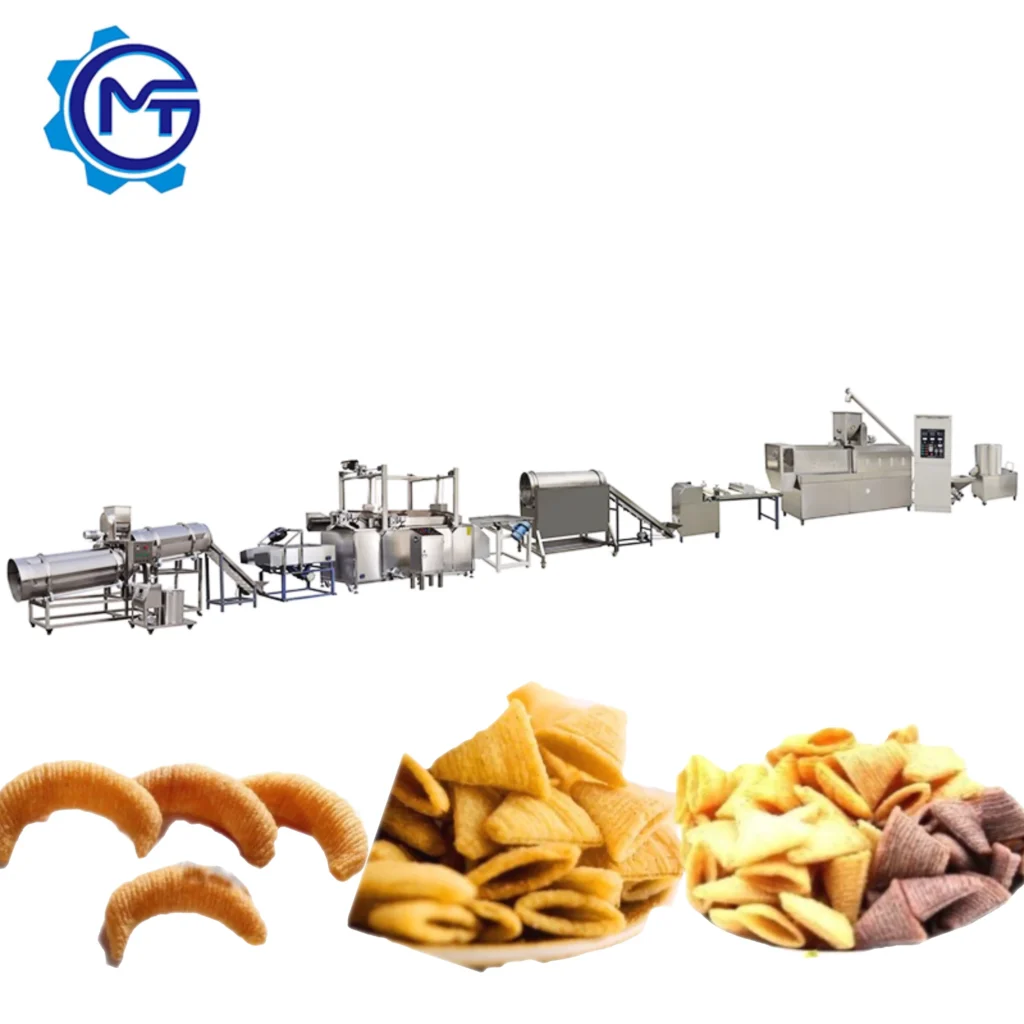
Single Source Catalogue — every station from mixer to cooler listed with throughput and utility data, so a puffing snack production line for sale can be specified without guessing where the bottleneck hides.
Technical Specifications
| Parameter | Value |
|---|---|
| Product Type | Puffing Snack Production Line (Single Screw Extruder) |
| Extruder Type | Single screw extruder |
| Raw Materials | Wheat flour, corn starch, potato starch |
| Output Capacity | 120 kg/h (basis not stated in source — confirm raw material, moisture, product shape) |
| Total Power | 50–70 kW (electricity); 50–60 kW (gas/diesel) |
| Voltage & Frequency | Three phases 380V/50Hz, Single phase 220/50Hz (customizable to local voltage) |
| Energy Options | Electricity, gas, diesel, or steam |
| Overall Dimensions (L×W×H) | 12000–26000 × 1200 × 2200 mm |
| Contact Material | Food grade stainless steel 201/304 |
| Motor & Electrical | Siemens (China-made) or China top brand motors; Delixi or Delta inverters |
| Process Flow | Mixer → Screw conveyor → Single screw extruder → Pulling and cutting machine → Automatic fryer → Automatic flavoring line → Cooling |
| Certification | CE, ISO 9001 |
Application Suitability
| Application | Material or Output |
|---|---|
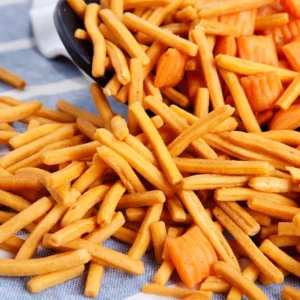
| Rice crust and Bugles-format puffed snacks | Wheat flour and corn starch blends |
| Golgappa / pani puri shells | Potato starch and wheat flour formulations |
| Screw shells, round and square tubes, rings | Starch-based dough with die changes |
| Cartoon-shaped fried snacks for children’s market | Corn starch and wheat flour mixtures |
When the Extruder and Fryer Speak Different Languages
Matching every station’s throughput before the line ships is the only way to avoid a bottleneck that no operator can fix on the floor.
I have walked into snack workshops where a single screw extruder pushed dough out faster than the downstream fryer could handle. The result was a pile of cut pieces sitting on belts, losing moisture and shape before they ever hit the oil. A puffing snack production line for sale might look competitive on paper, but if the fryer basket capacity and the flavoring drum volume are not calculated against the extruder’s actual output, the rated number means little. [NEED_CITE: throughput matching principles in continuous food processing lines]
Every Station Catalogued With Its Own Footprint
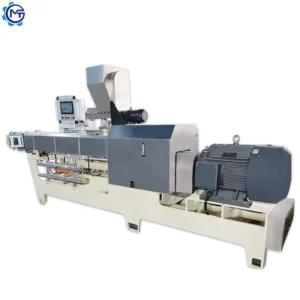
This equipment range covers mixing, screw conveying, single screw extrusion, pulling and cutting, automatic frying, flavoring, and cooling as individual stations. Each one carries its own power draw, floor space, and utility demand. Buyers surveying the full puffing snack production line for sale can compare station dimensions and decide whether the line fits an existing building or requires a new layout. The single screw extruder uses interchangeable dies, so the same barrel assembly can shift between screw shells, tubes, rings, and cartoon shapes without a full changeover.
Energy Source Flexibility Across Markets
The fryer and dryer sections accept electricity, gas, diesel, or steam, which matters when a buyer’s facility already has a central boiler or when local gas tariffs make electric heating uneconomical. Voltage and frequency are confirmed before production starts, so a plant running on 440V/60Hz in one market and 380V/50Hz in another receives motors and inverters matched to the grid. Delixi or Delta inverters allow speed adjustments on the screw conveyor and cutting unit to fine-tune piece length without stopping the line. [NEED_CITE: voltage and frequency standards by export market]
Reading the Specs That Actually Affect Product Texture
The single screw extruder’s barrel length-to-diameter ratio controls how long the starch dough stays under heat and shear, which directly governs gelatinisation and, ultimately, the crunch of the finished rice crust. Wheat flour and corn starch behave differently inside the barrel; wheat gluten adds elasticity, while pure corn starch produces a more brittle bite. Die geometry — not just diameter but land length and entry angle — determines whether a tube expands evenly or collapses on one side. The pulling and cutting machine must run at a speed synchronized with extrudate velocity, or pieces stretch and thin out before the knife closes. Food grade stainless steel 201/304 contact surfaces resist the acidic seasoning powders used in flavoring drums, preventing pitting that could harbor bacteria between shifts.
What Happens When Stations Are Sized by Guesswork
An undersized flavoring drum forces the line to slow down, because seasoned pieces pile up and tumble unevenly, leaving some bags under-coated and others over-salted. An undersized cooler sends warm snacks into packaging, trapping moisture that softens the crunch within days. These problems do not show up during a short factory test; they appear after the first full production run. [NEED_CITE: common post-installation issues in snack extrusion lines] Buyers who source each station from a different vendor often discover the mismatch only when the line is bolted to the floor.
Why Buyers Source the Full Range Here
- Complete station list from mixer to cooler under one supplier, so throughput is calculated across every belt and drum rather than left to chance.
- Screw configuration and die design specified to the buyer’s starch formulation and target snack shape before the extruder ships.
- In-house testing workshop where the buyer’s raw material runs through the single screw extruder and downstream stations before dispatch.
- Electrical schematics and voltage confirmation locked in before production, avoiding commissioning delays caused by wrong motor winding or inverter settings.
- CE and ISO 9001 documentation on file, supporting import clearance and local safety inspections in regulated markets.
Documentation & Verification
- Machine specification sheet listing extruder model, power rating, and die configuration for your snack shape
- Screw and barrel setup record matched to your starch formulation before dispatch
- Electrical schematic with confirmed voltage, frequency, and control language for your market
- Factory test report on your raw material including product density and expansion observations
- CE declaration of conformity and ISO 9001 certificate on file for customs and audit use
Installation, Commissioning & Support
- Floor plan layout covering the 12 to 26-meter line length with utility connection points marked
- Dedicated circuit planning for the 50–70 kW electrical load or gas supply sizing for thermal stations
- Single screw extruder barrel alignment and die seating verified during first powered run on site
- Cutting speed and fryer basket cycle synchronized to your target piece weight and shape
- Operator training on die changeover between screw shell, tube, and ring formats
- Wear parts list covering screw flights, die inserts, and fryer mesh belts with reorder codes
What We Need to Move Forward
Share the starch or flour formulation you plan to run, the target snack shape from the die catalogue, and your daily output requirement so the station capacities can be balanced. Confirm the local voltage, frequency, and preferred energy source for the fryer and dryer sections. If an existing building constrains the line length, provide the available floor dimensions and ceiling height so the layout can be adapted before quotation.
Frequently Asked Questions
Q: Which raw materials work on this single screw extruder and how do they affect texture?
A: Wheat flour, corn starch, and potato starch are all compatible. Wheat flour adds gluten elasticity, giving a chewier bite suitable for rice crust formats. Corn starch produces a lighter, more brittle expansion typical of Bugles. Potato starch sits between the two, offering moderate crispness. The screw configuration is adjusted to match the specific blend ratio before the extruder leaves the factory.
Q: How is voltage and control language confirmed before the machine ships?
A: During the specification confirmation stage, the buyer provides the local grid voltage and frequency. Motors and inverters are then sourced to match — for example, 440V/60Hz for parts of the Americas or 380V/50Hz for most of Asia and Europe. Control panel labels and inverter menus are set to the operator’s preferred language before dispatch.
Q: How are different snack shapes achieved and how long does a die change take?
A: The single screw extruder accepts interchangeable die plates — screw shell, round tube, square tube, ring, and cartoon shapes are all available. A trained operator can swap the die and adjust the cutting knife within a short break between batches, using basic hand tools. No barrel or screw changes are needed for shape conversion.
Q: Which energy source suits different production scales?
A: Electric heating works well for smaller output targets and markets with stable, low-cost electricity. Gas or diesel burners suit higher-capacity fryers where thermal demand would make electric bills prohibitive. Steam is practical when the facility already operates a central boiler. The fryer and dryer stations can be configured for any of these options during the order stage.
Q: How do you prevent one station from bottlenecking the rest of the line?
A: Each station — mixer, conveyor, extruder, cutter, fryer, flavoring drum, cooler — is sized against the extruder’s actual output on the buyer’s raw material. Belt speeds, fryer basket volume, and drum rotation rate are calculated so no single station forces the others to idle. The line layout proposal includes these capacity checkpoints before the order is finalized.